The results of the first season of the Jezreel Expedition are summarized at The Bible and Interpretation. The regional survey this summer was successful in preparing the team for beginning excavations next year. The article begins:

Members of the Jezreel Expedition headed by co-directors Norma Franklin (Zinman Institute of Archaeology, University of Haifa) and Jennie Ebeling (Department of Archaeology and Art History, University of Evansville) conducted an intensive landscape survey of “greater Jezreel” in June 2012. The main goal of the inaugural season was to record surface features in a three square kilometer area to the west, north, and east of Tel Jezreel in order to identify areas for excavation in summer 2013 (Figure 1). The Jezreel team documented more than 360 features, including cisterns, cave tombs, rock-cut tombs, agricultural and industrial installations, terrace and village walls, quarries and more; most of these features had never been systematically recorded before. The results of this survey shed light on the extent of different settlements at Jezreel from late prehistory through to the 20th century CE Palestinian village of Zer’in.

The article also includes an image from the recent LiDAR scan. The city of Jezreel is best known as the location of Naboth’s vineyard and Jehu’s coup. Here Jehu ordered the deaths of the kings of Israel and Judah as well as Queen Jezebel (2 Kings 9-10). In a 2008 article, co-director Franklin argued that the fortified enclosure of Jezreel was constructed not by Ahab but nearly a century later by Jeroboam II. Tel Jezreel and Mount Gilboa from the west (photo from the Pictorial Library of Bible Lands, volume 2)

Share:

Twenty-five years of excavations at et-Tell on the northeastern side of the Sea of Galilee are being celebrated with a fundraiser and photographic exhibition at the University of Nebraska at Omaha.

Celebrating 25 Years of UNO’s Biblical Excavation Project:
Artifacts from the Dig & Hanan Shafir: Photographs of Bethsaida In recognition of the 25th anniversary, the UNO Art Gallery will host a collection of photography from Bethsaida by Hanan Shafir. Showing in the Weber Fine Arts Building on UNO’s Dodge Street campus, the exhibition will run from Aug. 24 to Sept. 27. The gallery is free and open to the public. Hours are Monday through Thursday, 10 a.m. to 3 p.m. Groups are welcome to schedule an appointment outside of these times by calling 402.554.2796. Pre-Opening Fundraiser & Reception: Come see the place, the people, and the artifacts, meet the photographer, and listen to UNO Professor Rami Arav, lead excavator at Bethsaida. The event is Thursday, Aug. 23, from 6 to 9 p.m. All members of the public are welcome. Tickets are $40 in advance and $50 at the door. Proceeds will help faculty and students travel to Bethsaida and continue this important archeological study in coming years. Several gift items including commemorative pottery shards from Bethsaida will be raffled and Shafir’s photographs will be for sale by silent auction.

For more information, see the university’s website. HT: Jack Sasson Bethsaida Iron Age gate with stela replica, tb011412616 Iron Age gate of Bethsaida

Share:

(Post by Seth M. Rodriquez)

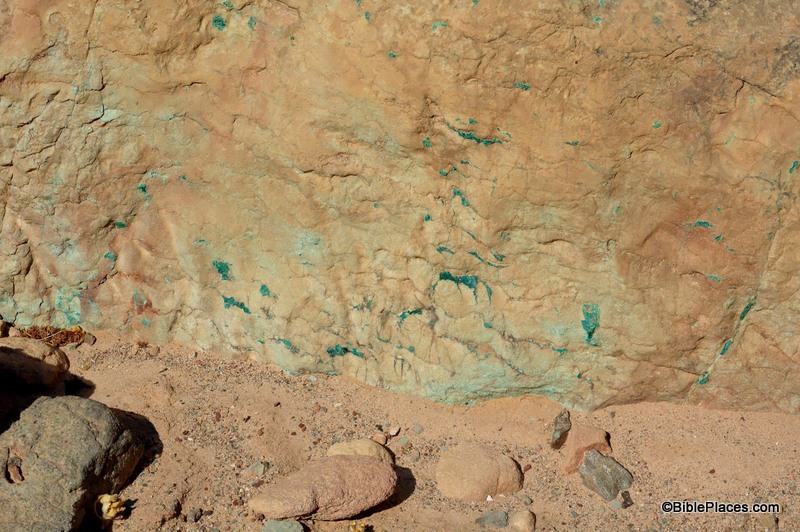
This week’s photo comes from Volume 6 of the revised and expanded edition of the Pictorial Library of Bible Lands, which provides a collection of pictures from the country of Jordan.  In my introduction to this series, I promised to highlight “the more unusual pictures that illustrate a particular feature of geography or archaeology that can be easily overlooked or that other photo collections fail to include.”  So this week’s picture is not a stunning photo of the ruins of Petra or the amazing Roman city of Gerasa or even the biblically significant Mount Nebo and Plains of Moab (although the new edition of the PLBL has new photos of each of those places).  Instead, this week’s photo was taken south of the Dead Sea in Wadi Jariya and focuses on a small section of bedrock.  It is entitled “Wadi Jariya Exposed Copper Ore in Bedrock” (photo ID #: df070807104) and was taken by Dr. Daniel Frese.  (Click on the photo for a higher resolution.)

You will never see this picture framed in a Sunday School classroom or hanging over someone’s mantelpiece, but it can go a long way in illuminating Deuteronomy 8:9 and is useful when explaining the process of ancient copper mining.

Deuteronomy 8:9 states that copper could be dug “out of the hills” in the land of Canaan.  Although Wadi Jariya lies within the territory of Edom and is outside the borders of the Promised Land, the process was similar there.  In the photo, the green specks on the rock are the copper ore.  This ore was chiseled out of the rock and then refined through a smelting process which removed the impurities.  When the impurities cooled, they formed a solid, dark substance called slag.  At various locations in Israel and Jordan (as well as elsewhere in the Middle East) large amounts of slag are left over from antiquity.  In fact at Khirbet en-Nahas, a neighboring site to the Wadi Jariya operation, a slag pile over 20 feet deep has been discovered.

Copper mining was an important element of the ancient economy since copper was used extensively in that society.  Usually the copper was mixed with a little bit of tin and was thus transformed into bronze, a strong metal sometimes used in scripture to refer to someone or something hard or stubborn (Deut. 28:23; Jer. 1:18; 6:28).  Bronze was used to make many things in biblical times, such as utensils (Exod. 38:3), weapons (1 Sam. 17:6), chains (2 Kgs. 25:7), and cymbals (1 Chr. 15:19) to name a few.  Its value is seen in the fact that it was listed among the spoils of war along with gold, silver and iron (Josh. 6:19, 24).  But its humble beginnings can be traced back to this picture … as a green speck within a hard rock found in a dry valley.

This and other photos related to copper mining are included in Volume 6 of the Pictorial Library of Bible Lands and can be purchased here.  More information and photos about copper mining can be found on the BiblePlaces website here.

Share:

The Israel Trail has been included in National Geographic’s list of the world’s best hikes. Tourists are returning to Shiloh, and the majority are evangelical Christians. Jerusalem firefighters have battled 5,000 fires this summer, the majority of them arson. Eight new animal species have been discovered in a cave 300 feet below Ramle. If approved, a new hotel rating system in Israel should cause prices to drop. The latest in the Top 5 series at the Jerusalem Post: Jerusalem hostels. Twelve new skyscrapers will change Jerusalem’s skyline. Wayne Stiles provides a history of the Garden Tomb. A bill has been drafted which would provide separate prayer times for Jews and Muslims on the Temple Mount. Accordance has a sale on the Anchor Bible Dictionary, marked down to $200 until August 21. Garden Tomb interior, tb010910352 Interior of the Garden Tomb (photo source)

Share:

The next time you hear someone talk about the “science” of archaeology or how some discovery (or lack of discovery) has proved or disproved this or that biblical claim, you may want to consider the words of one of Israel’s senior archaeologists, Amihai Mazar: “The interpretation of archaeological data and its association to the biblical text is a veritable minefield, as it is often inspired by the scholar’s personal attitude towards the text . . . we face over and over again arguments that, at their core, are circular. This was as true at the time of William F. Albright and his followers as it is today. There are few items of data in the archaeological record that are not disputable.” Source: Amihai Mazar, “The Spade and the Text: The Interaction between Archaeology and Israelite History Relating to the Tenth-Ninth Centuries BCE,” in Understanding the History of Ancient Israel, ed. H. G. M. Williamson, Proceedings of the British Academy, vol. 143 (Oxford: Oxford University Press for The British Academy, 2007), 145.

Share:

If I asked my readers for the top volume on archaeology of Israel from the Old Testament period, my guess is that most would mazar-archaeologychoose Amihai Mazar’s Archaeology of the Land of the Bible: 10,000–586 BCE. Those who didn’t select it would likely at least recognize the title of this best-selling work for the last two decades. I would guess that fewer readers would be familiar with the second volume in the series. Ephraim Stern’s Archaeology of the Land of the Bible, Volume II was released in 2001 and covers the years 732 to 333 BC. Though this is also a period stern-archaeologyof Old Testament history (from Hezekiah through Nehemiah), my sense is that not as many people know of or own this book. At $60, the casual reader will be turned away. The third volume in the series has just been published, but the volume’s title and cover do not clearly communicate its relationship with Mazar’s and Stern’s volumes. Alexander to Constantine: Archaeology of the Land of the Bible, by Eric M. Meyers and Mark A. Chancey, is the third in the trilogy, carrying the archaeological survey forward from the Hellenistic to the Late Roman periods. Brief chapters at the beginning and end address the Persian and Byzantine periods, but the focus is on the 1st centuries BC and AD, as can be seen by these chapter titles: 3. Herod the Great and the Introduction of Roman Architecture (33 pages)meyers-alexander-constantine 4. Khirbet Qumran and the Dead Sea Scrolls (30 pages) 5. From Herod to the Great Revolt (26 pages) 6. The Great Revolt and the Bar Kokhba Rebellion (35 pages) 7. The Emergency of Christianity (29 pages) The book arrived a few days ago and so I haven’t yet read it, but an initial review suggests that it will be an ideal survey of the archaeological finds from these periods for several reasons:

  • Eric M. Meyers is a distinguished scholar with decades of experience in field archaeology in these periods. 
  • At just under 300 pages (excluding endnotes and indices), this work covers the essentials but will not overwhelm the reader.
  • The book is lavishly illustrated with photos, maps, and reconstructions. I would estimate that there are more than 100 illustrations.

To conclude, if you are looking for a readable and up-to-date survey of the archaeological record from about 300 BC to AD 300 written by leading scholars in the field, I would start with this one. At the moment, Amazon is listing it as a pre-order with a discount of 44% off ($40 marked down to $22.52). In my experience, prices marked down this much during pre-order increase upon release.

Share: