THE TRINITY BIBLICAL AND ANCIENT NEAR EASTERN ARCHAEOLOGY LECTURE
Harry A. Hoffner, Jr.
Emeritus John A. Wilson Professor of Hittitology
The Oriental Institute
The University of Chicago
“Getting to be King and Staying There: David of Israel Seen in Comparison with Selected Hittite 
Monarchs”
Monday, April 23, 2012
7:00 p.m. – Hinkson Hall, Rodine Building
Trinity Evangelical Divinity School, Deerfield, Illinois

More details about the speaker are given on the university’s announcement flyer.

clip_image002

Share:

Using satellite images, a researcher has identified potentially 9,000 new sites in northeastern Syria.

“With these computer science techniques, however, we can immediately come up with an enormous map which is methodologically very interesting, but which also shows the staggering amount of human occupation over the last 7,000 or 8,000 years.”

The Jezreel Expedition “just released three-dimensional LiDAR models detailing the site’s architecture and ancient landscape taken from recently collected LiDAR data.”

The spring season at Tel Burna has ended.

A writer for the Detroit Free Press describes one day on a dig at Khirbet Qeiyafa.

A New York Times article describes problems facing archaeologists returning to Iraqi sites.

Travelujah tells the “beautiful and tragic” story of Naharayim and Peace Island.

Joe Yudin visits Chorazin this week.

The Winter 2012 issue of DigSight is now online (pdf). Topics include: The “Jesus Family Tomb”
Revisited, The Oldest Egyptian Reference to Israel?, Recent Sightings, and Upcoming Events.

James Tabor: “Discovery TV has confirmed that the one hour special titled ‘The Resurrection Tomb’
will air on Thursday, April 5th, at 10pm EST.”


Sitting at the Feet of Rabbi Jesus, the previous work by Lois Tverberg and co-author Ann Spangler, is
available for $3.99 for Kindle for a few more days.

HT: ANE-2, Joseph Lauer, Jack Sasson
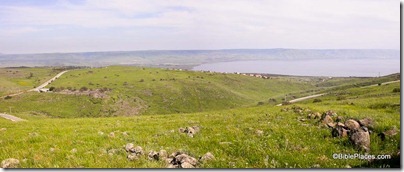
Chorazin panorama from west, tb041103211

Chorazin from the west
Share:

The best maps for detailed work in historical geography of Israel are the 1:50,000 series published by the Survey of Israel and the Survey of Western Palestine maps produced in the 1880s by the Palestine Exploration Fund. The first set comprises 20 maps and the second 16 (only going as far south as Beersheba), indicating the level of detail involved. Maps in the first set cost about $20 each and the second set costs in the thousands of dollars in the rare event that one comes on the market. In order to gain access to the Survey of Western Palestine, when one went on the market for sale in Germany some years ago, we purchased it and “shared the cost” by making an electronic version available.

An excellent new resource is available that combines the two maps in a single (free) website entitled amud anan (“pillar of cloud”). You can navigate on either map and then toggle to the other to see the land 130 years earlier (or later). The differences are dramatic. In addition, a “3D” option overlaps the maps on Google Earth topography so that the hills and valleys look like hills and valleys.

The 1:50,000 maps are in Hebrew. If you need to use detailed maps of Israel, and you don’t think you need to know Hebrew for anything else, these maps provide sufficient justification to learn the alphabet. (It really doesn’t take that long; there are only 22 letters and everything is phonetic.)

With a tablet and a good internet connection (or with purchase of the iPad app; Android coming), hiking in Israel may never be the same!

Northwestern shore of the Sea of Galilee, Survey of Western Palestine sheet 6
Share:

Excavations at Kh. el-Maqatir 1995–2000, 2009–2011: A Border Fortress in the Highlands of Canaan and a Proposed New Location for the Ai of Joshua 7–8. In this 11-page report, Bryant G. Wood surveys the major results of his excavations from the Late Bronze, Iron I, Late Hellenistic/Early Roman, and Byzantine periods. The well-illustrated article provides diagrams of the Late Bronze I fortress (Ai?) and the Byzantine monastery.

The Ossuary of James the Brother of Jesus: From Trial to Truth? Paul V. M. Flesher argues that “the trial produced no truth,” wonders whether Yuval Goren has changed his mind about the inscription’s authenticity, and concludes that unprovenienced objects must be ignored lest they distort the historical record.

Archaeology in Israel Update–February/March 2012. Stephen Gabriel Rosenberg reports on some recent stories.

  • Cultivation of ancient citrons (etrogim) at Ramat Rahel, Jerusalem
  • Restoration of historic sites, the Montefiore Windmill in Jerusalem
  • Another controversial find by Simcha Jacobovici
  • Sale of ancient shekel in New York auction
  • Forgery trial verdict announced
Share:

Off the top of my head, I cannot think of more appealing places to excavate than the beach or Tel Dan. Summers can be hot in Israel and Jordan and instead of baking at Tel Rehov or Feinan, you can excavate at Ashkelon, with its cool ocean breezes, or at Tel Dan, a lush garden “which lacks nothing whatsoever” (Judg 18:7).

While the registration window is quickly closing for this season’s dig at Dan, there is still time to get in at the site where the famous Tel Dan Inscription was found and where the high place of Jeroboam still stands.

The official website lists the Goals of the 2012 season:

1. We will continue digging in Area B, into the early Iron Age levels (circa 1200-1000 BCE), to flesh out the architectural plans and to facilitate spatial analysis of houses and neighborhoods, to understand lifestyle, economy, social identity (ethnicity) and political organization.  We are especially interested in retrieving carbonized grain from the Strata V and IVA destruction levels and to submit them for C14 dating (we have dates from wood, but the wood might already have been old when the town was destroyed).
2. We will continue digging in the new area in the center of the site, Area L, in the 8th cent. BCE levels destroyed in an earthquake.  What does a town look, one minute before disaster strikes?  How to people react to such a catastrophe? We will also be emphasizing “household archaeology” here. Is the earthquake mentioned in the book of Amos (Chapter 1)?
3. We will continue working in the area outside the city gate, Area A, in an attempt to date and understand the phantom gate of the Iron Age.  Was it constructed in the 10th century BCE, the 9th century or even later?  Will we find more pieces of the famous victory inscription of Tel Dan?

You can download an application here.

HT: Alexander Schick

Dan Iron Age gate with plaza and ruler's podium, tb052907083

Iron Age gate at Tel Dan
Share:

An article in Haaretz gives a little history and suggests a few reasons to put Neot Kedumim on your list of places to go.

Why for example, one might wonder, did that forefather of all forefathers Abraham camp under the “oak of Moreh” when he, Sarah and their nephew Lot first came to this land?  Is there significance to the oak? A deeper story behind the simple tale?
Have you always wanted to know why the children of Israel used the hyssop plant to brush paint on their doorposts when leaving Egypt? Or maybe you are one of those ancient history buffs more interested in why the Roman soldiers used the very same hyssop – dipped in vinegar – to quench Jesus’ thirst when he was on the cross?
And where on earth could one look for the answers to such questions?
Look no further than magical Neot Kedumim, Israel’s biblical landscape reserve, where the physical setting of the bible has been recreated on 625 acres teeming with everything from the majestic cedar of Lebanon to the scrappy hyssop bush.
[…]
One can rest in the shade of a willow around “Solomon’s Pool,” traipse around “Jotham’s Garden”, draw water from an ancient cistern, and then stop for a biblical themed lunch (which needs to be organized in advance) at “Abraham’s Tent.” Don’t expect tomatoes in your salad here, or any eggplant dishes, or, for that matter, any food not around when Rachel and Rebecca were in the kitchen. Sorry kiwi enthusiasts. And no surprise here: the restaurant is kosher.
Depending on the season, other activities offered at Neot Kedumim might include harvesting grain on a threshing floor, plowing and sowing a field, and plucking olives or operating an authentic olive press. Some activities such as shepherding, learn to write like Torah scribe and parchment preparation, and tree planting involve extra charges.

The full article is here. We recommended a visit several months ago. If you would like answers to some of the questions in the article but can’t wait for a visit, the books produced by Neot Kedumim (listed here) are the place to start.

Pool with date palms, Neot Kedumim, tb112103295

“Solomon’s Pool” at Neot Kedumim
Share: