This large 12th-century fresco discovered ten years ago near the Garden of Gethsemane goes on display next month in the Israel Museum.  From the Israel Antiquities Authority:

An enormous impressive wall painting (fresco) that was discovered in excavations by the Israel Antiquities Authority in the Monastery of Miriam in the Gethsemane courtyard in Jerusalem will be displayed for the first time when the renewed Israel Museum opens its doors to the public on July 26, 2010.
[…]
According to Seligman, the subject of this wall painting – only the bottom part of which survived and which originally rose to a height of about nine meters – is apparently a scene of deésis (meaning supplication in Greek). This is a known iconographic formula whereby Mary and John the Baptist beseech Jesus for forgiveness, for the sake of humanity. Only the bottom parts of the figures are visible in the main picture: Jesus sitting in the center, with Mary to his right and John the Baptist to his left. Two other pairs of legs, probably those of angels, can be seen next to Mary and John. In the middle of the painting are colorful floral tendrils on either side of which is a Latin inscription of a saying by Saint Augustine: “Who injures the name of an absent friend, may not at this table as guest attend.” We can conclude from this that the painting adorned the wall of a dining room – the refectorium – in the monastery. The prohibition to gossip is surprising since the monks there were Benedictines who refrained from unnecessary conversation. According to the researchers, the maxim was apparently intended for visitors who arrived at the monastery and were invited to dine there.
According to Nagar, “This is one of the most important paintings that have been preserved from the Crusader period in Israel. The painting is the largest to come out of an archaeological excavation in the country and the treatment the painting underwent in the laboratories of the Israel Antiquities Authority was, from a conservation standpoint, among the most complicated ever done here. This wall painting is special because of its size and quality. It measures 9 meters long and 2.7 m high, and is extremely rare because very few wall paintings have survived from the Crusader churches that were built in Jerusalem during the Crusader period. The excellent quality of the painting was in all likelihood the workmanship of master artists and the vibrant colors reflect the importance of the abbey in the twelfth century, which was under the patronage of the Crusader queen Melisende.” 

Five high-resolution images are available here (zip file).

UPDATE (6/30): The Jerusalem Post has the story.

Share:

Haaretz reported on this meeting yesterday, but as of now I haven’t seen an update on the ruling.

Jerusalem’s district planning council was on Sunday set to rule on a controversial museum project that archaeologists claim would destroy valuable ancient structures beneath the Old City.
The new museum is planned for the concourse beside the Western Wall of the Temple Mount – Judaism’s holiest site.
But a group of archaeologists who have petitioned the council says the new building, designed by architect Ada Karmi, would damage an ancient Roman road, flanked by rare and elaborate columns, that runs beneath the planned construction.
They say that if Jewish relics were under threat, the project would never have been allowed.
“It is impossible to exaggerate the cultural damage and the harm to antiquities that would result if the road is encased by the new building’s foundation pillars,” the archaeologists wrote in a petition to the planning council.

Whenever someone says “it is impossible to exaggerate,” it’s a dead give-away that they are exaggerating.  Unfortunately the article does not provide the names of any of the archaeologists who signed the petition.

The full story is here.

Western Wall plaza excavations, tb051908176 Excavations on the west side of the Western Wall prayer plaza, site of planned museum
Share:

Several years ago, excavators at Tel Rehov (near Beth Shean) discovered a series of beehives. 

Scholars have now concluded that bees were imported from Turkey because they were less aggressive and more productive than Syrian bees.  From the Jerusalem Post:

Although Turkey is currently in the dog house for many Israelis because of its involvement in the violent Mavi Marmara flotilla incident, during biblical times the Israelites imported bees from Turkey for the industrial production of honey in the Beit She’an Valley, according to a new archeological discovery by researchers from the Hebrew University of Jerusalem.
The team, headed by HU archeology Prof. Amihai Mazar, found a total of 30 intact hives in the ruins of the city of Tel Rehov, dating back to 900 BCE, as well as evidence that there had been 100-200 hives made of straw and unbaked clay.
Three millennia ago, the joint Israelite-Canaanite settlement had 2,000 residents.
The hives, lined up in an orderly way, may be the earliest complete beehives ever discovered and offer a glimpse of ancient beekeeping during biblical times.
The team of archeologists and biologists was surprised that bee remnants had been found in an urban setting.
[…]
Syrian bees are aggressive and irascible, said Bloch.
Thus, it would have been difficult to keep them within a dense urban area. The Anatalyan bee, which produces five to eight times more honey, is less aggressive, making it possible to raise them in an urban setting.
The Beit She’an Valley digs also showed evidence of widespread commerce with lands in the eastern Mediterranean, as well as techniques for transferring bees in large pottery vases or portable hives. An Assyrian stamp from the 8th century BCE provided evidence that the bees had been brought 400 km. south from the Taurus Mountains in southern Turkey – a distance that was just slightly shorter than that between Taurus and Tel Rehov. Thus, the import of “docile” bees apparently was a solution for the beekeepers of the Land of Israel.

The full article is here.

Share:

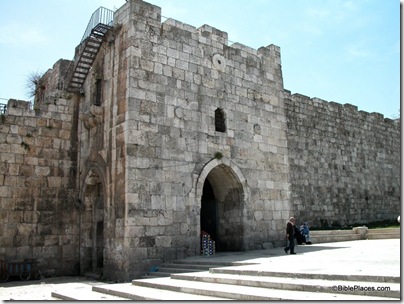
Renovation work has been completed on Herod’s Gate (aka Flowers Gate) and a dedication ceremony is scheduled for June 28.  From the Israel Antiquities Authority:

Herod’s Gate and sections of the walls adjacent to it were treated during the course of 2009 as part of the Jerusalem City Walls Conservation and Rehabilitation Project, which is funded by the Prime Minister’s Office, administered by the Jerusalem Development Authority and implemented by the Conservation Department of the Israel Antiquities Authority. The rehabilitation work on the gate took four months to complete and was conducted in cooperation with the local residents and merchants so as not to disrupt the bustling urban activity that is characteristic of the place.
The conservation and rehabilitation measures to the gate were preceded by very strict preparations that included a meticulous conservation and historical survey and documentation of the gate. During the course of the conservation work there the IAA Conservation Department had to contend with the complicated challenge of working in a teeming urban and commercial environment. The gate’s facades and interior received extensive treatment that included a thorough cleaning, treating the stones and decorations that have been subjected to years of weathering and removing hazards that stemmed from vegetation taking root and vandalism, as well as moisture penetrating into the fabric of the city wall. Among other actions that were taken, all of the electrical and water infrastructures that “adorned” the gate’s facades were removed and properly reinstalled so as not to detract from the appearance of the gate.
The Old City walls were built in the sixteenth century by the sultan Suleiman the Magnificent. Within the framework of that project Herod’s Gate was first inaugurated in the year 1539 CE. The gate was constructed originally as a postern gate which only allowed people and unharnessed animals to enter the city. At the end of the nineteenth century an opening was breached in the gate’s northern façade which allowed passage directly into the city. Remains of the sentry post that protected the original entrance can still be seen in the gate’s eastern façade.

The full press release is here (temporary link), along with a link to a zip file with five photographs showing the exterior and interior of the gatehouse, before and after restoration.

Herod's Gate, tb042403205

Herod’s Gate, 2003.  Notice original postern gate on left.  The large opening in the northern facade was only made in the late 19th century.
Herods Gate, tb010310664Herod’s Gate, January 2010
Share:

The Hyksos controlled Egypt from roughly 1650 to 1550 BC and it was likely one of their rulers who was the pharaoh “who knew not Joseph” and put the Israelites in slavery (Exod 1:8).  From Discovery News:

Radar imaging in Egypt’s Nile Delta has unveiled the outlines of a buried city that was the stronghold of foreign occupiers some 3,500 years ago, Egypt’s Supreme Council of Antiquities announced Monday.
Discovered by a team of Austrian archaeologists in Tell el-Daba in the northeastern Nile Delta, the ruins belong to the southern suburban quarters of Avaris, the capital of the Hyksos kings who formed Egypt’s 15th dynasty.
Known as the “rulers of foreign countries” (probably of Asiatic roots),  the Hyksos infiltrated Egypt and came to dominate the Nile valley for over a century during the Second Intermediate Period (1664-1569 B.C.).
From their strategic capital, Avaris, these foreign rulers are credited with introducing horse-drawn chariots into Egypt and controlling the lucrative trade routes with the Near East and the Mediterranean world.

The full article is here.

HT: Ferrell Jenkins

Share:

My first impression of this new atlas came from the weight of the box on my doorstep last night. 

This atlas weighs even more than the ESV Study Bible, and it probably weighs more than any two atlases on my shelf.  What makes it so heavy?

  • 175 full-color maps
  • 70 photographs
  • 3-D re-creations of biblical objects and sites
  • indexes
  • timelines
  • 65,000 words of narrative description
  • a CD with searchable indexes and digital maps
  • a removable, 16.5 x 22-inch map of Israel

Don’t miss the significance of 175 maps.  That means you see many events and perspectives mapped out that you probably never have before (see Ritmeyer’s comment below). 
esv_atlas

Another phenomenal resource of this atlas are the reconstruction drawings.  Some of these were published in the ESV Study Bible, and they are even more appealing on glossy paper.  They are also easier to find, as you do not have to page through large sections of the Bible to find what you’re looking for.

James Hoffmeier (see below) says the photographs are brilliant, and I am delighted to have contributed a large number of these.  It is a real pleasure to see some of my favorite images presented in such an attractive book.

Many readers here will be thrilled that the atlas includes a CD with the maps.  Many publishers never release the digital version, and those that do usually make you buy it separately (I have too many books that I’ve had to buy twice).  I love Crossway’s commitment to being generous to its customers and I hope that it becomes the new standard.

Price: $35, with free shipping(!) from Amazon.  With the CD, removable map, and full-color imagery, the book is worth much more.

Conclusion: Highly recommended

Still not convinced?  What if you were offered a CD with 125 biblical maps for only $35?  I get requests for such all the time.  I don’t know where to find one for $135, let alone $35.  Until now. 

And they’ll throw in a massive book and an attractive wall map for free. 

Many scholars are impressed, including James K. Hoffmeier and Leen Ritmeyer.

“This Atlas is a wonderfully illustrated tool to aid the layperson, student of the Scripture, or pastor who wants to dig deeper and gain new insights and appreciation of the setting, context, and message of the Bible. The text is easy to follow, pictures are brilliant, and maps are incredibly useful as the reader moves through the related narratives. I highly recommend this marvelous resource.”
James K. Hoffmeier, Professor of Old Testament & Near Eastern Archaeology, Trinity Evangelical Divinity School
“I had the privilege of being involved in the production of drawings based on the latest research for the ESV Study Bible. It is a joy to see these drawings plus the original ESV Study Bible maps, woven together with numerous new maps, brilliantly evocative photographs and useful indexes to make up the new Crossway Bible Atlas. This volume will become an indispensable companion for Bible students, fulfilling every expectation you might have of such a tool. Particularly innovative is the use of terrain imagery to facilitate the reader’s understanding of such Biblical viewpoints as that of Abraham from Hebron over the cities of the plain or Moses from Mt. Nebo.”
Leen Ritmeyer, Archaeological Consultant

Update (6/23): Leen Ritmeyer notes that you can view 45 pages of the atlas here.

Share: