Salvage archaeology is the unplanned kind which occurs when construction reveals ancient remains.  In a city like Jerusalem, modern builders uncover the past far more than they would like.  This Jerusalem Post article gives some good insight into the challenges and rewards.

Archaeologist Yoram Tsafrir is unhappy that the Israel Antiquities Authority is planning to build a three-story museum over the ruins of the Roman “Valley Cardo” on the western side of the Western Wall Plaza.

Stephen G. Rosenberg writes in the Jerusalem Post on two synagogues in the Golan Heights at Ein Nashut and Yehudiya.

An American geologist argued in a recent lecture that David chose the city of Jerusalem because of the karstic limestone formations.  The brief article in the Jerusalem Post only covers the basics and doesn’t reveal what he has contributed to the discussion.  An abstract of the article can be read here.

Case Western Reserve University has about 300 out-of-copyright books on the Ancient Near East available on their website.

The Jerusalem Post has a 3-minute video on the recent story (previously noted here) on the Western Wall tunnels and new discoveries made there.

Bridges for Peace sent me their 2010 calendar because they used one of my photos on the cover.  The calendar is full of beautiful photographs and I see that they are for sale here for $10.

HT: Joe Lauer, Mondo Gonzales, David F. Coppedge

Share:

From Arutz-7:

Israel is planning a major archaeological dig under the Western Wall (Kotel) plaza, opposite the Temple Mount, officials announced Thursday. The excavations will create an archaeological park directly underneath the area where worshippers currently stand while praying at the Kotel.
The current prayer area will remain open, supported by pillars, while a new area will be added underneath, at the level at which worshippers at the ancient Temple stood in the past.

Don’t expect the Arab leaders to miss this opportunity.

The dig may be met with harsh reactions from Muslim and Arab leaders in Israel and the Palestinian Authority, many of whom have accused Israel of attempting to damage the Al-Aksa Mosque on the Temple Mount. Jerusalem-area Muslims recently rioted for several days after it was rumored that “Jewish settlers” had planned to pray on the Temple Mount.

You can see an artist’s sketch of what the area will look like here.  The full article is here.

The present plaza level was lowered in the 1960s, as I noted with this interesting photo comparison.

Share:

The Bible and Interpretation has published a number of provocative essays since its return earlier this year.  A recent one that relates to a matter occasionally noted on this blog is Eric Cline’s “The Distortion of Archaeology and What We Can Do About It: A Brief Note on Progress Made and Yet To Be Made.”  The essay is adapted from a forthcoming book and thus may feel a bit long for internet reading, but you can profitably skim it, slowing down for the sections of greater interest.  After an opening illustration, the article begins:

We find similar situations every year in archaeology, for the junk science which is practiced by many pseudo-archaeologists and amateur enthusiasts (against which I have railed elsewhere) not only cannot withstand serious scrutiny, but in many cases the “results” themselves are not really results in the first place. However, when gratuitous claims of amazing finds, especially concerning Noah’s Ark, the Ark of the Covenant, and Sodom and Gomorrah, are first made, they are featured prominently in the media, but subsequent rebuttals are given little or no attention.
We have to face the reality of the situation, which is that the media are going to keep reporting such stories because they sell newspapers and get people to watch TV or click on Internet links. While they are not nearly as interested in later negative responses, reporters almost always seek immediate reactions which can be used in the original story. So, we have to decide what we are going to do about this and how to turn it to our advantage. (emphasis mine)

You can read it all here.

Share:

From the Jerusalem Post:

Despite recent accusations to the contrary, the chief site engineer for the Western Wall tunnels declared on Thursday that Israeli archeological excavations were not being done under the Temple Mount, were in no way detrimental to the structural stability of the mount or its surroundings, and were actually improving such stability "tenfold." "There’s been a lot of talk about instability [based on ongoing archeological excavations in the area], and let me reassure you, we have improved the structural stability here tenfold over the last few years and have actually strengthened areas where there was danger of further collapse," the chief engineer, Ofer Cohen, said during a Government Press Office-sponsored tour of the tunnels on Thursday afternoon. Standing in a section of the tunnels known as the "Hall of Ages" – so named because the archeological and subsequent reinforcement work there spans from the First Temple period until today – Cohen and the tour’s participants were dwarfed by a series of huge steel beams that had been set up to prevent the walls from caving in. "To those who say that our work here is causing structural instability, the exact opposite is true," Cohen asserted.

The rest of the story is here.

Share:

There are not many computer programs that I am wildly ecstatic about, but Google Earth qualifies even if no others do.  If you haven’t yet downloaded it, I recommend it.

I’ve been doing some reading recently on Pompeii.  I think my fascination with the city may in part be owing to my “discovery” of the site years after I thought I had been to the most important ruins of the Middle East and Mediterranean world.  When I visited, I felt that I had been cheated for years. 

Why had no one sat me down and told me in a most serious tone that I must discard all other travel plans and get myself to Pompeii?  Apparently I do not have friends who love me enough.

Sadly I learned very little from my delay in visiting Pompeii in Real Life, for I have done no better in visiting Pompeii in Google Earth.  I had no idea what a treat was awaiting me.  At least for those used to staring at the fuzzy, low-resolution imagery of Israel, Pompeii is a beautiful contrast.  (To find Pompeii quickly, paste these coordinates in the “Fly To” box: 40.750262°14.486046°).

Here is a comparison, with screenshots taken in Google Earth from the same elevation above the sites.

domeofrock

Dome of the Rock, in Jerusalem
pompeii Forum and Temple of Augustus, in Pompeii

I don’t know what it’s going to take before we see high-quality satellite imagery in the Middle East.

Share:

I’ve often been asked how tells grew so tall.  True, winds in the Middle East blow lots of dust throughout the year, but that certainly cannot account for tells which are 80 feet high.  A.D. Riddle recently sent me the following quotation from C. Leonard Woolley, in which he gives a good explanation for the phenomenon of tells from his report on excavations at Carchemish.  I have placed in bold the answer to this question, but the whole is worth reading, despite its length.  Woolley writes:

The whole of North Syria is dotted with tells, artificial mounds which consist of and conceal old settlements. So little has been done in the way of excavating these mounds that it is dangerous to theorize too much about the nature of what lies beneath them; but certain features which are common to all, or which distinguish one from another, may, with such more sure information as digging has afforded, serve to throw light on the conditions of life which brought them into being and shaped their history.
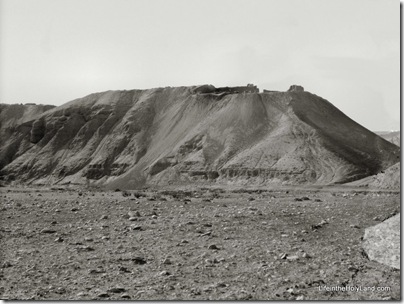
Tell el-Farah South, general view, mat13993 Tell el-Farah South

The neolithic folk, the original founders, undoubtedly, of all these tells, built their huts of mud and rubble either on some slight knoll or, where none such lay to hand, on an artificial platform laboriously piled up with basketful after basketful of earth,—piled just high enough to raise them above the damp of the level soil. The huts fell in ruins, and these ruins raised the ground level on which new homes were built, and that at a goodly rate, for mud-brick walls tend to be thick, and their cubic contents are very great in proportion to the area they enclose, and as the bricks can scarcely be used a second time the whole material of the fallen house was let lie where it fell and was merely leveled for the foundations of the new. Year after year went on this accumulation of débris and of house rubbish (there are sites in the Near East where the rubbish-heaps outside the walls are nearly as extensive as and much higher than the ruins themselves), and the original platform reached a height at which it commanded all the surrounding country. Then a wealthier generation, perhaps more warlike, or more timorous, walled the hill-top round, turning their village in to a stronghold. The chance of an asylum would attract new-comers, whose houses huddled together on the slopes of the mound and spread over the low ground at its foot, and this in its turn began to heap itself up above the level of the plain around. After a while the outsiders, too, might demand protection for their homes, not content to leave them in war-time to the mercy of the enemy while themselves taking refuge in the fort: they built a wall round the new outer town. In proportion as the whole town was thus made defensible, the original settlement, the tell, tended to become less a place of general residence, more and more the centre of administration and of worship; here the princeling might live in isolated state, here were the barracks of his regular retinue, here the temples which from of old had been the houses of gods or heroes deified. At the same time the defences of the tell were kept in good repair, for whatever might be its use of every day, it was still the inner stronghold, the last resort in case the rest should fall; from a military point of view the outer town and its high citadel within might be compared to the mediaeval castle with its bailey and its keep.
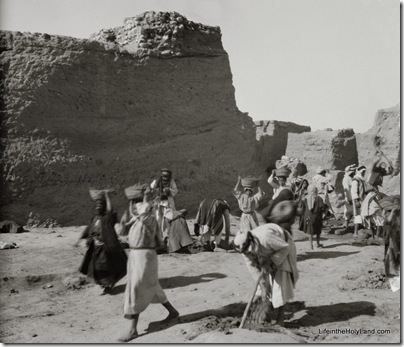
Tell el-Farah South, excavation, mat13986 Excavation of Tell el-Farah South, 1928-29, directed by Sir W. M. F. Petrie

Of course tells differ one from another in form as they differed in their history. There are low mounds scarcely noticeable above the level of the plain, short-lived villages whose ruins, scanty at their best, may have grown even less distinct through the gradual raising of the ground about them-the natural effect of long cultivation and often too of the ploughing of the nearer hillsides, whence little by little the rain carries the loosened surface soil down to the valleys. There are small steep-sided cones which, one thinks, can hardly be other than keeps or watchtowers, not the outgrowth of village settlements but military foundations to secure frontiers or trade-routes. There are rather larger whale-backed mounds, higher and more abrupt at one end and tailing off fanwise at the other, where one can almost see the cluster of domed or flat-roofed single-storied mud huts with, at the outskirts, the effendi’s two-storied house of stone dominating them from its higher ground. Again, on a larger scale, we have the steep-sided C-shaped tell with a broad channel running down it at a gentler slope between the horns of the letter, like a volcano’s crater with a gap in the rim; it looks as if, on the older mound’s flat top, a huge ring wall had been built with a gateway and an approach thereto between flanking towers. In other cases the main tell is more or less pyramidal in form with, on one side, the lower rounded mound of the outer town, its flimsier walls indistinguishable now from the heaped mass of house ruins which they enclose: in a few, the outer walls stand out clearly as a ring of earthworks overtopped only by the great bulk of the acropolis within.

Source: Woolley, C. Leonard. 1921. Carchemish: Report on the Excavations at Jerablus on behalf of the British Museum, Part 2: The Town Defences. London: Trustees of the British Museum.

The two photographs are from the newly published Southern Palestine volume of The American Colony and Eric Matson Collection (originally Library of Congress, LC-matpc-13993 and LC-matpc-13986).

Share: