Aren Maier, excavator of Gath, was at a meeting in Jerusalem recently with a group of Israeli archaeologists and Yossi Garfinkel and Saar Ganor presented a newly discovered inscription from Khirbet Qeiyafa.  Maier reports on the ANE-2 list:

This absolutely fantastic, fortified Iron Age site (late Iron I/early Iron IIA) has a very nice assemblage of pottery, and what may be the most important Iron Age Semitic inscription found in Israel in the last decade! (to be published by Haggai Misgav of the Hebrew University).
I can’t give details about it, but OH BOY – this is going to be VERY INTERESTING!!!!
Clearly, the site, its dating, the finds, and their significance, will be of paramount importance in the discussions of the Iron Age southern Levant, and just about anything connected to it, in the near future.
Based on Yossi’s previous track record in publishing excavation results, publications should be appearing soon!

I doubt Maier is exaggerating, and this could provide some fun discussion in the months ahead.  It may help some readers if I spell out more of what Maier means by “the site, its dating, the finds, and their significance.”


The site: Khirbet Qeiyafa (aka the “Elah Fortress“) is located opposite Azekah along a ridge north of the Elah Valley, near the famous battle of David and Goliath.


The date: The site, and therefore presumably the inscription, dates to “late Iron I/early Iron IIA,” which is the scholarly way of saying “10th century B.C.”  David and Solomon were kings in Jerusalem in the 10th century.


The finds: Some of this has already been reported, but Maier probably is meaning the inscription itself, about which nothing has been revealed to the public.  I reported previously that the ostracon (inscribed potsherd) has 4-5 lines of writing.


Its significance: The major discussion in “biblical archaeology” right now centers on the 10th century.  The newer view (popularized in this book) denies that Judah was a nation-state until hundreds of years later, insisting that the biblical account of the United Monarchy is pure fabrication. 

Most archaeologists reject that view.  My guess is that Maier’s excitement is because this inscription will play a role in this discussion.


Other inscriptions: It may be worth noting that two (or three) other significant 10th century inscriptions were found in the same region.  To the north, Robert Alexander Stewart Macalister found the Gezer Calendar in the early 1900s. To the south, Ronald Tappy discovered an abecedary (alphabetic inscription) at Tell Zayit a few years ago.  To the west at Gath, Maier uncovered the “Goliath inscription,” which dates to the 10th or 9th centuries.  If you’re an archaeologist looking for a 10th century inscription, head for the Shephelah.
Share:

A friend who works for the Jerusalem Post has alerted me to the first in a new series of articles: perspectives on Israel from college students studying near Jerusalem.  You can read the first one about a visit to the Old City of Jerusalem here

The students writing in this series are studying at the Israel Bible Extension (IBEX) of The Master’s College.  The school is located in the Judean hills west of Jerusalem, and students come from the United States to study biblical geography, archaeology, history, Hebrew, and more.  The semester-long program is very popular among students, and, in my opinion, is one of the best things a college student can do, anywhere, ever.  I’m not unbiased; I taught at the school for many years until my present study leave. 

Share:

Haaretz has a story on the new “Pilgrim’s Route,” select portions of which are below. 

Some three million tourists are expected to visit Israel next year. And when they arrive, they will discover a new “Pilgrim’s Route” leading from Jerusalem to the Dead Sea. Along the way, they will be able to visit the site where the New Testament story of the Good Samaritan took place; the Qumran caves; and the site where, according to the New Testament, John the Baptist baptized Jesus.

It is not clear what is meant by “Pilgrim’s Route.”  Ideally, there will be a walking path along the ancient Roman road.  More likely, there will be signs installed at each place designating it as part of the “Pilgrim’s Route.”

The Good Samaritan site is just off the highway leading from Jerusalem to the Dead Sea. During the Byzantine era, a church was built at that spot to commemorate the New Testament’s tale of a man attacked by robbers while en route from Jerusalem to Jericho, who is refused help by all the passersby except the Good Samaritan. Archaeologists recently reconstructed the entire mosaic floor of the church.

It is unlikely that this site is anything more than a traditional place to remember the story.  If there was an inn, it was probably in Jericho, not in the middle of the inhospitable wilderness.  Furthermore, this may have been a story that Jesus created to teach a point and not a historical event (Luke 10:25-37).

Concerning the baptismal site:

According to Shai Weiner, the Tourism Ministry’s deputy director general for economics, planning and infrastructure, the first stage of the site’s development, which includes setting up shaded areas and making it wheelchair accessible, will be finished in about two months. The ministry has thus far invested some NIS 3.5 million in the site, and the Defense Ministry will invest about another NIS 1 million to improve the access road.

In addition to shaded areas, they need to get some of those amusement-park-type misters.

Weiner said that other Christian pilgrimage sites in Israel typically attract between 400,000 and 600,000 visitors a year, and he expects the same at this site. The ministry noted that the site would also jump start other businesses in the area, such as restaurants and souvenir shops.

Note to investors: buy stock in these new shops and sell your holdings in Yardenit.

Oni Amiel, CEO of Amiel Tours, which specializes in Christian pilgrims, said it is about time Israel began competing with the Jordanian site. “There’s an enormous flow of tourists there,” he said. “It’s important that the site on our side also be respectable – and above all, that there be water in that dried-up Jordan.”

So you get a flow of tourists where there once was a flow of water.  Not such a good trade-off.

The full story is here.

HT: Joe Lauer

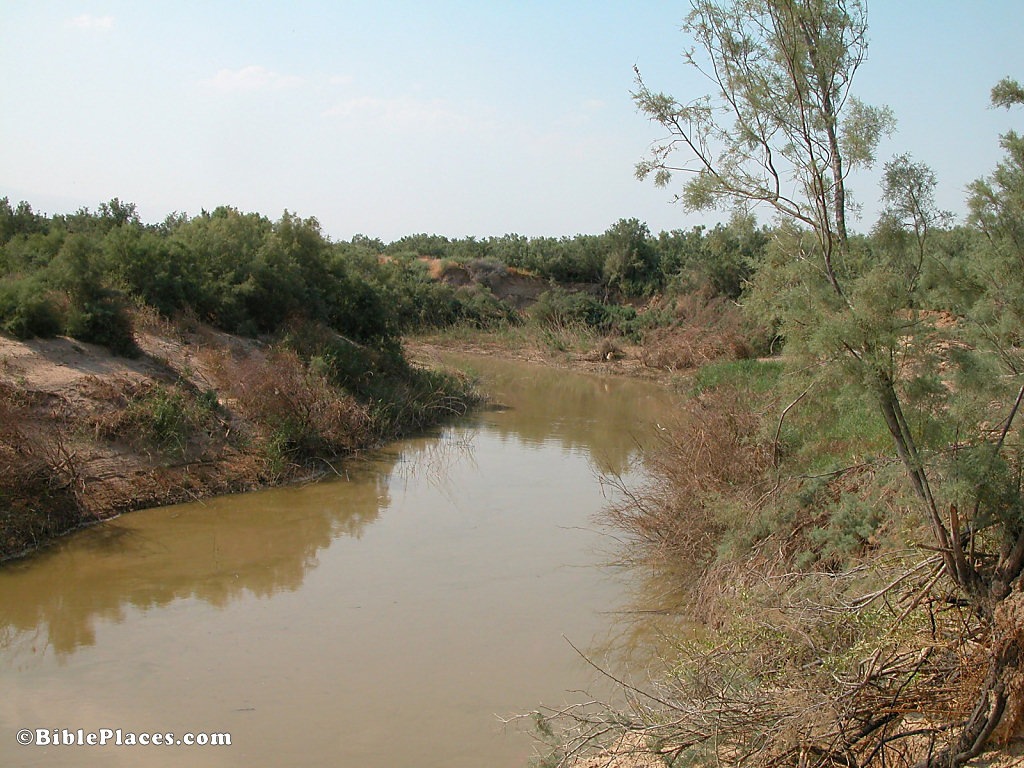
Jordan River by Bethany beyond Jordan, tb060303267
Jordan River near Jericho
Share:

From Today’s Zaman:

Excavations on some historical sites are not being carried out properly and the Culture and Tourism Ministry is not even sure if excavations are still continuing on others, the head of the ministry has said.
“If the excavation heads and professors who are not excited about the excavations any longer or are just carrying on their duties in a monotonous manner will let us, we will look for excavation heads who are more excited and enthusiastic to improve the conditions at the excavation sites both physically and scientifically,” Culture and Tourism Minister Ertuğrul Günay told the Anatolia news agency.
Noting that he has visited many excavation sites, the minister said he respected excavation leaders who care for their excavations and the antiquities they find like children and who attempt to improve the situation of their sites.
There are currently 134 excavation projects being carried out in Turkey — 90 by local teams and 44 by foreign teams. More than 100 surface research projects are under way.
In the excavation projects carried out by Turkish teams, the majority of the excavation heads are professors from İstanbul University and Ankara University. Currently most excavation heads are from Ankara University.

The story continues here.

HT: Explorator

Share:

The Israel Ministry of Foreign Affairs has a press release today describing the discovery of part of the southern wall of Jerusalem during the time of Christ.  Built by the Hasmoneans sometime after 150 B.C., Josephus dubbed it the “First Wall,” in distinction to Herod’s (?) “Second Wall” and Herod Agrippa’s “Third Wall.”  The “First Wall” encompassed the city on all four sides (unlike the later two), and had sixty towers.  Archaeologists recently discovered one of those towers preserved to a height of 10 feet (3 m).  The wall was in use until the destruction of Jerusalem in A.D. 70.

Some more details:

  • The wall was discovered on “Mount Zion,” the modern name for Jerusalem’s Western Hill.
  • The results were revealed in a press conference on Mount Zion today.
  • The area had been excavated 100 years ago by Frederick Jones Bliss and Archibald Dickie, once described in the Jerusalem Post as “archeologist Blis Vediki.” No kidding! (In Hebrew, “ve” means “and.”)
  • Archaeologist Yehiel Zelinger lectured on his discoveries about 6 weeks ago at the Bible Lands Museum in Jerusalem.
  • Portions of this wall have previously been excavated in Area G, the Citadel complex, south of the Citadel underneath the Turkish wall, and near the Broad Wall next to the “Israelite Tower” (unfortunately closed to the public now for years).
  • The chief contribution of this discovery will not be in revealing where the wall was (we already knew that), but in giving us more details about that wall, by means of careful stratigraphic excavation.  Bliss and Dickie excavated by digging underground tunnels, hardly the method for understanding the history of a structure.
  • The archaeologist is impressed: “This is one of the most beautiful and complete sections of construction in the Hasmonean building style to be found in Jerusalem.”
  • Apparently the remains will be preserved in the Jerusalem City Wall National Park.
  • Remains were also unearthed of the Byzantine period wall constructed by Empress Eudocia.

The story is also carried by the Jerusalem Post, Haaretz, and BBC (with two great photos).

UPDATE: The Israel Antiquities Authority has made five photos available for download.  The aerial photo reveals that the excavation is on the west side of the Catholic cemetery on the south side of Mount Zion.  The most famous inhabitant of the cemetery is Oskar Schindler.  His tomb is visible on the lower right of the photo.

Share: