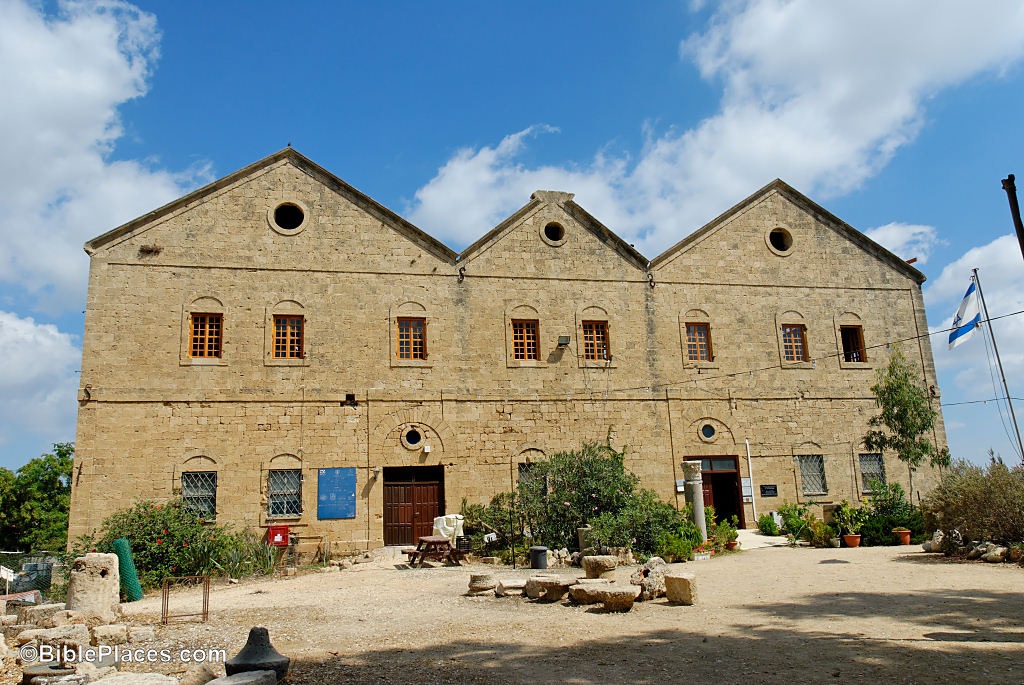
The best archaeological guide to Israel is now out in its fifth edition. The Holy Land: An Oxford Archaeological Guide, by Jerome Murphy-O’Connor is the best companion for a trip to ancient sites
anywhere in Israel. The section on Jerusalem is especially lengthy (150 pages in the 4th edition), and the whole is accurate and readable. Don’t expect to find out about hotels or restaurants – this is a guide to archaeological sites only! The 4th edition came out in 1998, so while I haven’t yet seen the new edition, I expect it will have significant updates. The author has lived in Jerusalem longer than I have been alive.
The Easter story for “60 Minutes” this year is about the bonebox inscribed with “James, son of Joseph, brother of Jesus.” The 13-minute video segment and a written transcript is available online.
In terms of production, the video is outstanding. They have beautiful footage, dramatic interviews, and a clear storyline. This 13-minute story will make understandable to millions what five years of scholarly debate has not. But I’d recommend watching this for entertainment value than for factual analysis. There are many problems with this “reporting.”
The first issue is the lack of scholarly testimony. Only a few scholars are interviewed and only one is allowed to give his verdict about inscription’s authenticity. Witherington and the Pfanns are quoted only about the excitement and possible value of the inscription. Silberman gets double the airtime, and his statements about authenticity (or lack thereof) seem to be carefully crafted for dramatic effect. The story does not give the background for any of these individuals, so it’s worth noting that Silberman is not an archaeologist nor a paleographer. He is a popular writer about biblical and archaeological subjects. He has co-written several books claiming that the Bible is a fraud, so it’s not surprising that he thinks that an inscription that supports the Bible is also a fraud. Unfortunately none of the scholars who specialize in this area were interviewed (or included), and most of them think the inscription is likely authentic.
While the story’s title would have you believe that this is a story about the James Ossuary, only the first half of the story discusses the bonebox. From that point on, the producers try to condemn the ossuary using guilt by association. This is the only way they can make the story work, because most scholars think the inscription is authentic. The argument against the inscription is that
1) the ossuary came from the collection of Oded Golan;
2) Golan had tools that could be used for making forgeries;
3) an Egyptian claims that he made other forgeries for Golan (but not this one).
What they insinuate and omit is more significant than what they report.
1) Did Golan forge the inscription or did the Egyptian? It doesn’t matter, as long as they can create doubt in the viewer’s mind.
2) Is Golan and/or the Egyptian capable of creating such a perfect inscription? Most scholars say they could not. 60 Minutes misleads by quoting a policeman who says that the Egyptian is a skilled craftsman. They don’t quote Ada Yardeni who says that if Golan faked it, “he’s a genius. But I don’t believe it.”
3) There is no mention of the old photograph that Golan has of the ossuary with the inscription. The authenticity of the photograph is disputed, but if authentic, it is compelling evidence that the inscription was not forged.
4) Did Golan pass a polygraph? I don’t know, but it seems like a simple test that would be of relevance.
5) Why is such an open-and-shut case taking the Israeli police more than three years in court?
6) Was the inscription forged or only part of the inscription? Like several components of the story, they want to have it both ways.
In 13 minutes, one cannot expect all of the evidence to be presented, but it is noteworthy that CBS has given us a glimpse of the prosecution’s case rather than an even-handed treatment. Even the multiple uses of an interview with Golan is intended to support their case. I haven’t read of anybody who supports or trusts Golan. He certainly doesn’t exude credibility on screen. But the issue isn’t about him. Even if he forged 1,000 pieces, that doesn’t prove that the ossuary inscription is fake.
Sitting on a toilet doesn’t prove that it is fake either. Maybe it is, but it is certainly better to analyze the artifact itself rather than its circumstances. But this they do not do. The fact is that many scholars believe that the entire inscription is very likely authentic, including Ada Yardeni, Bezalel Porten, Gabriel Barkay, and Andre Lemaire. The inclusion of the toilet photograph and the failure to include even one specialist of ancient inscriptions proves that this story is about entertainment and not facts.
One final note: Forgery of antiquities and looting of antiquities are major problems in Israel and around the world. These crimes should be prosecuted aggressively. But when a majority of the specialists believe an alleged forgery to be authentic, it is time to pursue other cases.
- Tagged Forgery
I found the subject of this article in the Jewish Journal to be quite interesting. How would a Jewish rabbi react to statues of Greek and Roman gods? One point that the writer does not seem to recognize though is the ease with which hellenized cities could be avoided. Just as one can easily live in Israel today and avoid the “pagan centers” of Tel Aviv and Eilat, it is not difficult to imagine the religious avoiding Beth Shean and Caesarea in the Roman period. To give one example, there is no record that Jesus ever entered either city.
Imagine a rabbi encountering a statue of Zeus in Roman Palestine, circa 70 to 300 C.E. — a monotheist’s nightmare.
“The myth is that he would have uttered something like the Yiddish ‘gevalt,'” said professor Yaron Z. Eliav of the University of Michigan, who recently spoke about Jews and statues at the Getty Villa in PacificPalisades. “We imagine he would have put his hand over his face, the way an ultra-Orthodox Jew might shield his eyes from a poster of a woman in a bikini.”
But the sages who wrote classical texts, such as the Talmud, could not afford to ignore such statues, which were like the mass media of the ancient world.
Images of gods, mythological monsters, sports heroes and emperors were everywhere: atop pedestals and in niches, adorning public buildings, temples, fountains and tetrapyla, the colonnaded structures marking street intersections. They were intended to be lifelike and often heavily painted, as revealed in the Getty’s new exhibition, “The Color of Life: Polychromy in Sculpture From Antiquity to the Present.”
“One could not have strolled heavily Jewish cities such as Tiberias or Caesarea without encountering Roman sculpture every step of the way,” said Eliav, as he strolled amid ancient statues at the museum. “While the assumption has been that the sages opposed everything Graeco-Roman, they were in fact far more sophisticated and varied in their response.”
The article continues here.
HT: Joe Lauer
- Tagged New Exhibits
History Talk:
In conjunction with the exhibit
Imagining the Temple:
The Models of Leen Ritmeyer
Steven Fine on
IMAGINING THE TEMPLE
Sunday, March 30, 2008
2 pm
Ever since the destruction of Jerusalem in 70 CE, Jews and, later, Christians, have tried to picture what the Jerusalem Temple looked like. During the 20th century, this imagining often resulted in three-dimensional models of the Temple. In this talk, Steven Fine, professor of Jewish History at Yeshiva University, sets the Ritmeyer models within the contexts of Jewish and Christian conceptions of the Jerusalem Temple.
Free with Museum admission.
Yeshiva University Museum
15 West 16th Street
New York, NY 10011
HT: Joe Lauer
- Tagged Lectures
Arutz-7 reports the discovery of a “half-shekel” from the City of David, but there are several questions about the story. On the biblical-studies list, Jack Kilmon writes that this coin, a Tyrian tetradrachm, was similar to a shekel, not a half-shekel. According to the article, only seven other Tyrian shekels or half shekels have been found in excavations in Jerusalem. The coin was found in the excavations of Reich and Shukrun, which were mentioned in a story yesterday as being halted by the Israeli High Court of Justice.
A half-shekel coin from the Second Temple was found in excavations in the City of David, just below and east of Jerusalem’s Old City. The upcoming Purim festival features the half-shekel prominently in its observance.
The ancient silver coin was discovered in an archaeological excavation that is being conducted in the main Second Temple-era drainage channel of Jerusalem. The foreign coin is of the denomination used during the turbulent Second Temple period to pay the Biblical half-shekel head-tax.
This coming Thursday night (Saturday night for Jerusalemites), before reading the Megillah (Scroll) of Esther, Jews worldwide will contribute a sum of money to charity in remembrance of that half-shekel command.
The Arutz-7 report continues and it also has some great photos of the coin.
HT: Joe Lauer
From Haaretz:
The High Court of Justice issued a temporary restraining order against the Israel Antiquities Authority (IAA), ordering a halt to an archaeological dig in the Silwan neighborhood of Jerusalem, after local Arab residents complained that the excavations were being carried out underneath their homes and without their approval. They claimed that according to the law, the IAA is required to notify property owners if they want to dig under their property. After the suit was filed, the police arrested three of the seven plaintiffs. (Meron Rapoport)
This is a reference to the excavations headed by Ronny Reich and Eli Shukrun in the vicinity of the Pool of Siloam. This excavation has been covered before here.
HT: Joe Lauer
- Tagged Jerusalem
Search
About the BiblePlaces Blog
The BiblePlaces Blog provides updates and analysis of the latest in biblical archaeology, history, and geography. Unless otherwise noted, the posts are written by Todd Bolen, PhD, Professor of Biblical Studies at The Master’s University.
Subscribe
Tags
10th Century
American Colony Photos
Analysis
Antiquities Trade
Dead Sea
Dead Sea Scrolls
Discoveries
Egypt
Excavations
Forgery
Galilee
Greece
Holidays
Israel's Coast
Italy
Jerusalem
Jezreel Valley
Jordan
Jordan Rift
Judah
Lebanon
Lectures
Mediterranean Islands
Mesopotamia
Museums
Negev
New Exhibits
Persia
Philistines
Photo Resources
Picture of the Week
Pseudo-Archaeology
Resources
Sad News
Samaria
Shephelah
Syria
Technology
Temple Mount
Tomb of Jesus
Tourism
Travels
Turkey
Weather
Weekend Roundup
Links
Notice
As an Amazon Associate we earn from qualifying purchases. In any case, we will provide honest advice.