There are two real benefits to seeing and studying Cyprus for biblical purposes, as far as I know.

1) Knowing the biblical world better – seeing Israel/Canaan in the context of their neighbors. For instance, seeing how Cyprus would supply copper in large quantities.

2) Better understanding the missionary work of Paul and Barnabas. I think this means more than simply seeing the sites where they traveled. For me, it’s also providing the opportunity and context to think more about this portion of their journeys. So I realize things like:

1. Barnabas was really the leader of the team at this point.

2. Cyprus was a natural place for them to start (indeed this was the first place they came after being sent out), given its proximity to Antioch and the fact that Barnabas came from Cyprus.

3. There was a Jewish community here. It is amazing just how scattered Jews had become after the First Temple Period. They seem to be everywhere in a relatively short period of time. The number of Jews was probably large given the “synagogues” (plural) that Paul went to in Salamis, and their trip “through the island.” Their pattern, as evident later, is to go to the synagogues to present the gospel to the Jews and whatever “godfearers” were in their midst. So it seems quite likely there there were Jewish communities that they visited on their travel across the island.

4. I would guess that their route was along the southern shore of the island. This seems more likely given the presence of high (6000+ feet) mountains in the center, and the presence of large cities on the southern coast, including Kition (settled at this time?), Amathus, and Kourion. And others.

5. It is interesting that there is no follow-up on this island tour, outside of Barnabas’ return of which nothing is recorded (except in apocryphal works). Paul apparently never writes a letter to any of the communities here, and though he often returns to places of former ministry (e.g., Lystra, Philippi, Corinth, Ephesus), he apparently never comes here, nor mentions Cyprus in any of his writings.

Perhaps he ceded the area entirely to Barnabas’ ministry and stayed out of his way.

6. The cities that are mentioned in the account of Paul’s travels are very large and important cities.

This is not surprising given Paul’s centers in the rest of his journeys (also major cities), but it is something that a reader in America might never guess. It also “clicks” more when you travel to many sites and see small and medium communities. Then when you come to Salamis and see the huge area that it covers, the large harbor that it had, the theater, forum, bathhouse, gymnasium, you are impressed that this was the “Los Angeles” of ancient Cyprus.

7. Unlike other places of Paul’s ministry, the two cities specifically mentioned in Cyprus continued to be major centers until today. Before Salamis existed, the major city on the east coast was Enkomi; this shifted a few miles to Salamis in later centuries, and after it was destroyed, the major population center shifted a few miles to the south to Famagusta, still a major center.


Gymnasium of Salamis
Share:

How long does it take to walk from Jericho to Jerusalem?  It took me 8 hours today to cover the distance of 15 miles (24 km) with an elevation increase of about 3400 feet (1060 m).  Not counting breaks, our group of 15 walked for six and a half hours.  It would have taken longer if it had been hotter or if we had run into Condoleeza Rice.  Fortunately, she went to Jericho today to solve the Middle East conflict.

Jesus traveled this route many times.  In fact, every time that he came to Jerusalem from Galilee, he would have traveled up the same Ascent of Adumim (unless permitted to travel through Samaria; cf. John 4 and Luke 9:52-53).  Scriptures record at least one trip of Jesus through Samaria and two trips by way of Jericho.  My guess is that he went this way dozens of times in his life.  Probably his parents had to climb back up to Jerusalem after realizing that their twelve-year-old boy wasn’t in their caravan (Luke 2:41-50).  I would’ve been upset myself to have to make that return journey.

Parts of the Roman road are still visible in places, and the way today is safe and pleasant.  We didn’t see any thieves, but did make a stop at the traditional “Inn of the Good Samaritan” (Luke 10:25-37).

Roman road from Jerusalem to Jericho

Sidenote: A couple of years ago I put together a photo essay on Jesus’ Final Journey to Jerusalem for Jerusalem Perspective.

Share:

A few days ago, the Israel Antiquities Authority announced that they intercepted a large shipment of ancient coins being mailed out of the country by a couple of licensed antiquities dealers.  More than 5,000 coins from the Hellenistic, Roman, Byzantine, and Islamic periods were recovered.

Photo: Israel Antiquities Authority (via JPost)

I was at a site in the West Bank a couple of weeks ago that was covered with holes from illegal excavations.  Looting is a lucrative business; some coins are worth more than a year’s salary.

Tekoa, hometown of prophet Amos, with evidence of illegal excavation
Share:

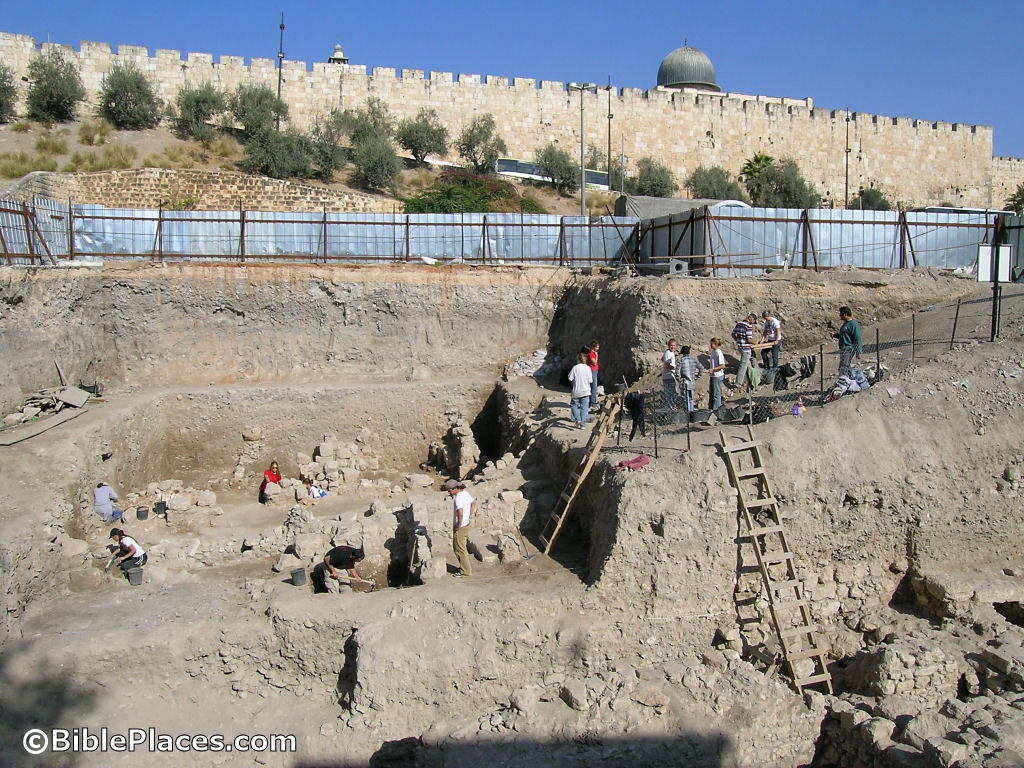
Plans to reconstruct an important synagogue in the Jewish Quarter of the Old City of Jerusalem have given archaeologists the opportunity to excavate. The Hurvah synagogue was the largest and most beautiful in the city before its destruction in the 1948 War of Independence. Following the restoration of the Jewish Quarter since 1967, the location of the synagogue has been marked by a single arch.

Hurvah Synagogue arch before removal

Haaretz reports on some of the discoveries made by archaeologists Hillel Geva and Oren Gutfeld. 

The most significant find is an intact Byzantine arch which apparently served as a gate for a street leading from the Cardo. They have also found buildings from earlier periods.

Hurvah synagogue during renovation

The excavations, which began in 2003, also unearthed structures and pottery from the First Temple period, remnants of rooms from the Herodian period (Second Temple), burnt wooden logs (evidence of fire that took place after the destruction of the Second Temple), and three plastered ritual baths carved in rock from the Second Temple period.

Old City from west; location of synagogue is circled in red
Share:

Tim Bulkeley of ebibletools.com has recently completed several videos (or narrated slideshows) of archaeological sites in Israel, including Lachish, Arad, and Megiddo. Each is approximately five minutes long and they are interesting and informative (though the Arad remains are Early, not Middle Bronze). I’ve had it in mind to do something like this myself, and perhaps this will renew my motivation. One subject that would lend itself well to this is the location of Jesus’ crucifixion. Tim also has some of his photos of Israel available for free (non-commercial) use.

HT: ANE-2 Yahoo Group

Share:

From the ANE-2 yahoo group:

Have you always wanted to be able to decipher the secrets of ancient Egypt yourself by reading the hieroglyphs? Have you tried teaching yourself hieroglyphs but gave up because you had no one to answer your questions and no other students with whom to learn? If so, Glyphdoctors’ course in Middle Egyptian provides you with a complete introduction to Middle Egyptian grammar, enabling you to comprehend and translate literary, religious, historical and documentary texts in the language. The course is taught online and is self-paced so you can fit it into any schedule, anywhere. You will gain access to a virtual classroom where you will have the guidance of Egyptologist Nicole Hansen (who has a Ph.D. in Egyptology from the University of Chicago) and be able to interact with other students.

You can read more about the course here, view an animated course preview here, or see what currently enrolled students are saying about the course here.

The material covered by this course is the equivalent of a first year university-level course in Middle Egyptian.

Share: