Tim Bulkeley of ebibletools.com has recently completed several videos (or narrated slideshows) of archaeological sites in Israel, including Lachish, Arad, and Megiddo. Each is approximately five minutes long and they are interesting and informative (though the Arad remains are Early, not Middle Bronze). I’ve had it in mind to do something like this myself, and perhaps this will renew my motivation. One subject that would lend itself well to this is the location of Jesus’ crucifixion. Tim also has some of his photos of Israel available for free (non-commercial) use.
 From the ANE-2 yahoo group:
Have you always wanted to be able to decipher the secrets of ancient Egypt yourself by reading the hieroglyphs? Have you tried teaching yourself hieroglyphs but gave up because you had no one to answer your questions and no other students with whom to learn? If so, Glyphdoctors’ course in Middle Egyptian provides you with a complete introduction to Middle Egyptian grammar, enabling you to comprehend and translate literary, religious, historical and documentary texts in the language. The course is taught online and is self-paced so you can fit it into any schedule, anywhere. You will gain access to a virtual classroom where you will have the guidance of Egyptologist Nicole Hansen (who has a Ph.D. in Egyptology from the University of Chicago) and be able to interact with other students.
You can read more about the course here, view an animated course preview here, or see what currently enrolled students are saying about the course here.
The material covered by this course is the equivalent of a first year university-level course in Middle Egyptian.
Last year I went on a 5-day trip to Cyprus with a friend. This was part of my project to visit all of the sites that Paul traveled to, and to include them on a new “Greek Islands” CD in the Pictorial Library series. At the end of the trip, I sat down and wrote a series of posts for the blog, which I never got around to posting. Now with the end-of-the-semester time crunch, this is a good opportunity to share these, with the hope that they are both instructive and enjoyable.
I’ll start with some of the negatives, moving to some of the more positive experiences and insights in later posts. Overall, I would characterize this trip as less enjoyable to me than other trips because:
1. There are only two biblical sites (Salamis and Paphos) and the connection there is very limited; furthermore, there is nothing at the sites that you can directly connect with the biblical account.
2. The weather was overcast more than sunny, making photographs more dreary. I would recommend visiting in April instead of March.
3. The costs were significantly higher than expected (e.g., $80/day for rental car; $45 for a cheap hotel).
4. Cyprus history is not well known to me, and as I learned more about it, I would confess that it did not become very exciting to me. There are connections with Israel/Canaan, but these are less than one might expect. The Myceneans and Minoans, who I would expect to have more of a connection with this island, don’t seem to. There is not much evidence of Jewish presence.
5. The divided nature of the island adds another challenge to travel logistics. It did seem to me that there was no control at the border, such that we could have stayed many days on the northern side and the Greeks wouldn’t know (though the rules say you can’t stay overnight). They didn’t stamp or record our passport when we left, and no one looked at it when we came back in. I could have used another day on the northern side to visit Kyrenia and some sites to its west.
6. They drive on the “wrong” side of the road here (as a former British colony). You drive from the “passenger” seat, and shift gears with your left hand. Of course you learn how to do all of this when starting at the rental car agency in the middle of the big city’s downtown.
7. Most of the sites were not well-marked, so oftentimes we didn’t know what we were looking at. And there were not brochures to explain it either. I don’t know of a good archaeological guide with plans of all of the sites. The Fant & Reddish book was helpful for what it covered.
8. The ruins are not dramatic. There are three sites that have more to see: Salamis, Kourion, and Paphos. But compared with other sites (such as in Egypt, Turkey, Greece, Rome), these are just not impressive.
9. We were a little too early in the season to see all of the colors of spring. The coastal areas were quite green and had flowers, but the mountains were still coming out of winter.
10. Cyprus is largely a tourist vacation spot today, and in many ways it seemed like a great place to come and spend a week with our wives. But it wasn’t warm, we didn’t spend any time at the beach, and our wives were not with us.

BiblePlaces.com has been one of the premier websites for biblical studies for over five years now and we’ve never celebrated or even noted our anniversaries. We’re not particularly proud of ourselves because we know how much better we could be. But we’re trying, and there are some terrific resources that we’ve been working hard on. So, for no special reason, except maybe to encourage people who only buy when there is a “sale,” we’ve decided to offer our first “sale.”
How much? 10% percent off
What products?
- Any of the Historic Views volumes
- The Above Israel DVD collection

- The Bible and the Land DVD
- The Historic Views of the Holy Land Collection
- The Pictorial Library and Historic Views Set
- The Ultimate Teaching Set (now almost 50% off)
How long? One week, until November 28, 2006.
How do I get it? This link [expired] will take you to the order page and give you the discount. The
reduced prices will be shown on the confirmation page.
How much is shipping? Free, unless you live outside the U.S. or want it tomorrow.
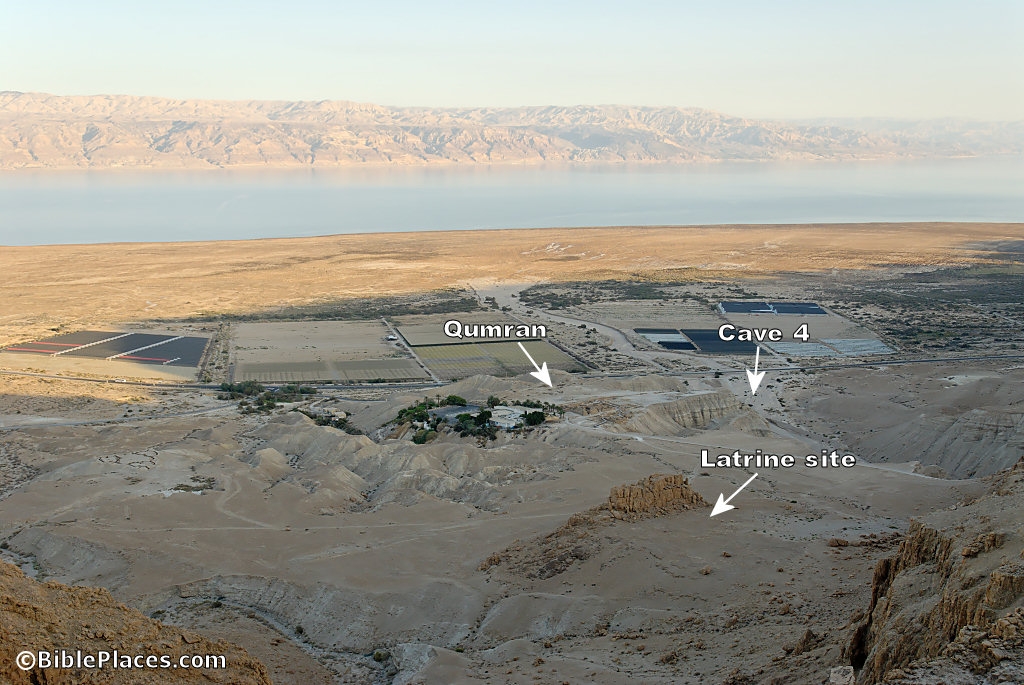
James Tabor, who made the initial suggestion to study a certain area for bathroom activity at Qumran, comments on the discovery on his Jesus Dynasty blog. He includes an aerial photo showing the location of the latrine area. Here is another photo which also shows the area of the latrines in relation to the site. The rocky outcropping would have provided privacy from anyone in the vicinity of the settlement.
HT: Paleojudaica