Archaeologists working in the City of David believe that they have found evidence of the 8th-century BC earthquake that occurred in the reign of Uzziah (Amos 1:1; Zech 14:5).

Archaeologists believe they have discovered the place where the Aramean king Hazael breached the walls of the Philistine city of Gath.

Israel will not renew the contract for Elad to run the Davidson Archaeological Park south of the Temple Mount (Haaretz premium).

Ruth Schuster gives the case for identifying el-Araj as the New Testament site of Bethsaida.

Haim Silberstein lists “10 of the best underground attractions in Israel.”

Bruce Chilton writes about “Herod, His Progeny, and the Cutting Edge of Power.”

The current issue of Adventist Review has a number of articles related to biblical archaeology.

This week on The Book and the Spade: “Wet Sifting or Not, An Archaeological Dilemma” with Jimmy Hardin.

Online conference on Sept 30: Jerusalem and Other Chosen Places

HT: Agade, Ted Weis, Arne Halbakken, Charles Savelle, Andy Cook, Roger Schmidgall, Explorator

Share:

“Researchers in Saudi Arabia have discovered a sixth-century B.C.E. rock carving of the last Babylonian king, Nabonidus” along with a lengthy cuneiform inscription.

“Beneath the murky waves of the Venice Lagoon, researchers have discovered the remains of an ancient Roman road and other possible port facilities, like a dock, that may predate the founding of the Italian city.”

“A spectacular ancient mosaic floor that was part of a building from the Hellenistic period is among the important finds from excavations carried out recently at Fabrika Hill in Kato Paphos, Cyprus.” The photo is apparently not of the newly discovered mosaic.

NPR has a story on what lies below ground in Istanbul.

“Work has begun to refurbish the old Acropolis Museum near the iconic Parthenon temple and turn it into an exhibition space.”

“Held annually on [Turkey’s] Aegean coast, the Selcuk camel-wrestling festival is part of a nomadic legacy rooted in ancient Turkic tribes.”

“Between the years 193 – 235, the Roman Empire was ruled by a series of emperors who were originally Phoenicians.”

The new director of Michigan State University’s excavations at Isthmia has developed a new website to share both old and new research with the public. The website is here.

The US government has seized the Museum of the Bible’s Gilgamesh Tablet, declaring that it was illegally deported from Iraq.

Death by stoning is not so common these days, especially in the United States. But that’s how a gunman in Texas recently died.

Zoom lecture on August 29: “From Standing Stones to Sacred Emptiness: Textual and Visual Portrayals of Israel’s God,” by Theodore Lewis.

University College London and King’s College London are co-hosting an eLecture series in August, entitled Ancient Near Eastern Languages in Contact (ANELC). The first eLecture will take place on Wednesday 4 August from 16:00 until 17:00 BST (London), when Dr. Ohad Cohen of the University of Haifa will be speaking on “The Canaanite Melting Pot – The Theoretical Implications of ‘Languages in Contact’ to the Understanding of Late Biblical Hebrew.”

New release: The City of Babylon: A History, c. 2000 BC – AD 116, by Stephanie Dalley

HT: Agade, Arne Halbakken, Wayne Stiles, Joseph Lauer, Ted Weis, Explorator, Mark Hoffman, Roger Schmidgall, Paleojudaica

Share:

Archaeologists believe that they have greater clarity about the roads in the southern Judean desert leading to Edom following the examination of a site near Nahal Gorer. The underlying journal article is available to PEQ subscribers.

Haaretz follows up on the Jerubaal inscription discovery with a report fashioned as a back-and-forth between David Vanderhooft and Christopher Rollston, with the former suggesting the inscription may have been Zerbaal or Ezerbaal, and the latter sticking with his original interpretation of Jerubaal.

Excavations are underway at el-Araj (Bethsaida?), and updates are posted daily on their website.

The 25th and final summer season of excavations at Tell es-Safi/Gath has concluded. They have had a remarkable run.

Haaretz surveys the debate between Erez Ben-Yosef and Israel Finkelstein on the effect of “architectural bias” in drawing conclusions about Israel’s United Monarchy.

Naama Yahalom-Mack writes about the history of iron in ancient Israel.

Naama Barak writes about the mystery of the 1,400 dog burials at Ashkelon during the Persian period.

Bryan Windle identifies the top three reports in biblical archaeology for the month of July.

Construction has begun on a new reception center at the traditional Shepherds’ Field site near Bethlehem.

A music historian plans to restore a 12th-century organ discovered beneath the Basilica of the Nativity in Bethlehem. The instrument is the oldest known example of a pipe organ.

Shea Sumlin is on the GTI podcast talking about what it was like to be one of the first tour groups to be back in Israel.

Joseph L. Rife reviews A Walk to Caesarea: A Historical-Archaeological Perspective, by Joseph Patrich.

2nd edition released: The Archaeology of Qumran and the Dead Sea Scrolls, by Jodi Magness.

One of the books on sale at Logos right now is the Zondervan Handbook of Biblical Archaeology, by Randall Price with H. Wayne House ($9).

John DeLancey’s new Institute of Biblical Israel is launching a new course on biblical archaeology tomorrow.

HT: Agade, Arne Halbakken, Wayne Stiles, Joseph Lauer, Ted Weis, Explorator, Mark Hoffman, Roger Schmidgall, Paleojudaica

Share:

“Archeologists in Saudi Arabia have discovered the largest inscriptions in the Kingdom depicting the Babylonian King Nabonidus in the north-western city of Hail.”

Egypt has found remains of a military vessel from the Ptolemaic era at the ancient submerged port city of Thonis-Heracleio.

Treasures similar to those from King Tut’s tomb were allegedly found at a site recently discovered in southern Iraq.

“Turkey’s Izmir Archaeology Museum recently launched a new, unique exhibition centered around the historical artifact known as a ‘strigil,’ which 2,300 years ago was a tool used for cleansing the body by scraping off dirt, perspiration and oil.”

Lee Lawrence provides a well-illustrated introduction to the “meticulous, miniature world of Mesopotamian cylinder seals.”

Robert Deutsch is the guest this week on The Book and the Spade, discussing seals, seal impressions, and wet sifting.

Stephanie Lynn Budin takes issue with recent studies that assume that nude terracotta figurines are all related to fertility and childbirth.

New release: Egg Whites or Turnips? Archaeology and Bible Translation, by Paul J. N. Lawrence. The book has endorsements from Alan Millard and James Hoffmeier.

The Bible Mapper Blog has posted some new maps, with downloadable high-res versions:

HT: Agade, Charles Savelle, Ted Weis, Arne Halbakken, Joseph Lauer

Share:

A new study indicates that Egypt was using copper mined at Timna during the reigns of David and Solomon, suggesting an important trade route was in use at the time.

A journalist proposed that Sennacherib’s failure to capture Jerusalem was owing to Tirhakah’s intervention on behalf of Judah. The Journal of Hebrew Scriptures commissioned eight scholars to evaluate it, with six scholars affirming the theory. Alice Ogden Bellis summarizes the discussion.

The City of David YouTube channel has released a Tisha B’Av special in which they look at newly discovered evidence of the destructions of Jerusalem in 586 BC and AD 70 (25 min).

Zachi Dvira is the guest on the “Times Will Tell” podcast, talking about the history of the Temple Mount Sifting Project.

Nadav Shragai discusses some of the stories and controversies of the 49 cisterns under the Temple Mount.

“Was a well-preserved set of game pieces and other childhood items buried [at Tel Kedesh] by a young woman before she got married?”

The team excavating Tell es-Safi/Gath has concluded their third week.

In a new episode on the Biblical World podcast, Mary Buck and Chris McKinny discuss the topography of ancient Jerusalem and the possible identification of the Millo with the Spring Tower.

From the maker of “Ushpizin,” and now playing in theaters in Israel, “Legend of Destruction” is a 90-minute film that “tells the story of the Jewish revolt against Rome in 70 CE, from the perspective of Ben Batiach, a good-hearted scholar who turns zealot, leading to the Roman siege on the city and the destruction of the Second Temple.”

HT: Agade, Charles Savelle, Ted Weis, Arne Halbakken, Joseph Lauer

Share:

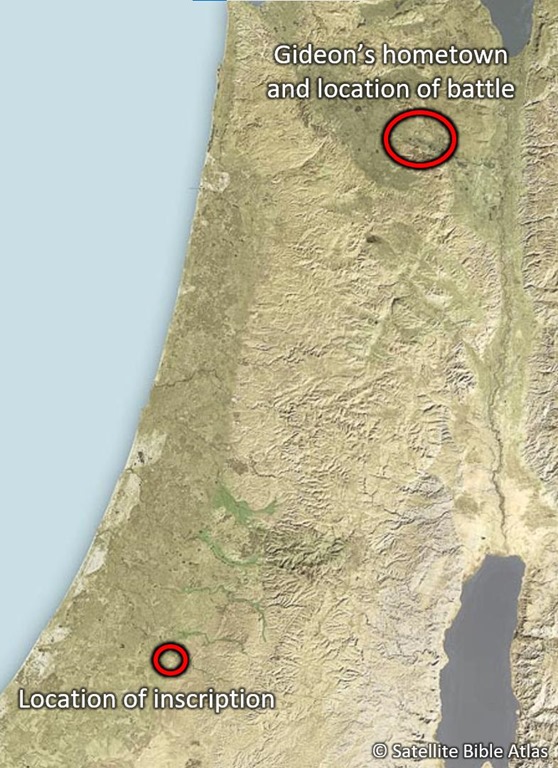
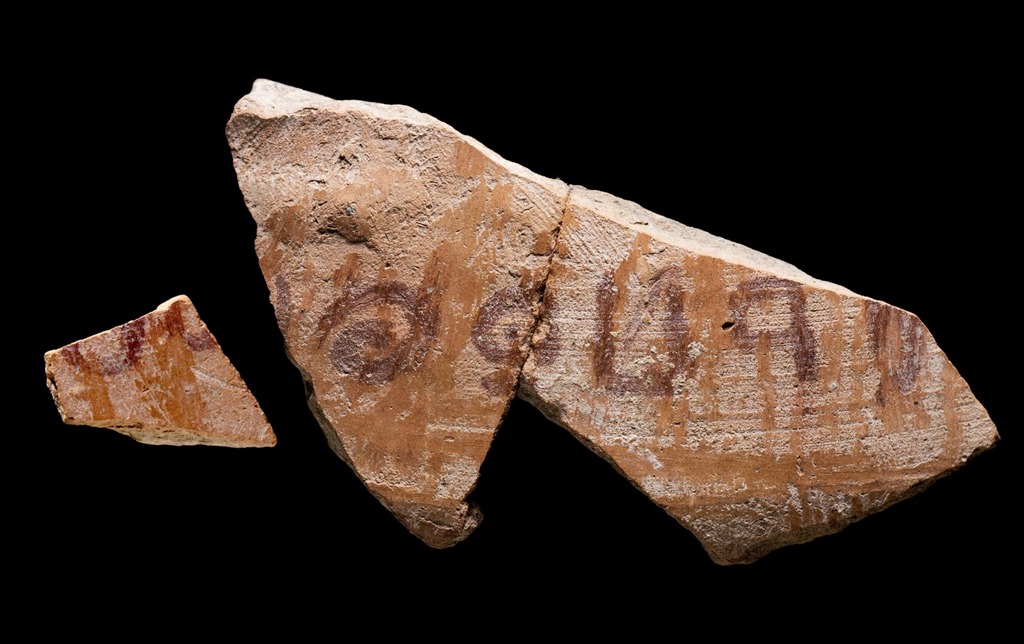
Archaeologists have discovered an inscription with the name “Jerubbaal” at Khirbet al-Ra‘i in the Judean foothills, not far from Lachish. Jerubbaal was another name for Gideon (Judg 6:32). If the inscription can be identified with Gideon, this would be the first ancient inscription with the name of a biblical judge.
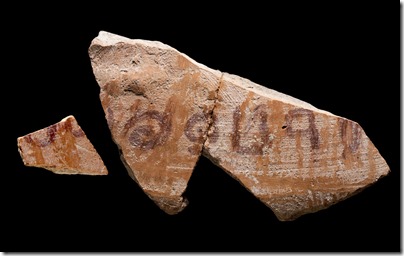
3.Jerubbaal inscription. Photo Dafna Gazit-Israel Antiquities Authority-sm

Jerubbaal inscription. Photo by Dafna Gazit and the Israel Antiquities Authority.

The inscription was published in the Jerusalem Journal of Archaeology (free pdf). Stories have been published in The Times of Israel, The Jerusalem Post, Haaretz, Bible History Daily, and elsewhere. The IAA has posted a 1.5-minute video (in Hebrew). The following is my summary of the main points.

The Sherds: Three pottery fragments were discovered with letters written in brown ink. Two of the sherds join together, but the third does not and its relationship to the other two is unclear. The sherds came from a small jug whose broken pieces had been swept into a stone-lined pit.

The Archaeologists: The excavations at Khirbet al-Ra‘i are directed by Yosef Garfinkel of the Hebrew University, Sa’ar Ganor of the IAA, and Kyle Keimer and Gil Davies of Macquarie University. The lead writer of the journal article is Christopher Rollston of George Washington University. Luke Chandler is credited with organizing a team of volunteers.

Date: The inscription is dated based on its stratigraphical context, pottery typology, and the shape of its letters to the late twelfth or first half of the 11th century, or approximately 1100 BC. This is approximately the time of Gideon. This is also the first Iron Age I inscription found in the Shephelah.

Language: The inscription was written by a trained scribe from right to left. The article’s authors identify the language as “Proto-Canaanite” or “Early Alphabetic,” in part because of their dubious assumption that Hebrew did not exist this early in history.

Baal: Two other inscriptions with the name “baal” have been found in the Shephelah in recent years. The Eshbaal inscription was discovered at Khirbet Qeiyafa, and the Baal inscription was unearthed at Beth Shemesh.

Jerubbaal: Four letters can be read clearly, reading rb‘l, equivalent to “rubbaal.” The initial letter is not fully preserved, but it may be a yod. If so, this would be the first discovery of the name Yrb‘l (Jerubbaal).

Is this the biblical Gideon?: The article’s authors raise the possibility but do not come to a conclusion either way. Here are some factors in favor of each position:

In Favor of Identifying with Gideon:

  • Name: There is a possible match between the name on the potsherd and the name given to Gideon. There are no other people known from the ancient world with the name Jerubbaal.
  • Date: This ostracon dates to the time of the judges, but it is difficult to know how close it is to Gideon’s day, because (1) the dating of the inscription is not precise; (2) the dating of Gideon’s judgeship is uncertain. Eugene Merrill dates Gideon to approximately 1180-1140, while Andrew Steinmann dates him to 1172-1133. If the inscription is truly from 1100, it is a few decades too late. In that case, perhaps the individual in the inscription was named after the biblical figure.

Against Identifying with Gideon:

  • Geography: All of Gideon’s known activity was in northern Israel or Transjordan. The southern Shephelah where this inscription was found is too far away. The tribe of Judah is never mentioned in the context of Gideon’s life. All of the biblical judges served in particular regions; there is no reason to believe that Gideon had a national ministry.
  • Patronymic: Though no other men named Jerubbaal are mentioned in the Bible, it is possible that there were men with this name at this time. If the sherd had included the name of Gideon’s father (Joash), that would make an identification more compelling.
  • Incomplete: The initial letter is fragmentary and may not be “J” (yod). It is also possible that there were other letters before or after that have not been preserved. In other words, the name may not be Jerubbaal. Haggai Misgav suggests the name could be Azrubaal. Other possibilities from names known from the ancient world include Zekharbaal and Merib-baal (1 Chr 8:34).

Conclusion: This discovery is valuable because inscriptions are rare in the land of Israel at this time. The potential connection with Gideon’s alternate name, and the proximity of the date, makes the identification possible but by no means certain.
Gideon-inscription-map-Satellite-Bible-Atlas

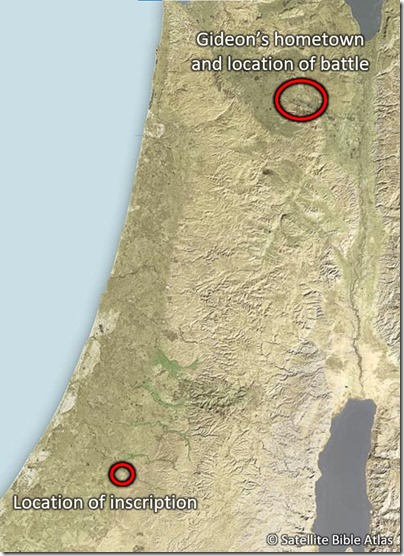
Location of discovery of “Jerubbaal inscription”; map from the Satellite Bible Atlas
Share: