The proposal that Sodom has been found on the northeastern side of the Dead Sea has been around for a decade or so, but with the publication of an article by Steven Collins this month it will receive the widest hearing to date. I thought it might be helpful for readers of Biblical Archaeology Review to know where to go for another perspective.

The proposal that Tall al-Hammam is Sodom fails on at least two counts, and these are helpfully summarized by two experts in their respective subjects.

Geography Fail: Bill Schlegel, professor in Israel for 25 years and author of the Satellite Bible Atlas, explains why the biblical text does not fit the geography of Tall al-Hammam.

Chronology Fail: Eugene Merrill, Distinguished Professor of Old Testament Studies at Dallas
Theological Seminary and author of Kingdom of Priests: A History of Old Testament Israel, shows in a recent Artifax article that for Tall al-Hammam to be Sodom one must deny all of the biblical dates before the time of the judges.

I’ve written about the issue several times as well:

Excavator Finds Evidence of Destruction at “Sodom” (Dec 2011)

Video: Search for Sodom and Gomorrah (Aug 2009)

Tall el-Hammam: Sodom, Abel Shittim, Abila, or Livias? (Jan 2009)

Sodom Identified? (May 2006)

One final point: the excavator of Tall al-Hammam insists that by identifying the site as Sodom he is supporting the historicity of the Bible. In fact, if his theory is true, we cannot trust the Bible for accurate details about times and places. Tall al-Hammam is certainly a significant site, but Sodom is surely to be found elsewhere.
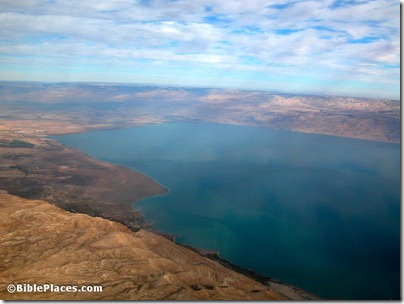
Dead Sea northern end aerial from west, tb010703242
Northern end of the Dead Sea
Photo from Pictorial Library of Bible Lands, volume 4

The Red to Dead canal is moving along faster than I realized. THe last hearings are being held now before the World Bank issues a final report. The Inter Press Service provides a good summary of the plans and problems.

The World Bank has declared the Red Sea-Dead Sea canal project feasible. Designed to “save the Dead Sea”, “desalinate water and/or generate hydroelectricity at affordable prices in Jordan, Israel and the Palestinian Authority”, and “build a symbol of peace in the Middle East”, the scheme, green groups warn, is fraught with environmental hazards.
Currently at 426m below sea level, the Dead Sea, Earth’s lowest elevation on land, is drying and dying in the desert by roughly 1.1 metres a year. Its surface area has shrunk by a third during the last 50 years from 960 square kilometres to 620 square kilometres.
[…]
What could save the Dead Sea from death foretold is a 180-km development project called the ‘Red Sea-Dead Sea Water Conveyance’.
This is how it would work: marine water would be pumped from the Red Sea. A pipeline conveyance system with six pipes and a tunnel would then flow the water by gravity, exploiting the difference in elevation at and below sea level, to a high-level desalination plant and two hydroelectric plants.
The high-salinity brine reject would be discharged to the Dead Sea to halt and, eventually, reverse its decline.
After a decade-long argument, the World Bank released a series of studies last month which deem the proposed ‘Red-Dead Canal’ (as the ambitious scheme is dubbed) technically, environmentally and socio-economically feasible.
The main objectives would thus be fulfilled, the World Bank assesses. All that for a total capital cost of 9.97 billion dollars, the World Bank estimates; half of it amortised by selling desalinated water and hydroelectricity, the other half financed out of international aid to development – “a win-win situation,” hails Shalom.

The rest of the article discusses objections to the plan, including chemical problems, earthquakes, groundwater contamination, and damage to the Red Sea coral reef. The article concludes with a forecast: “The canal could be built within six years and start operating in 2020, reaching its maturity stage by 2060.”

HT: Charles Savelle

Dead Sea from Masada, tb010810995
The disappearing Dead Sea, as seen from Masada
Photo from Pictorial Library of Bible Lands, volume 4

Some environmentalists are not happy with a plan to save the Dead Sea with a pipeline from the Red Sea.

Archaeology in Egypt has suffered from the political turmoil and resulting loss of tourist dollars.

Residents of Modi’in are protesting plans to build where someone else used to live a long time ago.

Seth Rodriquez provides insight into the Broken Wall of the Sluggard.

Rubén Gómez has a new website for his Spanish-speaking tour of Israel later this year.

The History Channel shares six “secrets” of King Tut.

In honor of Ehud Netzer, the Biblical Archaeology Society has made a collection of Ehud Netzer’s articles available for free, including the recent “In Search of Herod’s Tomb.” Click on each title to read.

The ASOR Blog provides a weekly roundup of stories in the broader world of archaeology.

HT: Jack Sasson

A cave above En Gedi is revealing well-preserved artifacts from the first century AD.

Luke Chandler has word that Yosef Garfinkel plans to follow his Khirbet Qeiyafa dig with excavations at Lachish.

The Daily Mail has photos of the newly opened exhibit of King Herod at the Israel Museum. Shmuel Browns has more.

Some are claiming that the Waqf is destroying more antiquities on the Temple Mount.

Gordon Franz evaluates Robert Cornuke’s use of a computer model to predict the location of Paul’s shipwreck on Malta.

A website for the excavations of Tel Abel Beth Maacah is now online.

En Gedi and Nahal David aerial from northwest, tb010703272
Aerial view of Nahal David and En Gedi

The level of the Dead Sea has risen for the first time in the last ten years.

Egyptian police seized a carload of 863 ancient artifacts, including 10 scarabs, 180 amulets, 120 Ptolemaic coins, 407 Roman coins of bronze, 3 Osirion wooden statues, and a limestone statue.

Victor Avigdor Hurowitz, Professor in the Department of Bible, Archaeology and Ancient Near East at Ben-Gurion University, has died after a long illness.

Shmuel Browns’ Photo of the Week is an impressive shot of the Keshet Cave in western Galilee.

The Samaritans on Mount Gerizim can vote twice this week.

Accordance Bible Software has an outstanding sale going on right now for both sets (9 volumes) of the Zondervan Illustrated Bible Background Commentary, Old and New Testaments. It’s marked down now 63% to $150. These volumes have lots of images you can easily search and use. Sale ends on Monday.

HT: Charles Savelle

Dead Sea, Ras el Feshkha, mat01742

Western shore of the Dead Sea in early 1900s
Photo from Southern Palestine photo collection

More than 5,000 high-resolution images of the Dead Sea Scrolls are now online at www.deadseascrolls.org.il. From the announcement by the Israel Antiquities Authority:

On the occasion of the 65th anniversary of the discovery of the Dead Sea Scrolls, the Israel Antiquities Authority and Google are pleased to launch today the Leon Levy Dead Sea Scrolls Digital Library website, www.deadseascrolls.org.il. The public is invited to experience, view, examine, and explore this collection of over 5000 images of Dead Sea Scrolls, in a quality never seen before.
The library was assembled over the course of two years, in collaboration with Google, using advanced technology first developed by NASA. It includes some 1000 new images of scroll fragments; 3500 scans of negatives from the 1950s; a database documenting about 900 manuscripts, two-thousand years old, comprising thousands of scroll fragments; and interactive content pages. It enables scholars and millions of users worldwide to reveal and decipher details hence invisible to the naked eye. The site displays infra-red and color images at a resolution of 1215 dpi, at a 1:1 scale, equivalent in quality to the original scrolls. Google has provided hosting services and use of Google Maps, image technology and YouTube. The project was made possible by an exceptionally generous grant from the Leon Levy Foundation, and further contribution by the Arcadia Fund, as well as the support of the Yad Hanadiv Foundation.
One of the earliest known texts is a copy of the Book of Deuteronomy, which includes the Ten Commandments; part of chapter 1 of the Book of Genesis, dated to the first century BCE, which describes the creation of the world; a number of copies of Psalms scrolls; tiny texts of tefillin from the Second Temple period; letters and documents hidden by refugees fleeing the Roman army during the Bar Kochba Revolt; and hundreds of additional 2000-year-old texts, shedding light on biblical studies, the history of Judaism and the origins of Christianity.
Shuka Dorfman, Director of the Israel Antiquities Authority, said: “Only five conservators worldwide are authorized to handle the Dead Sea Scrolls. Now, everyone can “touch” the scrolls on-screen around the globe, and view them in spectacular quality, equivalent to the original! On the occasion of the 65th anniversary of their discovery, the IAA, in collaboration with Google, presents the scrolls online, using the most advanced imaging technology. Thus, this most important national treasure is available to the general public, preserving it for future generations.”

This project was first announced in October 2010. Many news stories can be found here. This really is a fantastic resource and I hope they will expand it to include every scroll fragment.

4qdana-iaa-google
4QDana includes portions from Daniel chapters 1, 2, 3, 4, 5, 6, 7, 10, and 11. Image from the Leon Levy Dead Sea Scrolls Digital Library.