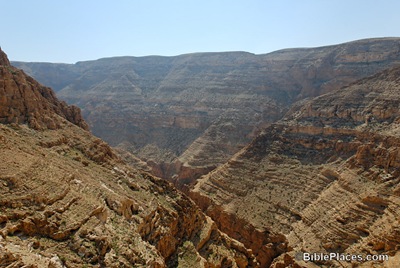
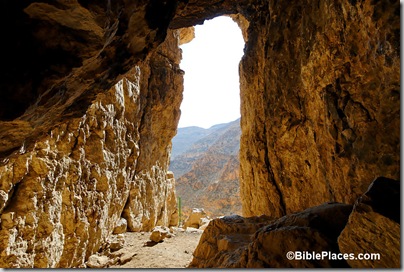
One of my favorite hikes in Israel is described in a recent story in the Jerusalem Post.  The Nahal Darga is a large canyon that drains the Judean Wilderness into the Dead Sea.  The marvelous hike combines spectacular views, historic caves, and challenging climbing.  Jacob Solomon’s article offers sage advice, but if you’re planning to heed the call, do not make the same mistake that he does and miss the real jewel of the hike, that is, climbing down the canyon itself!  Some excerpts from the article:

This is a memorable, varied and demanding full-day route. Shaded for much of the way, the earlier parts follow the deep, steep-sided gorge of Nahal Darga, and the sun should be well behind the Judean Hills by the late afternoon descent to the finish at Mitzpe Shalem. Check the flash-flood forecast immediately before this excursion….
You have reached one of the last stands of the Second Jewish Revolt against Rome (132-135 CE), led by Simeon Bar Kosiba, a.k.a. Bar Kochba. The official Roman conversion of Jerusalem to the pagan city of Aelia Capitolina with a temple to the god Jupiter fired a rebellion of sufficient magnitude for Emperor Hadrian to bring down his premier general Severus, then in Britain. The fighters retreated, making their last guerrilla-style stands in these mountains in the hopeful but erroneous belief that the geographical obstacles you have just surmounted might deter Hadrian’s imperial army.

If you do opt to climb through the canyon, you must be in good shape, you may need climbing rope, and you will get wet and probably dirty.  You also would be wise to leave anything behind that cannot get wet, including your camera. 

Nahal Darga, Wadi Murabaat, tb021107575Nahal Darga from above
Wadi Murabaat, Bar Kochba cave, view from interior, tb021107619Wadi Murabaat = Nahal Darga, Cave where Bar Kochba scrolls found
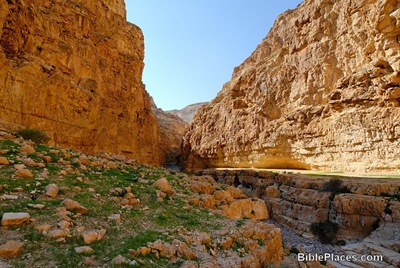
Nahal Darga, Wadi Murabaat, tb021107581

The best part of the hike is through the canyon itself 
Nahal Darga, Wadi Murabaat, tb021107612 
The best time of the year to hike Nahal Darga is February to April.  After that, the temperatures are too hot and the water becomes too putrid.
Share:

Having been the victim of unwelcome, sometimes lengthy, and usually inflammatory comments on posts on this blog related to the Dead Sea Scrolls, I’m happy to see that New York police have arrested a man for allegedly creating many false identities, impersonating scholars, and slandering Dr. Lawrence Schiffman.  The guilty party, whether he is the accused or someone else, had a single agenda: to promote the widely panned theories of Dr. Norman Golb.  I have long been curious what sort of person would be so committed to such an endeavor as to spend countless hours to promote this view in places that have little real significance (this and other blogs, Wikipedia).  The answer, if NY prosecutors are correct, makes some sense: the perpetrator was Golb’s son.  That son, however, was not 14 years old, but 49.  One scholar who has wrangled extensively with the multiple-aliased offender is Bob Cargill.  A scholar at UCLA, Cargill has posted an extraordinary catalog of the campaign of this individual (be he the accused or someone else).  A few hours after Cargill posted his catalog, NY police announced the arrest.  From the NY Times:

For decades, the origin of the Dead Sea Scrolls has been intensely debated.
The prevailing theory is that these ancient documents, which include texts from the Hebrew Bible, were written over the three centuries before 100 A.D. by a Jewish sect known as the Essenes, who were based in Qumran, a settlement at the northwest shore of the Dead Sea near the caves where the scrolls were found between 1947 and 1956.
An alternative theory, passionately proffered by a University of Chicago professor, is that the scrolls’ authors were not Essenes, and that the scrolls themselves were kept in various libraries in Jerusalem until they were hidden in the caves around Qumran for safekeeping during the Roman war of A.D. 67 to 73. Qumran, he has said, was not an Essene monastery but a fortress, one of several armed defensive bastions around Jerusalem.
The professor, Norman Golb, has stood behind his theory despite significant criticism. His son, Raphael Haim Golb, has been one of his greatest allies.
But prosecutors said on Thursday that Raphael Golb took defending his father’s theory too far. Mr. Golb is accused of using stolen identities of various people, including a New York University professor who disagreed with his father, to elevate his father’s theory and besmirch its critics, Robert M. Morgenthau, the Manhattan district attorney, said at a news conference.
Mr. Golb, 49, was arrested Thursday morning and charged in Manhattan Criminal Court with identity theft, criminal impersonation and aggravated harassment. He faces up to four years in prison if convicted.
Prosecutors said Mr. Golb opened an e-mail account in the name of Lawrence H. Schiffman, the New York University professor who disagreed with Mr. Golb’s father. He sent messages in Professor Schiffman’s name to various people at N.Y.U. and to others involved in the Dead Sea Scrolls debate, fabricating an admission by Professor Schiffman that he had plagiarized some of Professor Golb’s work, Mr. Morgenthau said. Raphael Golb also set up blogs under various names that accused Dr. Schiffman of plagiarism, Mr. Morgenthau said.

NYUNews has posted one of the emails that Golb is alleged to have forged.

(HT: Joe Lauer)

Unfortunately dad’s response is not altogether encouraging.

Reached at his office in Chicago on Thursday afternoon, Professor Golb said he was shocked at the allegations leveled against his son, who is a real estate lawyer and has a Ph.D in comparative literature from Harvard.
“My son is an honorable person,” Professor Golb said. “He could not have done such a thing.”
Professor Golb said that opposing scholars had tried to quash his views over the years through tactics like barring him from Dead Sea Scrolls exhibitions. He said he saw the criminal charges as another attack on his work.
“Don’t you see how there was kind of a setup?” he said. “This was to hit me harder.”

I’m not sure that this is the best time for Professor Golb to be complaining of the same thing that led the impersonator to carry out his campaign.

Share:

Mid-America Baptist Theological Seminary is hosting a conference on the Dead Sea Scrolls with an impressive line-up of speakers.  More information is on the school’s website, but unfortunately no list of lecture titles is given.

Qumran and the Dead Sea Scrolls and Biblical Interpretation Conference

Mid-America Baptist Theological Seminary, 2095 Appling Road, Cordova, TN 38088 (901)-751-8453
April 23-24, 2009

This conference will include world class archaeologists, authors, and researchers as well as Old and
New Testament scholars. The speakers will include:

  • Kirk Kilpatrick, Professor of Old Testament and Hebrew, Dean of the Masters and Associates Program, Mid-America Baptist Theological Seminary
  • Jodi Magness, renowned author and the Kenan Distinguished Professor for Teaching Excellence in Early Judaism, University of North Carolina
  • Stephen Ortiz, Associate Professor of Archaeology and Biblical Backgrounds and Director of the Charles C. Tandy Archaeology Museum, Southwestern Baptist Theological Seminary
  • Lawrence H. Schiffman, renowned author and the Ethel and Irvin A. Edelman Professor in Hebrew and Judaic Studies at New York University
  • Michael R. Spradlin, President, Chairman and Professor of Evangelism; Professor of Old Testament and Hebrew, Practical Theology, and Church History, Mid-America Baptist Theological Seminary
  • Emanuel Tov, renowned author, Department of the Bible, Hebrew University, Jerusalem
  • James Clair Vanderkam, renowned author; and John A. O’Brien Professor of Theology, University of Notre Dame
  • Steven L. Cox, Professor of the New Testament and Greek, Mid-America Baptist Theological Seminary

The registration cost is $25 for students, $30.00 for alumni, and $50 for others. Registration includes snacks and a banquet meal. Meal selections will be either beef, chicken or kosher. 

The conference and banquet will be held on the MABTS campus.

On April 23, the conference runs from 2:00 p.m. through 9:30 p.m. (the banquet will be from 5:45 through 6:45 p.m.) and on April 24, the conference runs from 8:00 a.m. to 12:30 p.m.

For a registration form, click here.

To register and pay online, click here.

The Tyndale House blog notes that DVDs of the conference will be for sale for $39.95.

HT: Joe Lauer

Share:

From the Jerusalem Post:

An IDF training exercise sparked a massive wildfire at the Ein Fasha Nature Reserve Tuesday morning, destroying nearly 2000 dunams [500 acres] of land in what the chief firefighter on the scene called “the largest wildfire of the summer.” “It’s by far the largest,” said Amnon Amir of the Judea and Samaria Fire Department, as flames in the area were still being sprayed by airplanes overhead. “It started around four in the morning, and has been extremely difficult to put out.” According to Amir, the exceedingly dry conditions in the area, which borders the northern Dead Sea, added to the difficulty, and low amounts of rainfall over the winter were to blame. But he also told The Jerusalem Post that the IDF had initially prevented his firefighters from entering the area, making it more difficult to combat the intense flames…. “It will take 10 years before the area completely renews itself,” Nissim said. “But within six months or so, we’ll already see new signs of life. This isn’t a completely tragedy, because it’s somewhat healthy for the vegetation to renew itself like that, but still, it’s been difficult to watch it all burn.” The army refused to comment further on the incident, which Army Radio reported had begun from a flash or smoke grenade. According to the Judea and Samaria fire department, there were no injuries reported, and damage was limited to the plant life in the reserve. There have been three large wildfires throughout the country since Saturday, two in the Jerusalem Hills before Tuesday’s at Ein Fasha. Firefighters blame high temperatures and dry conditions as a factor in all of the fires, but at least one, on Saturday afternoon near Kibbutz Ma’aleh Hahamisha, was reportedly the result of arson.

Share:

A new study suggests that the scrolls in two of the Dead Sea Scroll caves were deposited fifty years earlier than the rest of the scrolls.  You can read a brief report of the study here; the full report was published here:

Stökl Ben Ezra, Daniel. “Old Caves and Young Caves: A Statistical Reevaluation of a Qumran Consensus.” Dead Sea Discoveries 14/3 (2007) 313-333.

I am curious which two caves have the older material.  Based on geographical location of the caves, I’d expect 1 and 2, or 3 and 11.  But I don’t have access to the article as I write.

For some photos of the Dead Sea Scroll caves, see here.

HT: Joe Lauer

Update (2/11): The link above has been corrected.  In the process, I found the full article itself, plus an abstract, which answers my question above: 1 and 4.  The link that Al gives in the comments below is to an earlier, abbreviated version.

Share:

The Biblical Archaeology Society has a survey for current subscribers that takes not more than 5 minutes and after which you can supply a mailing address to receive a free Dead Sea Scrolls mug. 

This normally sells for $10.

Unfortunately, they don’t have space for comments. If they did, I’d complain that they sell my address to others. Ironically, in the email requesting subscribers to do the survey, they say, “We will not sell your mailing or email address and nobody will contact you as a result of your responses.” But they do sell your magazine subscription address without asking or telling you.

Share: