If you needed a quick summary of information about En-Gedi, where would you go? I’m doing research for an essay in a future volume of the Lexham Geographic Commentary series and this morning I was studying En Gedi in relation to David’s flight from Saul. I went through a dozen commentaries and pulled out various tidbits about David’s time in the area. Then I went to my standard Bible dictionaries. I usually consider Anchor Bible Dictionary to be the best, and so I started there. The article was decent. Then I went to others to see what else they had (ISBE, NIDB, EBD).

I recently pulled into my line-up the Lexham Bible Dictionary. I’ve been a bit skeptical of its value because it’s not a printed work and they used a wide variety of writers (including many students). But when I pulled up the LBD entry on En-Gedi I was immediately impressed. It was much longer and more thorough than the others. In fact, I think its length is probably twice that of the other four combined. That means there are separate sections on En-Gedi in Ancient Accounts (subdivided into biblical and extrabiblical), Geography and Geology (no one else has much on this), and Archaeological Investigations (which is subdivided into many sections). Then it closes with a bibliography, which is easily better than any I’ve seen elsewhere.

A final delight was to discover the author: Christian Locatell. I know this guy! He’s one of our ace creators of the Photo Companion of the Bible! (Many years before that, he was my student and he gave me various nicknames, but we won’t get into that…) He made a big contribution to our Acts volume, and his work on Romans has been spectacular! (That volume should be available in November.) So I figured I would write a little blogpost with three purposes: (1) to share some interesting tidbits about En-Gedi that you may not know; (2) to suggest you include the Lexham Bible Dictionary as part of your Bible study tools; and (3) to let you know that the author of this terrific article is creating more amazing resources for BiblePlaces followers. 🙂

Here are five ten interesting observations about En-Gedi from Dr. Locatell’s article:

1. Edward Robinson was the first modern explorer to identify En Gedi, and he did so on the basis of its Arabic name: Ain Jiddi.

2. David hid from Saul in the “strongholds” of En-Gedi (1 Sam 23:29), but when he wrote a psalm praising God for saving him from Saul, he called God his “stronghold” (2 Sam 22:2; Ps 18:2).

3. En-Gedi is believed to be the home of the Essenes (and not Qumran) by some scholars.

4. 700 inhabitants of En-Gedi were slaughtered by the Sicarii in the First Jewish Revolt.

5. Many ancient accounts rave about En-Gedi’s lush fertility.

[In one paragraph, Locatell quotes Karmon, Baly, and Efrat and Orni! I don’t think I’ve ever seen such geographical richness in one place. It’s a great paragraph, but too long to copy here. I am certainly proud to be this guy’s first geography teacher.]

6. Clouds over En-Gedi are rare, and the flash floods in the area are the result of the top rock layers being unable to absorb much of rainfall.

7. Most of the springs along the western shore of the Dead Sea have a high saline content, making En-Gedi such a precious resource of sweet water.

8. Between 1949 and 1972, there were seven archaeological expeditions to En-Gedi. [I had no idea there were that many.]

9. An Aramaic mosaic from the 5th-century AD synagogue refers to the “secrets of the town.”

10. Excavations on the northern slope of the tell revealed workshops and equipment probably used for producing the perfumes for which En-Gedi was famous.

There you have it. This is the best article on En-Gedi I know of. Thanks to Lexham and to Locatell for serving us so well.

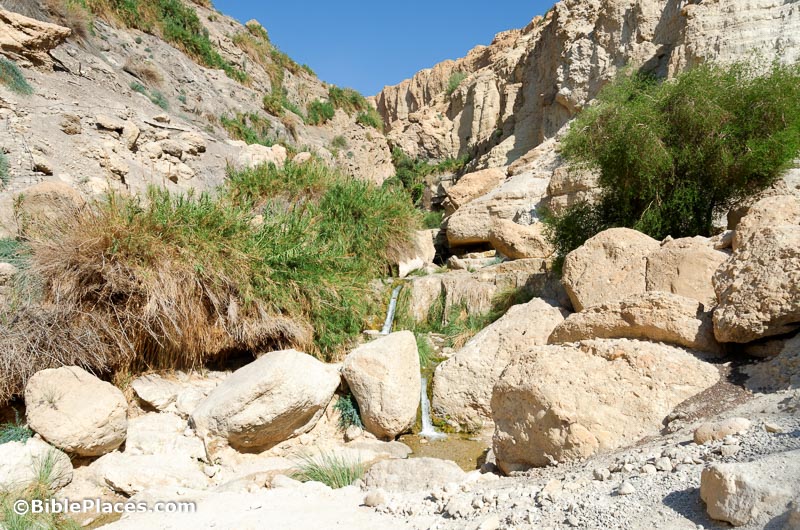
BTW, we have some great photos of En-Gedi in our Judah and the Dead Sea volume.
I go away for one week, and I come back to a large pile of stories in the biblical and archaeological world. This is going to take three long posts to catch up.


Discoveries:

Excavations at the synagogue of Huqoq have uncovered a mosaic depicting the Israelites’ encampment at Elim as well as two of the four beasts of Daniel 7.

Recent research has revealed that Tel Shikmona was not a trading settlement but a purple dye manufacturing center.

The Siloam Road, connecting the Pool of Siloam to the Temple Mount of Jerusalem, was officially opened this week.

Archaeologists discovered an ancient baptismal font hidden inside another baptismal font at the Church of the Nativity in Bethlehem.

An ancient Roman-era shipwreck has been discovered at the bottom of the Mediterranean Sea off the eastern coast of Cyprus.”


Excavations:

The Tel Burna crew has finished three weeks of their summer dig, with daily posts providing summaries of the finds along with photos. Here’s the latest. John DeLancey has posted his perspective as a volunteer.

The Gath expedition is halfway finished with their season, and they are unearthing a road, a window, architectural remains, and a monster wall.

This summer’s excavations at el-Araj (Bethsaida?) have produced more mosaics from the Byzantine church, a mold for making lead fishing weights, part of a roof roller, and Roman flagstones.


The Jerusalem Report has a feature piece on recent excavations at Tell Beth Shemesh.

Excavations are beginning in Laodicea on the road that leads to the ancient stadium.


Studies:

A new DNA study indicates that Philistines living in Ashkelon in the late 12th century BC originated from Greece, Crete, or Sardinia. These articles are based on a journal article published in Science Advances (pdf).

“New research explains why salt crystals are piling up on the deepest parts of the Dead Sea’s floor.”

Joe Zias argues that nearly all, if not all, of the human remains found at Masada are ethnically non-Jewish.

A new study shows that masons’ marks were used at Hippos only from the late first century to the late second century (Haaretz premium).


Sad News:

Doug Greenwold died on June 23. Doug was the Senior Teaching Fellow at Preserving Bible Times and a co-founder of The Institute of Biblical Context. He will be greatly missed.

HT: Joseph Lauer, Ted Weis, Charles Savelle, Agade, Explorator, Lois Tverberg

A statue likely depicting an Ammonite king in the 9th or 8th centuries BC was discovered near the Roman theater in Amman.

“Egypt’s antiquities ministry on Saturday unveiled a 4,500-year-old burial ground near the Giza pyramids containing colourful wooden coffins and limestone statues.”

Jerald Starr argues that a plaque discovered by Sir Leonard Woolley near Ur depicts a temple prostitute.

Gabriel Barkay provides a tour of important archaeological sites in east Jerusalem.

Roman buildings like the Colosseum may have withstood earthquakes because of “seismic cloaking,” though it’s questionable whether this design was intentional.

John DeLancey is summarizing each day of his current tour to Israel, with the latest post about their visit to the Judean desert, the hill country of Samaria, Shiloh, and Beth Shean.

The Tel Burna Excavation team has released their lecture and tour schedule.

Carl Rasmussen explains and shows how early churches may have met in a second-story room above a shop.

Justin Taylor interviews Weston Fields about the history and significance of the Dead Sea Scrolls.

Clyde Billington and Gordon Govier discuss what the Bible has to say about horses and dogs on The Book and the Spade.

BiblicalCulture.org is offering a three-month long summer course in Biblical Hebrew. No previous knowledge is necessary. Classes begin in June.

The Temple Mount Sifting Project is beginning a crowdfunding campaign in order to move and resume their operations as well as publish their results.

Helga Weippert passed away in March.

HT: Agade, Joseph Lauer, Charles Savelle, Ted Weis, Keith Keyser, Chris McKinny

Excavations in the Sharafat neighborhood in west Jerusalem revealed a Hasmonean-era agricultural village. Haaretz (premium) has a longer article with more photos.

A study of the garbage dumps of the Byzantine city of Elusa in Israel’s Negev reveals that the city’s decline was the result of climate change.

The Malham Cave, under Mount Sedom near the Dead Sea, has been identified as the longest salt cave in the world.

The third artifact in the TMSP’s 12 object series is a fiscal bulla inscribed “Gibeon / to the king.”

Amnon Ben Tor will be awarded the Israel Prize in the field of archaeology.

Gabriel Barkay, an Israeli archaeology, recalls his experience in excavating Susa in Iran

The Anglo-Israel Archaeological Society will be hosting lectures in the coming months by Amihai Mazar (on Tel Rehov), Jonathan Price (on Beth Shearim), and Jürgen Zangenberg (on Horvat Kur).

Andrea Berlin will be lecturing in Rockford, Illinois, on April 1, on “Phoenicians and Jews — A Tale of Two Peoples in Israel’s Upper Galilee.”

“Striking Power: Iconoclasm in Ancient Egypt” is a new exhibit at the Pulitzer Arts Foundation in St. Louis. A review article explains why so may of the statues’ noses are broken.

The latest video by the Institute for Biblical Culture is on “Ancient Israelite Fashion.” New classes in April include “The Prophets of Ancient Israel” and “The Geography of Biblical Israel/Canaan II.”

The founder of Sirin Riders explains why Israel is a great place to ride horses.

James Papandrea is on The Book and the Spade discussing his new book, A Week in the Life of Rome.

HT: Agade, Ted Weis

Emek Shaveh is requesting that the plans for renovation in the Jewish Quarter include opening the massive Nea Church from the Byzantine period.

The controversy continues over whether the Muslims can open the Golden Gate to worshippers.

The Karaite community is concerned that the proposed Jerusalem cable car will desecrate its ancient cemetery.

Mark Barnes explains why Jesus was crucified outside Jerusalem.

Ferrell shares a favorite photo this week of the Dead Sea.

Israel’s Good Name shares nature photos from his hike along Nahal Alexander.

A clever vandal spray-painted on the ancient synagogue of Merom, “This holy place will not be desecrated.”

The water level of the Sea of Galilee has risen above the lower red line for the first time in two years.

A study of the mountain fortress of Sela confirms the importance of the site in the Iron II period.

Video: An archaeologist is using drone imagery to track tomb looting in Jordan.

The Department of Antiquities of Jordan has made some great resources available for free online, including the Annual of the Department of Antiquities of Jordan and Studies in the History and Archaeology of Jordan.

HT: Explorator, Agade, Chris McKinny, Paleojudaica

New clues to the lost tomb of Alexander the Great are being unearthed in Egypt (National Geographic).

Sinai’s 500 plus photographic entries from mid 19th to mid 20th centuries . . . are now published online with detailed geography and history description . . . based on the 19-year field survey and maps of Sinai Peninsula Research (SPR).”

Erin Blakemore recounts the tale of how a modern attempt to play King Tut’s trumpets went awry.

Somehow John DeLancey is able to post summaries every day for his tours, including their recent days in Egypt.

Iraq is seeking World Heritage List status for the ancient city of Babylon.

Tourists are apparently returning to the ancient city of Ur in southern Iraq.

Esagil, Treasure Hunt in Babylon, is a a board game with a real-scale map of ancient Babylon.

The opening of a spectacular ancient Jewish catacomb in Rome continues to be delayed.

What is “biblical archaeology”? Owen Jarus provides some definitions and an introduction to some of the controversy surrounding its use.


Smithsonian Magazine profiles Wendell Phillips, sometimes known as America’s “Lawrence of Arabia.”

The majority, or perhaps even all, of the 75 new “Dead Sea Scrolls” fragments that have appeared on the market since 2002 are modern forgeries, according to Årstein Justnes and Josephine Munch Rasmussen. UPDATE: I am told by someone I trust that this article has many errors, including in its basic assertions.

ASOR has begun its March Fellowship Madness 2019 to raise funds to help students and scholars.

Ferrell Jenkins explains why he is fond of an “unattractive” photo taken at the Corinth Museum.

Two new videos with Aaron Brody: Introduction to the Bade Museum and Repatriating Antiquities.

HT: Ted Weis, Agade, G. M. Grena

IMG_20190301_134514_thumb[1]
Destroyed baptismal site on the Jordan River after recent flooding
(Photo by Alexander Schick)