The Israel Antiquities Authority has announced, with a rather mild headline, the discovery of a synagogue at Magdala (Migdal) dating from 50 B.C. to A.D. 100. I would consider this big news, even though, as far as I can tell, no one is reporting it yet (except Joe Lauer, who always seems to know everything first).
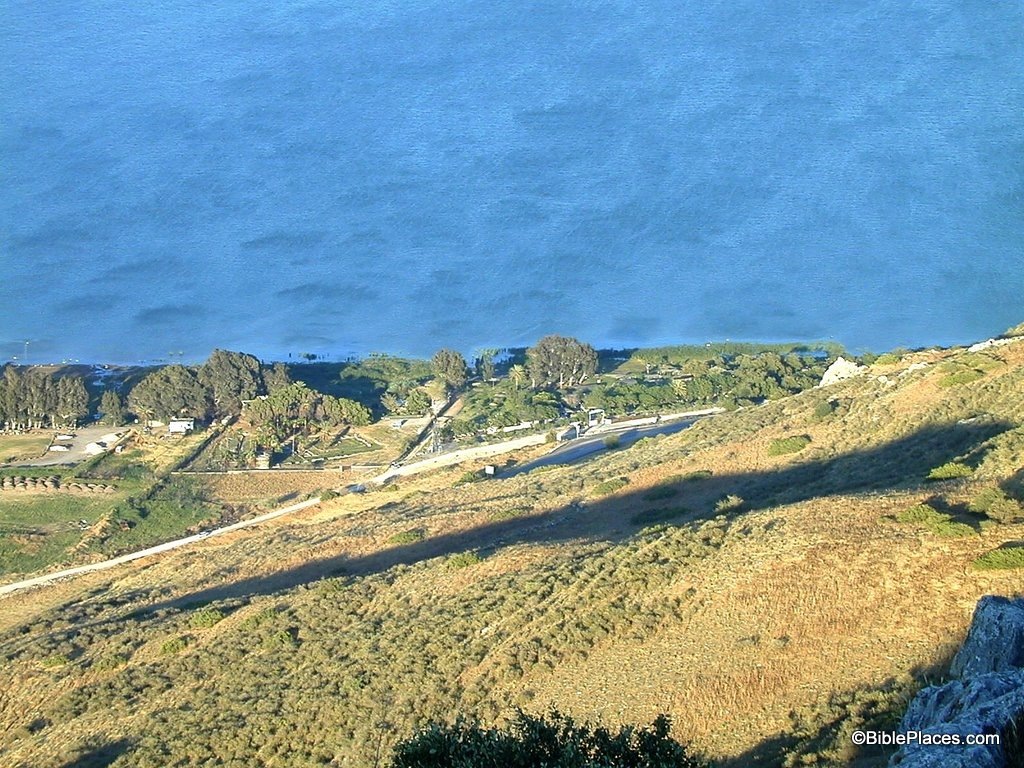
Magdala was the home of Mary Magdalene, one of Jesus’ disciples. That, together with the fact that its location was near the center of Jesus’ ministry (Capernaum, Chorazin, Gennesaret, etc.), makes it quite likely that Jesus visited Magdala. Matthew records that “Jesus went through all the towns and villages, teaching in their synagogues,” and I see no reason that Magdala would be excluded (Matt 9:35; cf. 4:23). Thus it is likely, in my opinion, that Jesus visited this synagogue.
Magdala from above, tb052000203 Magdala from above

This is not the same thing as saying, as they did last year, that “archaeologists have discovered vases of perfumed ointment which may have been used by Mary Magdalene to anoint the feet of Jesus.” 

This is not the first synagogue excavated that Jesus visited. He almost certainly was in (an earlier version) of the Capernaum synagogue, may have been in the Chorazin synagogue (though there is a dating problem), and could have been in the Gamla synagogue. We know of other 1st century synagogues, but it is most unlikely that Jesus visited those at Herodium and Masada, particularly since they were constructed after his death.

The discovery is most significant to me because it puts Magdala “on the map,” so to speak. Before this synagogue was found, visitors would only zip by the site on the highway while a rushed tour guide cried out, “there is Magda…well, too late. It was behind those trees and next to the ferris wheel.” More intrepid explorers could do no better than stand at a fence and look at a few old walls. 

Hopefully these new excavations will give the world a chance to see a portion of this ancient town.

The IAA has three high-res photos you can download (zip file), and the press release begins as follows:

A synagogue from the Second Temple period (50 BCE-100 CE) was exposed in archaeological excavations the Israel Antiquities Authority is conducting at a site slated for the construction of a hotel on Migdal beach, in an area owned by the Ark New Gate Company. In the middle of the synagogue is a stone that is engraved with a seven-branched menorah (candelabrum), the likes of which have never been seen. The excavations were directed by archaeologists Dina Avshalom-Gorni and Arfan Najar of the Israel Antiquities Authority.
The main hall of synagogue is c. 120 square meters in area and its stone benches, which served as seats for the worshippers, were built up against the walls of the hall. Its floor was made of mosaic and its walls were treated with colored plaster (frescos). A square stone, the top and four sides of which are adorned with reliefs, was discovered in the hall. The stone is engraved with a seven-branched menorah set atop a pedestal with a triangular base, which is flanked on either side by an amphora (jars).
According to the excavation director, Dina Avshalom-Gorni of the Israel Antiquities Authority, “We are dealing with an exciting and unique find. This is the first time that a menorah decoration has been discovered from the days when the Second Temple was still standing. This is the first menorah to be discovered in a Jewish context and that dates to the Second Temple period/beginning of the Early Roman period. We can assume that the engraving that appears on the stone, which the Israel Antiquities Authority uncovered, was done by an artist who saw the seven-branched menorah with his own eyes in the Temple in Jerusalem. The synagogue that was uncovered joins just six other synagogues in the world that are known to date to the Second Temple period”.

The full release is here. I don’t know enough yet to comment on the relationship of this newly excavated building to another previously excavated at Magdala which was identified (with controversy) as a synagogue. From the photos and the decoration, there should be little debate as to the function of this building.
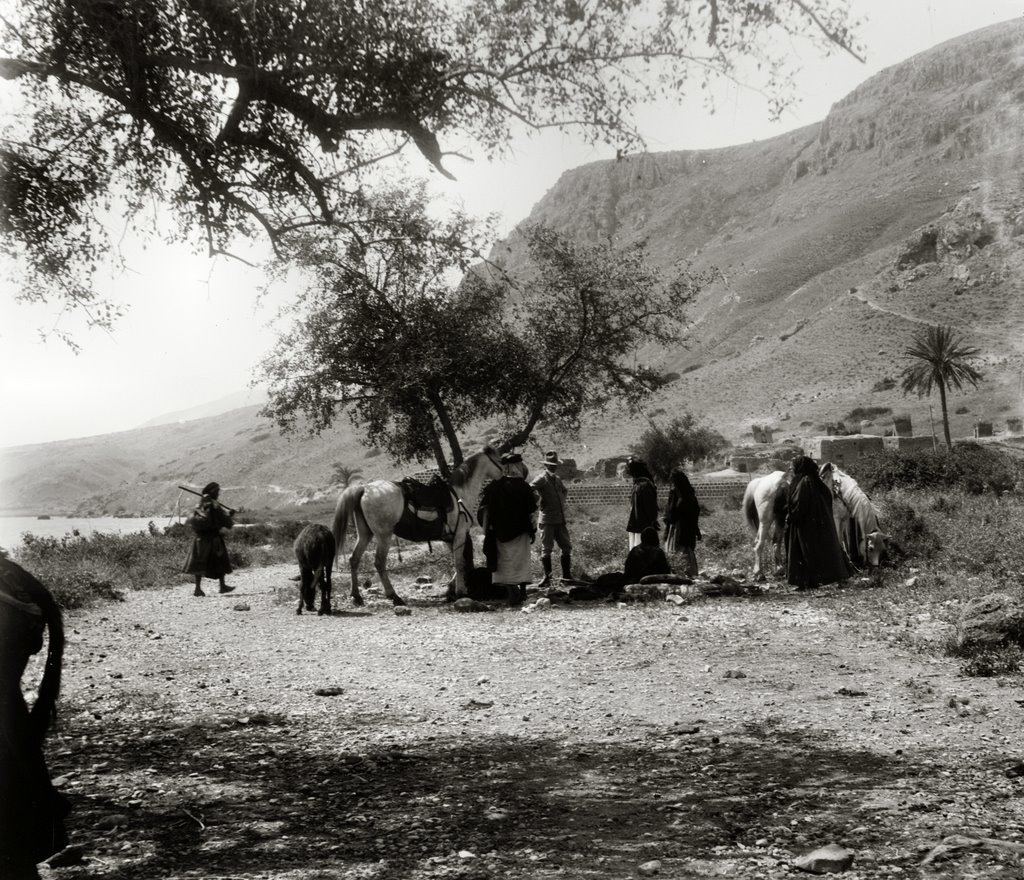
Magdala from north, mat07447 Magdala from the north, early 1900s

This photograph is one of 600 high-resolution images in the newly released Northern Palestine CD, volume 1 of The American Colony and Eric Matson Collection. Photo: Library of Congress, LC-matpc-07447 (but currently misidentified there).

Share:

A press conference by Hebrew University is being reported at GNews, with beautiful photographs of the finds.

The largest cache of rare coins ever found in a scientific excavation from the period of the Bar-Kokhba revolt of the Jews against the Romans has been discovered in a cave by researchers from the Hebrew University of Jerusalem and Bar-Ilan University.
The coins were discovered in three batches in a deep cavern located in a nature reserve in the Judean hills. The treasure includes gold, silver and bronze coins, as well as some pottery and weapons.
The discovery was made in the framework of a comprehensive cave research and mapping project being carried out by Boaz Langford and Prof. Amos Frumkin of the Cave Research Unit in the Department of Geography at the Hebrew University.

The discovery included 120 gold, silver, and bronze coins, many in excellent condition. You can read the rest of the article here. As other news sites prepare stories, you can find them via this Google News link.

As for the “Cave Research Unit,” when word gets out about that, I bet they get lots of applicants!

UPDATE: The story is now covered by the Jerusalem Post, Haaretz, and Arutz-7.

UPDATE (9/16): Joe Lauer notes a link with interviews (mp3) of the archaeologists who discovered the coins.

Share:

A PhD student has discovered a fragment of Codex Sinaiticus under the binding of an 18th-century book. The parchment contains part of Joshua 1:10 and dates to A.D. 350.

Azusa Pacific University has purchased five Dead Sea Scrolls fragments from a book dealer in southern California. “This acquisition will set Azusa Pacific University apart from all other Christian institutions of higher education in the world,” said Paul Gray, vice provost for graduate programs and research and dean of the University Libraries. As an educator, I think this is a publicity stunt which will do little more than give them bragging rights for recruiting. How about this as an idea for setting apart a school and improving education: build an extension campus for your students in Israel.

CNN carries the story of the Middle Bronze passageway discovered in Jerusalem, together with a 2.5 minute video that includes interviews with archaeologists Reich and Shukrun.

A carved stone with Egyptian signs from the First Dynasty has been discovered at Tel Bet Yerah (Khirbet Kerak) on the southwestern shoreline of the Sea of Galilee (photos here).

HT: Joe Lauer and Ferrell Jenkins

UPDATE (9/11): NPR has a 4-minute radio interview of Ronny Reich (with written transcript)

Share:

The discovery of a massive fortified walkway leading to Jerusalem’s Gihon Spring has been announced by archaeologists Ronny Reich and Eli Shukrun. Excavations so far have uncovered a portion of a Middle Bronze wall that is 26 feet (8 m) high and 75 feet (24 m) long. The wall apparently protected a passageway that led from the fortified city of Jerusalem down the eastern slope of the City of David to the Gihon Spring in the Kidron Valley.

The discovery is reported in a press release of the Israel Antiquities Authority and a story in Arutz-7, soon to be followed by all the major news outlets. There are some parts of the story that don’t make sense or are inaccurate.

“This is the most massive wall ever discovered in the City of David,” Reich said. “It is tremendously large in terms of its dimensions, thickness, and size of the rocks used. It appears that they protect a walk-way used to walk down from some tower atop the hill towards the spring.”

That statement is fine, but then Reich is quoted as saying,

This is the first time we have found such massive building in Jerusalem from before the period of King Herod.

But he said the same thing years ago, for his excavations of the Pool and Spring Towers reveal monumental construction from the Middle Bronze Age. Perhaps he means that collectively all of his excavations in the past decade have found such construction “for the first time.”

The new double wall/passageway is apparently related to the Pool and Spring Towers which protected Jerusalem’s water supply at this same period. When discovered, there was a mystery as to whether these were free-standing towers outside of Jerusalem’s wall. My guess is that this new wall “connects the dots” and explains how Jerusalemites accessed these towers without exposing themselves to enemy attack.

Connecting discoveries to biblical figures increases interest, but few people would agree with the article’s assertion that this was the time period of Abraham. The wall dates to 1800-1700 BC, while the biblical chronology puts Abraham’s death closer to 2000 BC.

My favorite quote of the article is a statement I’ve often heard archaeologists make, but which rarely seems to make it into print.

The new discovery shows that the picture regarding Jerusalem’s eastern defenses and the ancient water system in the Middle Bronze Age 2 is still far from clear.

And then this:

Despite the fact that so many have excavated on this hill, there is a very good chance that extremely large and well-preserved architectural elements are still hidden in it and waiting to be uncovered.

The IAA release invites you to see the discoveries in person.

The fortification will be revealed to the public for the first time tomorrow (Thursday, September 3), within the framework of the 10th Annual Archaeological Conference on the discoveries in the City of David. Admission to the conference is free and the public is invited. Unique artifacts from all of the excavations at the site, such as the gold earring that was found in the excavation at the Givati Car Park, will be presented in the conference. In addition, before the conference, visitors can participate in any of 17 different tours that will be guided by scholars there.

Two high-resolution photographs of the wall are available here or here (direct link to zip file).

The official (and beautiful) website of the City of David is here.

Share:

Stonewatch/Arad Academy e.V. has announced the discovery of a proto-Sinaitic inscription in Timna, Israel, about 20 miles north of Eilat.  The press release, via ANE-2:

The engraving, measuring ca. 12 x 16 cm, was found by "Stonewatch / Arad Academy e.V.", an institution based in Germany, that has been conducting surveys of rock art in Timna and worldwide for many years (www.stonewatch.de). Dr. Stefan Jakob Wimmer, an Egyptologist and ANE epigraphist at the University of Munich – who is not related to Stonewatch – is studying the engraving and working on a scholarly publication. He has preliminarily suggested to identify the writing as Proto Sinaitic: "… The right oval shows signs that are identical with characters of the Proto-Sinaitic script, and can in my view quite easily be read as a West Semitic personal name. In the left oval several signs will need more consideration. Some features of the inscription are especially remarkable: The suggested personal name in the right oval ends with the sign of a seated man. The adoption of a personal determinative has to my knowledge not been observed in other PS inscriptions, but is easily conceivable and should by no means contradict the identification of the inscription as PS. The upper character in the left oval could in my view be a variant of the image of the sun with two uraei protruding on either side, reduced to the uraei, and may shed light on a roughly similar sign in the Wadi el-Hol inscriptions. It will have to be examined if the oblong frames were inspired by cartouches. As an alternative one might think of stylised footprints…. The constellation of Egyptians and Semites in the context of mining activities is attested at two places: Serabit el-Khadim/Sinai, where almost all PS inscriptions were found (with the only exception until now of Wadi el-Hol near Luxor), and Timna. … The importance of the discovery of this inscription – if indeed Proto-Sinaitic – is obviously considerable. It is hoped that its common ground with the inscriptions from Serabit el-Khadim, and also Wadi el-Hol, and even more its new, variant features, may substantially contribute to the study of the early alphabet." We can add that the location of the inscription (which will not be disclosed until the necessary measures to protect the engraving from vandalism have been taken) corroborates a connection with the Egyptian copper mining activities at Timna. It is not, however, in close vicinity to the Hathor sanctuary. The possibility of a modern "hoax" can safely be excluded due to clear signs of erosion and the identical colour (patina) of the grooves with the stone surface. For more rock art from Timna including what may be other examples of yet undiciphered inscriptions, go to our free downloads:
http://stonewatch.de/free_downloads/special_cds/index.html (Catalogue of Rock Art in Southern Israel Timna Valley) Josef Otto
Stonewatch / Arad Academy e.V.
www.stonewatch.de

A photograph is available at http://www.stonewatch.de/Daten/Timna-1.jpg

Share:

From Arutz-7:

Excavations in Tel Dor have turned up a rare and unexpected work of Hellenistic art: a precious stone bearing the miniature carved likeness of Alexander the Great. Archaeologists are calling it an important find, indicating the great skill of the artist.
The Tel Dor dig, under the guidance and direction of Dr. Ayelet Gilboa of Haifa University and Dr. Ilan Sharon of Jerusalem’s Hebrew University, has just ended its summer excavation season. For more than 30 years, scientists have been excavating in Tel Dor, identified as the site of the Biblical town of Dor. The town’s location, on Israel’s Mediterranean Sea coast some 30 kilometers south of Haifa, made it an important international port in ancient times.
“Despite the tiny proportions – the length of the gemstone (gemma) is less than a centimeter and its width less than half a centimeter – the artist was able to carve the image of Alexander of Macedon with all of his features,” Dr. Gilboa said. “The king appears as young and energetic, with a sharp chin and straight nose, and with long, curly hair held in a crown.”

The full article is here and includes a small photo.

UPDATE: Joe Lauer sends along direct links to two beautiful photos:

  • Tel Dor, aerial view at the end of the 2009 excavation season
  • The gem of Alexander the Great, photographed using binocolor
Share: