Dr. Claude Mariottini has posted his “Ten Important Archaeological Discoveries in 2008 Related to the Bible.” Since he beat me to it, I think I’ll not try to create my own list, but will give some of my thoughts on these finds. I’ll do that in the next few days. For now, you can read his list and follow the links.
There is something important to this story, but it’s not what you might think. What is exciting is that ancient Magdala is being excavated. Perhaps that will increase our knowledge of this ancient city that was home to Mary Magdalene. Perhaps it will result in the site being opened to visits by tourists. Perhaps there will be silly sensational claims made before analysis is done – oh wait, that wish has already come true. From the Telegraph, written by Nick Pisa in Rome:
Archaeologists have discovered vases of perfumed ointment which may have been used by Mary Magdalene to anoint the feet of Jesus.
This sentence should immediately clue you into the fact that this is a “made-for-TV” story, fashioned for maximum publicity without regard to truth. You know this because:
1. It is quite incredible that of all the vases in the ancient world, the first ones the archaeologists find at this city are related to this biblical event.
2. Mary was from Magdala, but since there is no record that Jesus was ever in Magdala, his feet were not anointed there. Perhaps, though, Mary carried the bottles back to her hometown.
3. Except that it’s hard to believe that Mary only poured some of the contents out and left the rest for archaeologists to find.
4. Most important to ignore in order to make this story fly is the fact that the Bible nowhere says that Mary Magdalene anointed Jesus’ feet. A different Mary anointed him the week before his crucifixion (John 12:1-8). And a sinful woman anointed him at the house of a Pharisee (Luke 7:36-50). She is never named and Mary Magdalene is introduced by Luke two verses later (Luke 8:2) with no indication that this was the same woman. Furthermore, the unnamed woman used an alabaster jar.
Did the excavators find an alabaster jar? Mary Magdalene did plan to anoint Jesus’ body one Sunday morning, but she failed in her attempt (Mark 16:1-8).
The Italian team have been digging for several months at the ancient Palestinian town of Magdala – from where Mary gets her name.
In Mary’s day, Magdala was in the district of Galilee. Today, its ruins are in the state of Israel. It was not then, and is not now, a Palestinian town, except for those who wish to see the Jewish nation replaced by an Arab one.
The archaeologists of the Franciscan academic society Studium Biblicum Franciscanum found the unopened vases dating to the first century AD conserved in mud at the bottom of a swimming pool in Magdala’s thermal complex….
Speaking of the discovery Father Stefano De Luca who is leading the dig, said: “The mud-filled condition of the site allowed us to find these truly extraordinary objects, which were intact and sealed and still contain greasy substances.
“We think these are balms and perfumes and if chemical analysis confirms this, they could be similar to those used by Mary Magdalene in the Gospels to anoint the feet of Christ.
I have a revolutionary idea. Analyze the contents, and then tell us what they are.
“The discovery of these vases is very important. We have in our hands the cosmetic products from the time of Jesus. It’s very likely that the woman who anointed Christ’s feet used these products, or ones similar in organic composition and quality.”
Frankly, this story could have been written long before the excavations. They already knew the site was inhabited in the 1st century A.D. All they needed was to find some vases, any vases, and they could say that these were related to Mary. And the reporters would come, and the donations would flow.
HT: Joe Lauer
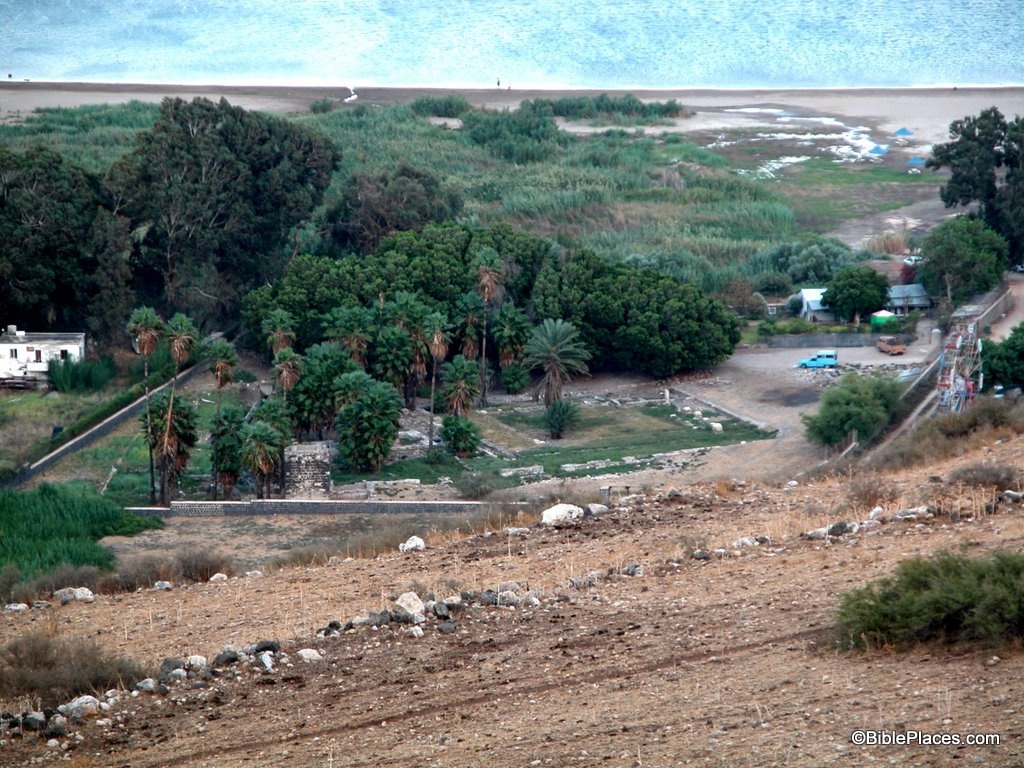 Magdala from west
UPDATE (12/12): An article in Italian is longer and includes a photograph.
In advance of the upcoming National Geographic special on Herod’s tomb, as well as the cover story of the same on the December issue of NG, archaeologist Ehud Netzer held a press conference today announcing the most recent discoveries. You can read the Hebrew University press release (with photos) and articles in Arutz-7, Haaretz, and National Geographic. Below are selected portions of the articles.
Summary
The findings include coffins of Herod’s family, a theater with a VIP room, and two coffins containing the remains of most likely Herod’s wife and the wife of Archelaus, Herod’s son. The new findings further support the idea that the grave discovered last year belongs to Herod the Great. (Arutz-7)
Netzer described the winter palace, built on a largely man-made hill 680 meters high, as a kind of country club, with a pool, baths, gardens fed by pools and aqueducts and a 650-seat theater. (Haaretz)
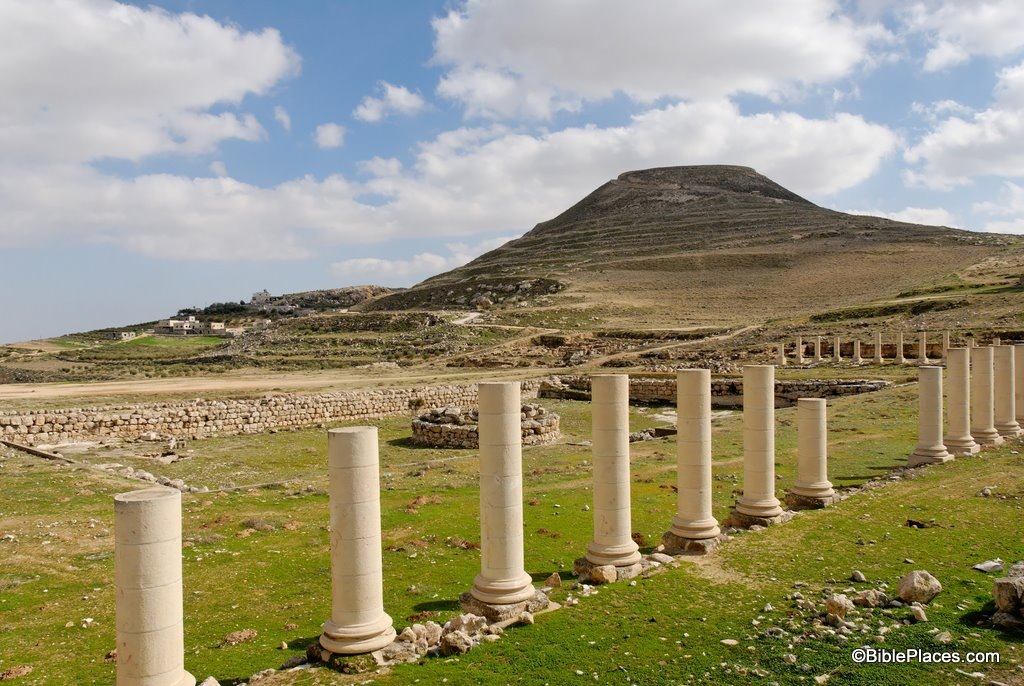
Herodium with lower pool
Theater
A theater that could hold an audience of 750 was discovered not far from the mausoleum. In front of the seating area is a large room for VIPs, from which the king and his close friends would watch the shows. (Arutz-7)
“In Herod’s private box at the auditorium, the diggers discovered delicate frescoes depicting windows opening on to painted landscapes, one of which showed what appeared to be a southern Italian farm,” said Roi Porat, one of Netzer’s assistants on the digs. Just visible in the paintings, dating from between 15-10 B.C., are a dog, bushes and what looks like a country villa. (Haaretz)
“Normally in Judean art you wouldn’t paint scenes such as these with animals. The style is so similar to what is known from Italy, it really looks like a team came over to do the painting,” said Rachel Chachy-Laureys, a surveyor working with Nezter. “It fits the context.” (National Geographic)
The theater, its two side rooms and VIP section, were intentionally destroyed when Herod constructed the cone-shaped artificial mountain, which enclosed the round structure that stood at the top of the hill. (Arutz-7)
Tomb
“What we found here, spread all around, are architectural fragments that enable us to restore a monument of 25 meters high, 75 feet high, very elegant, which fits Herod’s taste and status,” [Netzer] told The Associated Press. (Haaretz)
In the excavation that took place this year in the area of the mausoleum, the remains of two white-colored tombs were found, most likely belonging to Herod’s family. The bright red and elegant coffin of Herod, which was displayed last year, is now completely restored, along with a large tomb. Prof. Netzer ascertains that the red coffin is the burial coffin of Herod. In contrast to the white coffins, the red coffin was shattered into hundreds of pieces, and spread throughout the mausoleum area. Prof. Netzer estimates that Malthace the Samaritan was buried in the larger of the two white burial coffins. (Arutz-7)
One big question remains: Where is Herod’s body? “We have only found a very small number of human bones at the site and have not been able to come to any conclusions,” Netzer said. “We have not yet finished digging and have only uncovered a small area.” But he does not believe the king’s remains will ever be recovered. (National Geographic)
Previous discussion and photos of Herod’s tomb can be found here.