From today’s Jerusalem Post:

The remains of an ancient terraced street dating back to the Roman Period have been uncovered in the Western Wall tunnels, the Israel Antiquities Authority announced Wednesday.

The street, which likely led to the nearby Temple Mount, dates back nearly 2,000 years to when the city was called Aelia Capitolina, during the second to fourth centuries.

The site, which was uncovered in archeological excavations over the past year, is a side street connecting two major roads in the area, said Jon Seligman, the Antiquities Authority Jerusalem regional archeologist.

The ancient street is paved with large flagstones and is amazingly well-preserved. It is demarcated on both sides by walls built of ashlar stones.

The recent finding is the latest indication that even after they destroyed the Second Temple in 70 CE, the Romans continued to value the Temple Mount as one of the main urban focal points of activity in the city.

Various artifacts were discovered in the excavations, including pottery, glass vessels and dozens of coins that all date to the construction of the street and the period after it was abandoned.

Update (11/16): Link above updated. Reuters also has the story with photos.

Share:

A few weeks ago I reported on a discovery of Persian period material in the City of David. In a presentation at an archaeological conference in Israel yesterday, Eilat Mazar gave more details about the discovery. The mainstream press hasn’t yet picked up the story, but it is reported on the web at theTrumpet.com (HT: Joe Lauer). A few excerpts in italics, with my commentary:


Yesterday, at an archaeological conference at Bar Ilan University near Tel Aviv, Dr. Eilat Mazar told 500 attendees that she had discovered Nehemiah’s wall.

This conference was the 13th Annual Conference of the Ingeborg Rennert Center for Jerusalem Studies on “New Studies on Jerusalem.” One of the lectures scheduled later that day was by Israel Finkelstein: Jerusalem in the Persian Period and the Wall of Nehemiah. No report of that talk is given in this article.


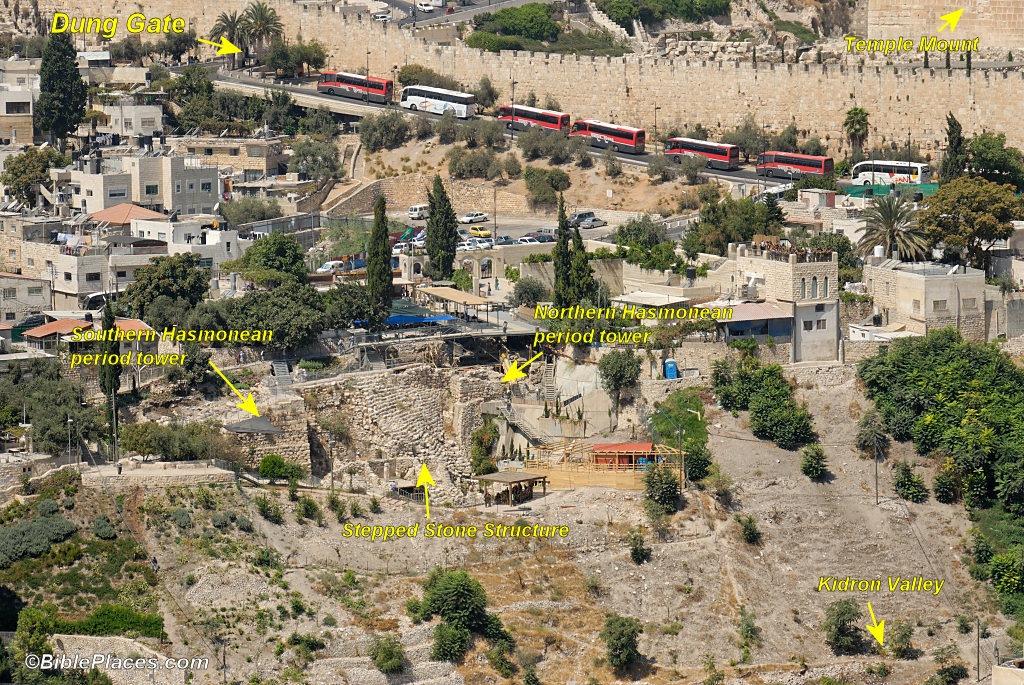
Adjacent to the palace wall stood a large stone tower archaeologists believed to be built during the Hasmonean dynasty (142-37 b.c.). Early last summer, a section of that tower, which was built on a steep slope just outside the palace, began to give way, indicating it was on the verge of collapse. And so what started as a simple task of repairing a collapsing tower turned into a six-week dig—and a fascinating new discovery.

There are two towers that could fit this description. My guess is it is the northernmost of the two, because

1) the excavation had been working in close proximity to this for the last couple of years, including workers standing on top of it for debris removal and

2) previous excavators had suggested that the base of this tower was originally built in the Persian period. I’ve taught for years that if there’s any evidence in Jerusalem that has been found of Nehemiah’s wall, it’s here. What’s new, then, is the additional evidence to support this contention.
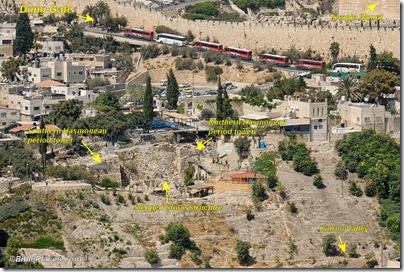
City of David Area G from southeast, tb091306302labeled


“Under the tower,” Dr. Mazar said at the conference, “we found the bones of two large dogs—and under those bones a rich assemblage of pottery and finds from the Persian period [6th to 5th centuries b.c.]. No later finds from that period were found under the tower.” The pottery is what clearly dates the time period for the tower’s construction. Had the tower been built during the 2nd or 1st century b.c., Dr. Mazar explained, 6th-century pottery underneath the wall would leave a chronological gap of several hundred years. Therefore we know, based on the pottery dating, that the tower would have been built three to four centuries earlier than previously thought, during the Persian Empire’s heyday, which is precisely when the Bible says Nehemiah rebuilt the wall around Jerusalem.

According to biblical chronology, Nehemiah returned to build the walls of Jerusalem in about 445 B.C., which is the middle of the 5th century. Thus the dating of this wall would correspond with the biblical record of Nehemiah’s wall. Furthermore, it is logical that that the Hasmoneans built their wall (the “First Wall”) above the remains of Nehemiah’s wall. The dog burials are interesting because 800 of such were found in a Persian period level at Ashkelon. The article does not mention the seal impression (bulla) with “a beautiful 5th century B.C. inscription” mentioned here previously.


Many of the landmarks described in Nehemiah’s book can now be clearly identified today thanks in large part to the work of Eilat Mazar.

False on two counts. Most of the landmarks of Nehemiah’s book are not identifiable today (for understandable reasons). And Mazar has excavated very little from the Persian period. Mazar would not make this claim for herself.


For the rest of the morning, Dr. Mazar’s colleagues spoke one after another, each of them picking apart her findings, some even rejecting her conclusions. But the entire morning session of perhaps the most important archaeological conference of the year in Israel was devoted to Eilat Mazar’s work—not her theories, her work.

This is what makes the archaeological discipline so much better than it was 100 years ago, when one archaeologist could make a claim and that was the end of the matter.


And that’s just the way she likes it. As she has said before, in the end, the stones will speak for themselves.

Rubbish. Stones do not speak for themselves. Archaeology is large part interpretation, which makes it as much of an art as a science.

UPDATE (11/12): Yitzhak Sapir was at the conference and would have written an entirely different article.
Share:

I don’t think this recently discovered alphabetic inscription has received coverage in the popular press like it deserves.  From the Pittsburgh Post-Gazette:

Ron Tappy became a committed Christian in his mid-20s, after deciding to read the Bible straight through.
When he did, “the Old Testament just floored me, and the history of Israel became my history, and I became a Christian in that process. To this day, I have an abiding respect for the texts of Scripture,” he said.
It seems fitting, then, that Dr. Tappy’s most famous discovery as a biblical archaeologist is a 38-pound limestone rock inscribed with a 2,900-year-old alphabet.
The stone was found two years ago at Tel Zayit in Israel, a dig about 25 miles southwest of Jerusalem. Using distinctive pottery and carbon dating of the soil levels above it, the stone was firmly traced to the 10th century B.C., the time when the biblical King Solomon was supposed to have lived.
The discovery was described by some experts as the most important find in biblical archaeology in the last 10 years.
One reason for the buzz was that the stone suggests the earliest Hebrew Scriptures could have been written down in that era — hundreds of years earlier than many scholars had believed.
For Dr. Tappy, the alphabet stone also suggests not only that King Solomon was a real historical figure, but that he did in fact have a growing kingdom at the time, because Tel Zayit sits on the border of Solomon’s Judah and the kingdom of Philistia, where the Philistines lived.

The story continues here.  The excavation’s website is here, but has not been updated recently. 

Photographs of the inscription appear to be more sacred than the ark rare but here’s one with Tappy and another showing a few of the letters.

UPDATE: Offline there is a lot of information and photographs in this article:

Tappy, Ron E., P. Kyle McCarter, Marilyn J. Lundberg, Bruce Zuckerman (2006). “An Abecedary of the Mid-Tenth Century B.C.E. from the Judaean Shephelah”. BASOR 344 (November): 5-46.

Share:

I was talking with a scholar the other day about the general lack of archaeological material in Israel from the Persian period (530-330 B.C.).  This is especially true for the city of Jerusalem.  Then today I learned this from a reliable source:

Just yesterday, Eilat Mazar found a Persian period layer with much pottery and bullae, mostly fragments, but one with a beautiful 5th century B.C. inscription from the Persian Period.

Mazar is excavating in the City of David, above Shiloh’s Area G, on the summit of the hill in an area where she believes she is excavating the palace of David.  When I know more, or when this is reported in the media, I’ll mention it here.

Share:

A remarkable discovery of undisturbed archaeological material from the Temple Mount and dating to the Old Testament period was announced yesterday by the Israel Antiquities Authority.  This is remarkable for a few reasons:

By all appearances, there was little apparent archaeological supervision of the Muslim digging of a trench on the Temple Mount last month.  That’s why lots of people were screaming.  It’s not that digging itself is bad, but digging without proper archaeological procedure is simply destruction.

Undisturbed layers from the First Temple period (1000-586 B.C.) are not often found anywhere in Jerusalem.  This is because of later building activities and because of current inhabitation of the city.

No undisturbed layers from any period have been excavated on the Temple Mount, ever.  This is owing to Muslim control of the site and their prohibitions against archaeological excavation.  This dates back to the earliest “archaeologists” in Jerusalem, including Charles Warren in the 1860s.

It has been expected that the construction of the present Temple Mount by King Herod in the 1st
century B.C. was so extensive and destructive that little would remain (in stratified contexts) from the previous eras.  The present discovery does not seem to constitute significant material in and of itself, but it certainly gives hope that more could be recovered should excavations be permitted.  Similar discoveries from this time period have been made by Gabriel Barkay in his Temple Mount Sifting Project, but they were not from a stratified context as this was.

Enough of the significance of the discovery, here are some details:


Items discovered: ceramic table wares, animal bones, olive pits, bowls, juglet base, storage jar rim. 


Date of items: 8th-6th century (roughly the times of Hezekiah to Josiah)


Location of discovery: southeastern corner of raised platform on Temple Mount


Archaeologist in charge: Yuval Baruch, Jerusalem District Archaeologist


Consulting archaeologists: Sy Gitin, Director of the W. F. Albright Institute of Archaeological
Research in Jerusalem, Israel Finkelstein of Tel Aviv University and Ronny Reich of Haifa University


The key statement making this an important discovery: “The layer is a closed, sealed archaeological layer that has been undisturbed since the 8th century B.C.”, Jon Seligman, Jerusalem regional archaeologist.


The skeptic: Eilat Mazar, “I think it is a smoke screen for the ruining of antiquities.”


The future: examination of the discoveries in a future seminar to be organized by the Israel Antiquities Authority


More information: Israel Ministry of Foreign Affairs (with photos), Israel National News (with wrong dates), Haaretz, Jerusalem Post, Maariv (more detailed article in Hebrew)

Share:

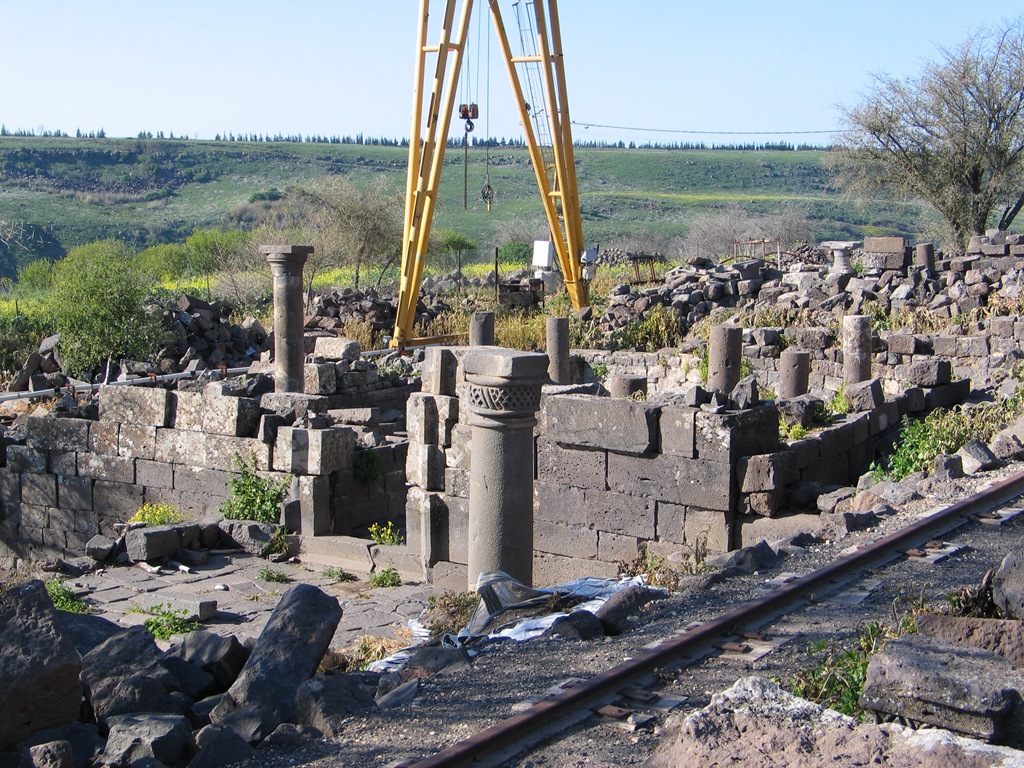
Scientists have just released a report on a massive earthquake in 749 A.D. in Israel.  The Jerusalem Post article is misleading in suggesting that they just now learned about this particular earthquake, as any visitor to Beth Shean will attest when viewing the fallen columns.  But some more information has been learned based on excavations at Umm el-Kanater in the Golan Heights.

The discovery by Tel Aviv University scientists that a major earthquake (over 7 on the Richter scale) took place on the Golan Heights in the year 749 CE – and none of similar magnitude in some 975 years – means the area is long overdue for another one. So say the TAU geologists and archeologists who published their findings in Seismology Research Letters released to the press on Sunday.
The archeological signs of the earthquake were found at Umm el-Kanater (“Mother of the Arches”), a five- or 10-minute drive from Katzrin and near Moshav Natur east of the Kinneret. The damage consisted of a broken pool of water whose two parts were moved a meter from one another. The pools had been used to collect water for a nearby village inhabited from the Byzantine Period until the middle of the eighth century. The dig site has been open to the public for more than three years.
The village suffered destruction, including damage to an elaborately built synagogue that collapsed and whose stones were fortunately not stolen, unlike those of many other archeological sites on the Golan.

You can read the rest at the Jerusalem Post.

The reference to 975 years is enigmatic.  It probably is a reference to an earthquake in 1724 A.D., but why that means Israel is due for another one at this time is not clear.

Umm Kanatir, db031007598
Umm el-KanatirPhoto courtesy of David Bivin (March 2007)
Share: