The big story of the week was the announcement of the discovery in Jerusalem of a large administrative complex that dates to the time of Kings Hezekiah and Manasseh. The site is located about 2 miles south of the Old City, and finds included more than 120 LMLK jar handles. There are more photos here, and a video with drone footage here. A 5-minute news story includes an interview with the archaeologist.

While most excavations in Israel are cancelled this summer, Tel Azekah’s dig begins today with 45 students expected to participate.

A new outdoor archaeological exhibit has been created in the Jewish Quarter of Jerusalem’s Old City, featuring 180 items previously scattered around the area.

A fifth century baptismal font that was stolen from its original site by antiquity looters has been located and returned” to Tel Tekoa. Palestinian authorities accuse Israel of stealing the item from Bethlehem.

John DeLancey’s latest teaching video focuses on Beth Shean.

Carl Rasmussen posts a couple of photos of the Intermediate Bronze tombs at Deir Mirzbaneh.

Le Destroit is apparently a Crusader fortress near Atlit. I’m guessing you missed it on your tour of Israel. The tour continues to a sunken vessel and to Tel Dor.

Joel Kramer has announced an Israel Study Tour for March 2021.

Bryan Windle identifies the Top Three Reports in Biblical Archaeology for July.

Magen Broshi died on July 14. Broshi was an archaeologist for the Israel Department of Antiquities and Museums as well as Curator of the Shrine of the Book, Israel Museum.

HT: Joseph Lauer, Agade, Ted Weis, Mark Hoffman
**When we updated our blog design earlier this month, we accidentally broke the system that sends posts out by email. With that now fixed, we are re-posting the recent roundups, one part each day through Friday.**

The digs may have stopped, but the stories have not. With no roundups the last two weeks, I have more than 60 items of interest to share in the coming days.

A seal and a seal impression found in Jerusalem are rare discoveries from the Persian period.

“A Second Temple period Jewish ritual bath was discovered by chance last month in the Lower Galilee and a group of locals are trying to save it from its current destiny of destruction.” There’s a video report here.

“A new study carried out on pottery items uncovered in the Tomb of the Patriarchs in Hebron suggests the cave . . . was used and visited as a pilgrimage site during the First Temple Period.”

A new study suggests that many cisterns in the Negev may date back not to the Iron Age but to the Bronze Age. (Journal article for purchase here.)

The cancelled archaeology department at Southwestern Baptist Theological Seminary has found a new home at Lipscomb University in Nashville.

Steven Ortiz, formerly of SWBTS, is interviewed by Bryan Windle in the latest in the Discussions with the Diggers series.

Mark Lanier, who helped bring the SWBTS program to Lipscomb, is interviewed on The Book and the Spade.

Moshe Garsiel has proposed a new theory to support the location of Tell es-Sharia as biblical Ziklag.

Aren Maeir visited the excavations at Tel Hadid, which along with Tell Abu Shusha and Tel Azekah, is one of the few excavations in Israel that were not cancelled this summer.

A study claims that buses and shuttles are a better solution than the planned Old City cable car project.

A couple of officials of the City of David organization give a 40-minute tour of the Siloam Pool and the Pilgrimage Road to the Temple Mount.

Biblical Israel Ministries and Tours is hosting a “Top 10 Israel Photos” contest and offering prizes.

Accordance is offering a number of its graphics collections at big discounts, including:

  • Bible Lands PhotoGuide (all 6): $74.90
  • Pictorial Library of Bible Lands: Cultural Images of the Holy Land: $24.90
  • Pictorial Library of Bible Lands: Trees, Plants, and Flowers of the Holy Land: $24.90
  • Historic Views of the Holy Land: Views That Have Vanished: $24.90
  • Historic Views of the Holy Land: American Colony Collection: $89.90
  • Virtual Tour to the Temple: $39.90
  • The Virtual Bible (Enhanced): 3D Reconstructions of the Biblical World: $19.90
  • The Add-On Bundles include many resources at very good prices ($59; $119).

HT: Agade, Joseph Lauer, Alexander Schick, Ted Weis, Charles Savelle, Jared Clark, Explorator

A scholarly study uses radiocarbon dating to determine that “Wilson’s Arch was initiated by Herod the Great and enlarged during the Roman Procurators, such as Pontius Pilatus, in a range of 70 years, rather than 700 years, as previously discussed by scholars. The theater-like structure is dated to the days of Emperor Hadrian and left unfinished before 132–136 AD.”

A 1,800-year-old fountainhead in the shape of a face was uncovered by chance by a visitor at the Tzipori [Sepphoris] National Park in the Galilee.”

Rami Arav discusses his excavations at et-Tell and a newly discovered moon god stele (Haaretz premium).

Excavations will not be possible at el-Araj (Bethsaida?) this summer because of the high water level. The article includes many photos.

NPR has a story on the Israeli and Jordanian sides of the tourist site for Jesus’s baptism, including a discussion of creating a new “soft crossing” to allow tourists to enter Jordan from the Israeli side.

A new study of the DNA of 35 fragments from the Dead Sea Scrolls is providing insight into the diverse origins of the parchments.

Mark Vitalis Hoffman has published an interesting article on “Jesus and Jerusalem and the ‘Things That Make for Peace.” He has also created a video to supplement the article.

Gabriel Barkay is on The Book and the Spade this week talking about the archaeology of Jerusalem’s Temple Mount.

Israel’s Good Name had a productive trip scouting out the birds and fish at the Beit Zayit Reservoir west of Jerusalem.

A Jerusalem Post piece looks at the resumption of tourism in Israel and the safety measures being put in place.

From boom to bust: with tourism in Israel all but gone, tour guides are considering their options.

The Winter 2019 issue of the ACOR Newsletter is now available (high-res; low-res).

The Bible and Interpretation provides a selection about ancient Moab and the Mesha Stele from the new book by Burton MacDonald.

Gulf News has a write-up on artifacts from Saudi Arabia that are featured in the traveling “Roads of Arabia” exhibit.

Smithsonian magazine has a long, well-illustrated piece on archaeological work in and around Aigai, Philip II’s capital of Macedon. A massive new museum is scheduled to open in January.

The latest historical city travel guide by the British Museum is of Athens in the 5th century BC.

Some stories on re-opening: excavations in Turkey, Vatican Museums, Rome’s Colosseum, Pompeii, Al Ula, Israel’s museums, the Temple Mount.

Two Asian lion cubs were recently born at the Jerusalem Biblical Zoo.

HT: Joseph Lauer, Chris McKinny, Agade, Keith Keyser, Steven Anderson, Charles Savelle, Explorator

“A six year old hiking with his family [at Tel Jemmah] . . . discovered a one-of-a-kind, 3,500-year-old depiction of a naked, humiliated Canaanite prisoner and his victorious warden.”

A new study of organic material on the Iron Age altars from the shrine at Arad indicates that frankincense and cannabis were burned on them in ancient times.

A well-preserved Roman mosaic floor from the 3rd century AD has been discovered in a vineyard in northern Italy.

Archaeologists have discovered a well-preserved 3rd century AD Roman ship in Serbia.

A recent review of Egyptian antiquities in Scotland has identified more than 14,000 objects.

The latest post on the ASOR Blog is about the Egyptians’ views of foreigners.

A Jewish leader in Tehran denies that a traditional tomb of Esther and Mordecai was set on fire. The article in a regime-approved newspaper includes other interesting background about the shrine.

Mark Wilson reflects on Paul’s imprisonments in light of his current confinement in Turkey.

A Times of Israel article describes two new documentaries on the Church of the Holy Sepulcher. In one, a priest explains how the “holy fire” is lit with a lighter.

“Following an extreme and unusually long heatwave last week, Israel on Sunday was hit by showers and unseasonably cold temperatures.”

Museums reopening in Italy will use “chaperones” and vibrating necklaces to ensure people don’t get too close to each other.

Now on pre-pub for Logos: A Christian’s Guide to Evidence for the Bible: 101 Proofs from History and Archaeology, by J. Daniel Hays ($19).

Ferrell Jenkins dug up a great photo to illustrate Isaiah 1:18.

HT: Agade, Ted Weis, Arne Halbakken, Keith Keyser, Explorator

“A singular two-millennia-old subterranean system of three rooms has been uncovered near the Western Wall. The three-room complex — painstakingly chiseled by hand out of bedrock prior to the fall of Jerusalem in 70 CE — is the first evidence of everyday life gone underground in the ancient city.” There’s a nice 3-minute video in English here.

An intact terracotta sarcophagus dating from the second century AD has been unearthed alongside the archaeological site of Ostia Antica” near Rome.

Researchers have found that early Iron Age Nubia utilized bitumen from the Dead Sea in funeral preparations.

An incredible, undisturbed tomb probably dating back to the Punic period has been found in Tarxien” on the island of Malta.

Eberhard Zangger and Rita Gautschy argue that a monumental depiction of the Hittite pantheon in the rock sanctuary of Yazılıkaya near Hattusha actually served as an ancient calendar based on celestial events.

A study of a trash pit in Beth-Yerah/Philoteria provides insights into the diet of the inhabitants in the 2nd century BC.

The founders of Hobby Lobby are suing Christie’s auction house for selling it a stolen copy of the Gilgamesh Dream Tablet.

Some of the lectures from the Bar Ilan archaeology series have been recorded and are available online.

HT: Agade, Keith Keyser, Arne Halbakken

For only the 4th time, a Bar Kochba coin has been found in Jerusalem, possibly brought there by a Roman soldier. This article has nice photos, and this article has a short video.

The Jerusalem Post surveys how archaeology in Israel has been affected by governmental actions in response to COVID-19.

El-Araj, a good candidate for Bethsaida, has been flooded by this winter’s rains and the rise of the Sea of Galilee.

Critics are claiming that construction by the Palestinian Authority is destroying remains at Tel Aroma, the northernmost Hasmonean fortress in Samaria.

“Exploratory drilling has started just outside the Old City for a project to extend the Tel Aviv-Jerusalem fast rail to the Old City’s Dung Gate — the main entrance to the Western Wall.”

The Greek Orthodox Church of Jerusalem has filed a lawsuit demanding closure of Ein Yael outdoor museum.

Four fragments of Dead Sea Scroll fragments that were thought to be blank are not.

A new excavation at Petra will focus on the lower part of the Treasury as well as nearby tombs and facades.

A new burial chamber has been discovered at the mummification workshop complex of the 26th Dynasty at Saqqara.”

“A stone chest excavated by archaeologists near Deir el-Bahari and the temple of Hatshepsut could lead archaeologists . . . to a royal tomb.”

Egypt’s decision to move ancient objects from their original setting in Luxor to Cairo’s Tahrir Square is stirring controversy.

“The excavation team working on the site of the ancient city of Patara, near the Mediterranean resort city of Antalya, has unearthed a new inscription in the ancient theater.”

“A small sinkhole that appeared next to the Pantheon in Rome has enabled archaeologists to examine the original Roman paving that was laid when the Pantheon was built by Marcus Agrippa around 27-25 BC.”

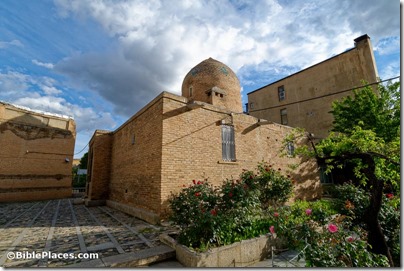
The traditional tomb of Esther and Mordechai in Hamadan, Iran, was set afire yesterday.

David Moster has created a new video on “Biblical Pandemics.”

The Temple Mount Sifting Project Symposium on May 24 features eight lectures via Zoom on the archaeology of Jerusalem and the Temple Mount. Registration is required.

Francis I. Andersen died recently. His breadth of publications is remarkable.

Thomas O. Lambdin died on May 8.

HT: Agade, Ted Weis, Joseph Lauer, Explorator, BibleX

Ecbatana tomb of Esther and Mordecai, tb0510183126

Traditional tomb of Esther and Mordecai in Hamadan (biblical Ecbatana) before attack