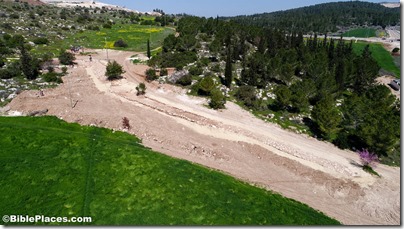
Archaeologists have discovered the Roman theater at the site of Hippos.

Excavations of the Crusader-era Montfort Castle in Galilee have discovered game pieces, belt buckles, pig bones, and much more.

Analysis of organic remains from a 10th B.C. gatehouse complex in the Timna Valley suggests that food and supplies were brought in from a long distance.

Engravings of an ancient menorah and cross were found inside a cave in the Judean Shephelah.

A gang of antiquities thieves was caught illegally digging at a site near the Golani Junction in the Galilee. A 3-minute video (in Hebrew) is online.

What are the origins of tomb raider curses?

Three scientists from Beersheba’s Ben Gurion University have used NASA data to date the “sun standing still” to an eclipse in 1207 BC.

A life-size CAVEkiosk (“cave automated virtual environment”) recently opened at UCSD will allow scholars to study 3-D data from at-risk sites.

The Israel Museum has announced that Eran Neuman will succeed James S. Snyder as director.

Wayne Stiles explains why God made the Israelites rest the land every seven years and what that means today.

Colin Hemer’s The Book of Acts in the Setting of Hellenistic History is available in Logos this month for $1.99.

HT: Agade, Joseph Lauer, Ted Weis

A stone bowl inscribed with the name “Hyrcanus” was discovered in the City of David. Since the name was common in the Hasmonean period, it is not clear if it belonged to one of the two rulers with this name. High-res images are available here.

A bronze coin with the image of Antiochus Epiphanes was discovered during maintenance work in the Citadel of David Museum in Jerusalem.

Mary Shepperson, a free-lance archaeologist working on five projects in Iraq, describes work in the new excavations of Charax Spasinou.

Archaeologists have discovered a large “lost city” about 150 miles north of Athens.

The Center for Ancient Middle Eastern Landscapes (CAMEL Lab) at the Oriental Institute of the
University of Chicago would like to announce that a substantial subset of its digital holdings of maps and geospatial data are now available for online public search and download.”

The Temple Mount Sifting Project is asking readers to Name That Find!

The IAA has completed a detailed survey of the village of Lifta ahead of its planned replacement by a new neighborhood.

Before and after photos reveals the significant war damage in the Syrian city of Aleppo.

Ferrell Jenkins recounts his 2002 visit to Aleppo and its museum.

New research suggests some ancient Egyptians believed a deceased woman had to briefly become male in the afterlife in order to be reborn. Reader Ted Weis notes that this theory corresponds with saying #114 in the Gospel of Thomas.

Egypt is trying to stop the auctioning of Egyptian relics around the world.

A stolen relief of Queen Hatshepsut has been restored to Egypt.

Bricks of ancient Babylon have been used in rebuilding houses in the area.

The Tower identifies “seven fascinating discoveries Israeli archaeologists made in 2016.”
Kudos to Dr. Chris McKinny!

Carl Rasmussen describes an “unknown” Christmas site near Bethlehem.

We wish all of our readers a Merry Christmas and Happy Hanukkah! We’ll be traveling for several weeks and roundups will return when we do.

HT: Joseph Lauer, Agade, Charles Savelle, Ted Weis

Haaretz reports on the discovery of new fragments of Dead Sea Scrolls.

New fragments of the Dead Sea Scrolls have been found in the Cave of the Skulls by the Dead Sea in Israel, in a salvation excavation by Israeli authorities. The pieces are small and the writing on them is too faded to make out without advanced analysis. At this stage the archaeologists aren’t even sure if they’re written in ancient Hebrew, Aramaic or another language. “The most important thing that can come out of these fragments is if we can connect them with other documents that were looted from the Judean Desert, and that have no known provenance," says Dr. Uri Davidovich of the Hebrew University of Jerusalem, among the scientists investigating the caves. […] The latest finds, two papyri fragments about two by two centimeters with writing and several fragments without discernible letters, were made during a three-week salvage excavation in the Cave of the Skulls this May and June by a joint expedition of the Israel Antiquities Authority and the Hebrew University of Jerusalem. The excavations were led by Uri Davidovich and Roi Porat of the Hebrew University, together with Amir Ganor and Eitan Klein from the IAA.

Read the full story here.

A winepress from the 1st century BC has been discovered in Ashkelon.

A gang of antiquities thieves were caught in the act of plundering ancient tombs in Galilee.

Heritage Daily lists the top 10 archaeological discoveries of 2016, including the ancient shipwreck found at Caesarea.

The January/February 2017 issue of Biblical Archaeology Review includes stories on Khirbet Qeiyafa and the Pool of Siloam.

Wayne Stiles’s post on Bethlehem includes lots of photographs.

SourceFlix has released a new video short entitled “Born in Bethlehem.”

Ferrell Jenkins has created an index of his numerous articles related to Bethlehem.


National Geographic History: “How King Herod Transformed the Holy Land

Israel’s supreme court is hearing a petition to identify the Western Wall Tunnels not only as a holy site for Jews but also for Muslims and Christians.

A staff member explain why the Temple Mount Sifting Project is so important and you should consider supporting it.

HT: Joseph Lauer, Agade, Charles Savelle, Paleojudaica

A tomb with a number of well-preserved frescoes from the Hellenistic or Early Roman periods has been discovered in northern Jordan.

A dozen sculptures recently unearthed at Perga are now on display in the Antalya Museum.

The BBC runs an interesting story on the Muslim families that lock and unlock the Church of the Holy Sepulcher each day.

“A crew of facial reconstruction experts have successfully recreated the face of a male who lived in the Biblical city of Jericho.”

Scanning technology has provided 3-D images of unwrapped mummies from ancient Egypt.

A pair of mummified knees are most likely those of the famously beautiful spouse of Pharaoh Ramses II.”

James Davila considers the reemergence of the Jordanian lead codices and links to an insider perspective.

Archaeologists working in the Wadi Feinan region of Jordan believe that they have found evidence of the world’s first polluted river.

The breed known as “Jacob’s sheep” have returned to Israel.

The Jerusalem Post runs a story on Douglas Petrovich’s theory that the earliest alphabet was Hebrew.

The US and Egypt have come to an agreement regarding the importing of looted archaeological artifacts.
Recent damage to the ancient site of Mari is discussed by archaeologist Pascal Butterlin in a short video (in French).

Relics looted from Syria’s ancient city of Palmyra have been recovered in Switzerland.

“Radiocarbon dating remains a reliable tool if it is supplemented by 13C measurements.”

“Why would the Lord first announce the Messiah’s birth to lowly shepherds?” Wayne Stiles explains.

In light of the recent excavation of the Church of the Holy Sepulcher, Gordon Govier at Christianity Today explains why there are two competing sites for the place of Jesus’s burial.

The late Charles Ryrie’s Bible collection has been sold to various collectors for more than $7 million. 
Daniel Wallace was one of the bidders and he provides more details. I wonder how many of the 
purchases will show up in the Museum of the Bible.
The Westminister Bookstore has a big sale on the ESV Bible Atlas, described by them as “‘National Geographic’ meets world class Biblical Scholarship.” You can look inside here.

HT: Charles Savelle, Explorator, Ted Weis, Agade, Joseph Lauer

Archaeologists have finally discovered the port of ancient Byblos.

Philippe Bohstrom looks at the history of the city of Dan and the tribe of the Danites in a well-illustrated Haaretz article.

Wayne Stiles beat me to the new Virtual Reality tour at the Western Wall in Jerusalem and I asked him to write about it. He did.

Albawaba has a short slide show of the pre-Islamic Middle East.

New tests on the (probably fake) lead codices from Jordan suggest that the lead is ancient.

The Jewish Virtual Library posts a list of significant archaeological discoveries in Israel from 2004 to present. The list seems to be more complete for the last two years than for earlier ones.

Leon Mauldin visited the largely ignored site of Tirzah on his recent trip to Israel.

The Jewish Press posts a 15-minute video entitled “Secrets of the Machpela in Hebron.”

Amazon has a $5 off code good through Sunday on any book(s) that total $15 or more. Enter GIFTBOOK at checkout. Here are three books that qualify:

HT: Charles Savelle, Joseph Lauer, Agade