Archaeologists have excavated a dolmen on the Golan Heights that is unique because of its large size and artistic decorations. The capstone weighs about 50 tons. You can watch a 2-minute video here.

Two large pharaonic statues, believed to be from the 19th dynasty, have been found near the ruins of Ramses II’s temple in Heliopolis. Zahi Hawass has responded to criticism of the rescue work.


Haaretz (premium): “The long-lost wreck of a Crusader ship and sunken cargos dating to the 13th century C.E. have been found in the bay of the crusader stronghold city Acre, in northern Israel.”

The Sea of Galilee is at its lowest level in a century, and it’s only March.

Here’s a short video of the Assyrian palace remains beneath the destroyed Tomb of Jonah.

Jordan’s Department of Antiquities has announced that the lead codices discovered in 2010 have “not been proven to be authentic so far.” James Davila provides a good review of why he (and others) rejects their authenticity.


The New York Times offers a guide to “make the most of the British Museum,” including sections on

“5 Must-Sees,” “Off the Beaten Path,” and “Tips for Visiting.”

The Grand Egyptian Museum is scheduled to open in the middle of next year.

ISD has a sale on two multi-volume archaeology works: The Oxford Encyclopedia of the Bible and Archaeology, ed. Daniel M. Master (was $395; now $150); The Oxford Companion to Archaeology, ed. Neil Asher Silberman (was $595; now $99; sold out?).

The new Cultural Backgrounds Study Bible is for sale on Kindle now for $3.99.

Purim begins at sundown. You might want to grab the kids and read them the book of Esther. Or check out the Maccabeats’ interpretation.

HT: Explorator, Joseph Lauer, Agade, Ted Weis, Charles Savelle, Bill Soper

Share:
Archaeologists have discovered a well-preserved Roman-period road in the Shephelah of Judah. 
Based on a milestone previously discovered with the name of Hadrian, they have dated the road to circa AD 130, though numismatic evidence may indicate a first-century date for the revealed section. 
The road was discovered during the process of laying a water pipeline to Jerusalem.
Roman road near Elah Valley, ws030817362
Stone construction of Roman road

The road is located near the junction of the “Chalk Moat” route running south from Beth Shemesh and the Elah Valley road that runs up into the Judean Hill Country towards Bethlehem and Jerusalem.
On a modern map, the road is near the intersection of Highways 375 and 3855.

Satellite Bible Atlas 1.11, Roman road
Map from the Satellite Bible Atlas, with red circle identifying location of discovery

The Israel Antiquities Authority has determined that the road is about 20 feet (6 m) wide and one mile (1.6 km) long, but only 150 meters of the road have been exposed and will be preserved for visitors to view.

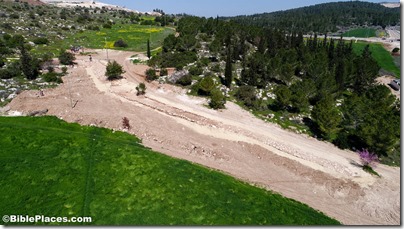
Roman road near Elah Valley aerial from south, ws030817228
Aerial view showing relationship of excavation to Highway 375 (foreground) and Highway 3855 (approaching from distance)

The ancient road was a spur that apparently connected the ruin of Khirbet Beit Natif on the hills north of the Elah Valley with the “Emperor’s Road.” This latter road was constructed in the time of Hadrian and ran from Bet Guvrin (ancient Eleutheropolis) through the Elah Valley near the newly discovered road and then up into the hills along the Hushah ridge.

Roman road near Elah Valley aerial from south, ws030817211
Aerial view of Roman road from the south

Ilan Ben Zion identifies Beit Natif as the first-century site of Bethletepha, “a town sacked by
Vespasian’s army during the First Jewish Revolt, between 66 and 70 CE.”

Coins were discovered between the pavement stones that suggest a first-century date:

  • a coin of Pontius Pilate, dating to AD 29
  • a coin of Agrippa I, dating to AD 41 and minted in Jerusalem
  • a coin from Year 2 of the Jewish Revolt (AD 67)
Roman road near Elah Valley aerial from southeast, ws030817218
The Roman road (aerial view from the southeast)

All photos in this post were taken earlier today by Bill Schlegel. More photos from the IAA are posted here.

It’s too bad that when they laid a similar water pipeline along the Roman road to Emmaus from Jerusalem that they didn’t take steps to preserve it.

HT: Joseph Lauer, David Bivin

Share:

The tomb of Jonah is a traditional site and unless the prophet lived for more than a hundred years, this tradition has now been undermined by the discovery of a 7th-century palace built by the Assyrian king Sennacherib. The Times of Israel reports:

In July 2014, weeks after overrunning Mosul and much of Iraq’s Sunni Arab heartland, IS militants rigged the shrine and blew it up, sparking global outrage.
In mid-January, Iraqi troops in Nineveh liberated the site.
“(It is) far more damaged than we expected,” Culture Minister Salim Khalaf said.
But IS also dug tunnels beneath the shrine searching for artifacts to plunder.
Iraqi archaeologist Layla Salih told Britain’s Daily Telegraph that in the tunnels she discovered a “marble cuneiform inscription of King Esarhaddon thought to date back to the Assyrian empire in 672 BCE.”
[…]
Eleanor Robson, head of the British Institute for the Study of Iraq, said the terror group’s destruction had opened the way to a “fantastic find.”
“The objects don’t match descriptions of what we thought was down there,” she said, according to a Telegraph report. “There’s a huge amount of history down there, not just ornamental stones. It is an opportunity to finally map the treasure-house of the world’s first great empire, from the period of its greatest success.”
However, IS plundered many of the items that were in the palace. Khalaf estimated that more than 700 items have been looted from the site to be sale on the black market.

The full story has more sad news.

HT: Mike Harney

Share:

Tabgha’s Church of the Multiplication of Fish and Loaves has re-opened after 20 months of restoration following the arson attack.

Hebrew inscriptions discovered on a Roman-period capital point to the Jewish history of the Druze village of Pekiin.

The oldest known sickle blades have been discovered on the shore of the Sea of Galilee.

Archaeologists working at Omrit have discovered a house decorated with frescoes dating to circa AD 100.

Robert Cargill suggests that “Cave 12” provides evidence that parchment was produced at Qumran.

Israel’s Culture Minister has offered to trade two elephants to Turkey in exchange for the Siloam
Inscription from Hezekiah’s Tunnel.

Israel’s Good Name describes a morning hike in the Ramot Forest on the north side of Jerusalem where a herd of gazelles live and a wild boars were recently spotted.

Carl Rasmussen shares a photo of a mosaic depiction in Berea that shows Jesus climbing a ladder on to the cross.

The Temple Mount Sifting Project blog gives the back story on Zachi Dvira and how he came to direct this important project.

HT: Agade, Joseph Lauer

Share:

The New York Times recounts the recent destruction of Palmyra and reviews a new online exhibit by The Getty Research Institute, “The Legacy of Ancient Palmyra.”

The search for hidden chambers in King Tut’s tomb continues this year.

A Japanese team has discovered the tomb of a royal scribe of Amenhotep III.

Ferrell Jenkins has posted on an attractive display of ossuaries at the Hecht Museum in Haifa.

Seth Rodriquez explains what happened to Judah after they were exiled.

Thomas Kiely of the British Museum reviews The Oxford Handbook of the Archaeology of the Levant c. 8000-332 BCE in the Oxford Handbooks in Archaeology series.

On the ASOR Blog, Anna-Latifa Mourad argues that the Hyksos were foreigners but not invaders.

Since 1833 there has been no mosque in Athens. Until this year.

Daniel Falk will be lecturing on “The Myth of the Dead Sea Scrolls” at Baylor University on Tuesday, February 21.

Alexander Schick will be lecturing at The Jordan Museum in Amman on Thursday, February 23, 5:00 pm, on “Uncovering the Scrolls: The Early and Late History of the Dead Sea Scrolls.” All are welcome.

HT: Agade, Joseph Lauer, Mark Hoffman, Ted Weis, Charles Savelle

Share:

A Roman-period gate has been discovered at Beit Shearim (“house of gates”).

A study of LMLK seal impressions reveals that there was a massive spike in the earth’s magnetic field in the time of King Hezekiah. I expect that G. M. Grena will have more to say about this on his blog soon. (UPDATE: now online here.)

A preliminary report from the 2016 season at et-Tell (Bethsaida?) is now up at The Bible and Interpretation.

A man who fished a Persian-period amphora out of the sea at Ashdod has turned it over to authorities.

I enjoy seeing my photos (especially of more obscure sites) put to good use, and no one does it better than Wayne Stiles. This week he ventures over to Ein Parath.

Lawrence Schiffman has written an article for Ami Magazine on the discovery of Qumran’s 12th cave.

Liberty University has a story on their role in the Qumran excavations.

James VanderKam considers it a “bit premature to call it Qumran Cave 12.”

Gordon Govier talks with John DeLancey about Qumran Cave 12 and upcoming excavations in Israel on this week’s edition of The Book and the Spade.

Is Genesis History? is a new documentary showing on theaters on Thursday, February 23. I’ve heard good reports from those who have seen it.

HT: Agade, Joseph Lauer, Paleojudaica

Share: