The Jerusalem Post has a feature story on the current excavations at the Philistine city of Gath. For daily updates, see the excavator’s blog. In particular, you may want to check out this remarkable 3-D image of Area A.

The Post also reports on a new virtual tour of the Temple Mount, online at HarHakodesh.co.il.

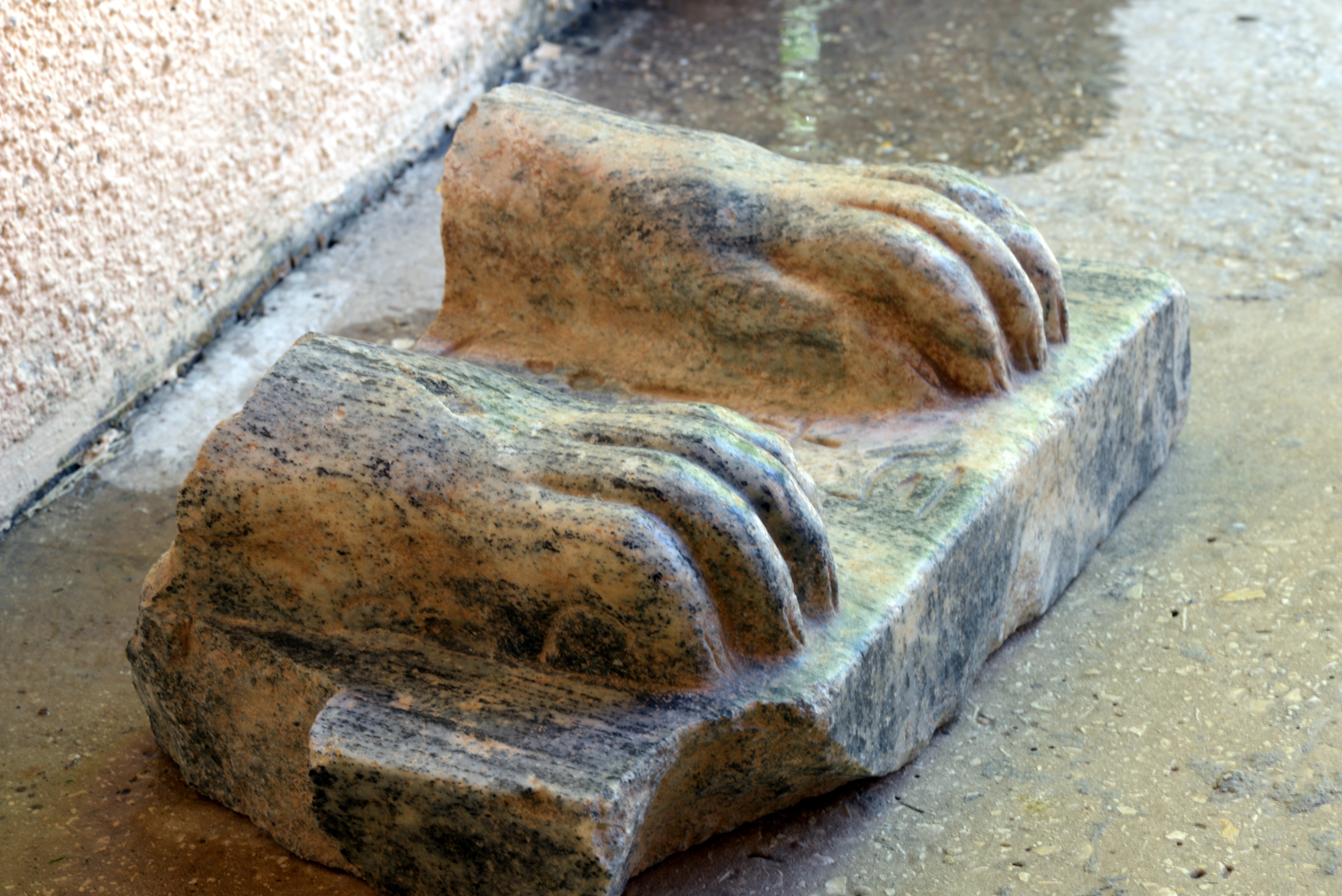
The sphinx found at Hazor is described by the archaeologists in a 3-minute video. Apparently this was the last of 24 years of excavations at the site. UPDATE (7/19): My interpretation that this was the final season was incorrect. See comments below.

Tel Aviv University is offering a free online course via Coursera on “The Fall and Rise of Jerusalem,” taught by Professor Oded Lipschits, Ph.D. and Ido Koch.

John H. Hayes died last week at the age of 79.

HT: Joseph Lauer, Jack Sasson

Hazor upper city aerial from west, tbs112040011
The upper city of Hazor
Photo from the Pictorial Library of Bible Lands

The Hebrew University has announced the discovery of a fragment of an Egyptian sphinx. From the press release:

At a site in Tel Hazor National Park, north of the Sea of Galilee, archeologists from the Hebrew University of Jerusalem have unearthed part of a unique Sphinx belonging to one of the ancient pyramid-building pharaohs.
The Hazor Excavations are headed by Prof. Amnon Ben-Tor, the Yigael Yadin Professor in the Archaeology of Eretz Israel at the Hebrew University’s Institute of Archaeology, and Dr. Sharon Zuckerman, a lecturer at the Hebrew University’s Institute of Archaeology.
Working with a team from the Institute of Archaeology, they discovered part of a Sphinx brought over from Egypt, with a hieroglyphic inscription between its front legs. The inscription bears the name of the Egyptian king Mycerinus, who ruled in the third millennium BCE, more than 4,000 years ago. The king was one of the builders of the famous Giza pyramids.
As the only known Sphinx of this king discovered anywhere in the world — including in Egypt — the find at Hazor is an unexpected and important discovery. Moreover, it is only piece of a royal Sphinx sculpture discovered in the entire Levant area (the eastern part of the Mediterranean).
Along with the king’s name, the hieroglyphic inscription includes the descriptor “Beloved by the divine manifestation… that gave him eternal life.” According to Prof. Ben-Tor and Dr. Zuckerman, this text indicates that the Sphinx probably originated in the ancient city of Heliopolis (the city of ‘On’ in the Bible), north of modern Cairo.
The Sphinx was discovered in the destruction layer of Hazor that was destroyed during the 13th century BCE, at the entrance to the city palace. According to the archaeologists, it is highly unlikely that the Sphinx was brought to Hazor during the time of Mycerinus, since there is no record of any relationship between Egypt and Israel in the third millennium BCE.
More likely, the statue was brought to Israel in the second millennium BCE during the dynasty of the kings known as the Hyksos, who originated in Canaan. It could also have arrived during the 15th to 13th centuries BCE, when Canaan was under Egyptian rule, as a gift from an Egyptian king to the king of Hazor, which was the most important city in the southern Levant at the time.

The full press release is available here.

OLYMPUS DIGITAL CAMERA
hu130709_hazor_sphinx2
OLYMPUS DIGITAL CAMERA
All photos courtesy of archaeologists Prof. Amnon Ben-Tor and Dr. Sharon Zuckerman (shown above).

Ken Dark recently lectured at the University of Edinburgh on the archaeology of Nazareth and the Plain of Gennesaret (Ginosar). Summaries of these lectures are available online.

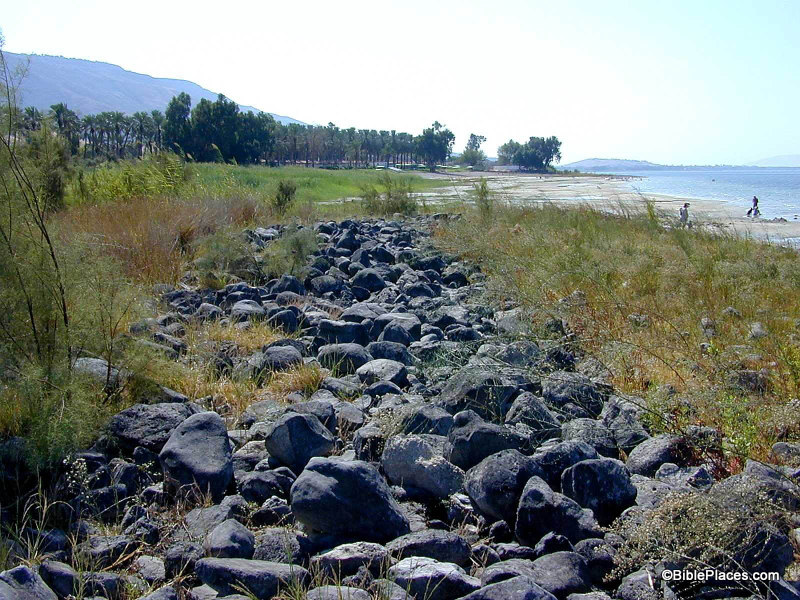
While I find highly dubious his suggestion that there was “no road between Nazareth and Sepphoris”—what sort of physical evidence would you expect to find for a road from an agricultural village of a few hundred people?—I am very interested in his claim to have discovered a “very large, but previously-unrecognised, Late Hellenistic, Roman-period, and later, settlement” between Magdala and Kibbutz Ginosar. He suggests that the site may be the Dalmanutha of Mark 8:10.

“About four thousand men were present. And having sent them away, he got into the boat with his disciples and went to the region of Dalmanutha. The Pharisees came and began to question Jesus. To test him, they asked him for a sign from heaven.” (Mark 8:9–11)

Because the parallel account in Matthew 15:38–16:1 has “vicinity of Magadan,” some scholars believe that Dalmanutha was another name for Magadan/Magdala. Mendel Nun has proposed that Dalmanutha be identified with a small anchorage north of Magdala (Anchor Bible Dictionary 2:4). Dalmanutha may not be a proper name but simply the Aramaic word for harbor.

You can read the lecture summaries and see the bibliographic details at the blog of the Centre for the Study of Christian Origins.

HT: Charles Savelle

Plain of Gennesaret from Arbel, tb032507715
Plain of Gennesaret (Ginosar) from Arbel. Is this the region of Dalmanutha?
Photo from the Pictorial Library of Bible Lands

Matti Friedman posts new photos and information about the royal (proto-Aeolic) capital discovered in a water tunnel not far from Bethlehem.

The first official Israeli exhibit in the Louvre is the Lod Mosaic. It opens tomorrow and runs through August 19.

Wayne Stiles explains why Nazareth Village is not just another tourist trap.

The Jewish Voice suggests 13 Must-See Museums in Israel.

Jerusalem Experience has a new video of the Pools of Bethesda.

All of the articles of the latest issue of Atiqot are now online.

Ferrell Jenkins recommends the new Satellite Bible Atlas for tours anywhere in Israel.

Rockefeller Museum entrance, tb042403209
The Rockefeller Museum in Jerusalem
Photo from the Pictorial Library, volume 3

A rare film from 1913 shows footage of Jerusalem and the train ride up from Jaffa. Footage of prayers at the Western Wall are shown at about the 4-minute mark. (The audio is in Hebrew.)

Leen Ritmeyer explains why he disagrees with the belief that the Shushan Gate had to be directly opposite the entrance to the Temple.

Wayne Stiles has an excellent post on the City of David and its significance in history. If you haven’t seen the new 3-D film shown at the City of David Visitor’s Center, you can watch it here.

An ultra-marathoner has completed the 600-mile Israel Trail in just 15 days.

Despite warnings that it will lead to a sharp drop in tourism, the Israeli government has approved adding an 18% tax (VAT) on services to non-Israelis.

Highlight Israel shares a 30-second time-lapse video of the sun setting over the Old City of Jerusalem.

Menachem Kaiser praises the Israel Museum’s exhibit of King Herod for not only representing his great buildings but for revealing the man himself.

The 2012 Bethsaida field report is now online. Figure 2 is a scarab dated to the 8th century and possibly connected with Israel’s royal house. Previous field reports are available here.

Geza Vermes died this week. Mark Goodacre reflects on his legacy.

One of the best Bible collections in the world opened Thursday evening in Dallas. The Museum of

Biblical Art houses the new Charles C. Ryrie Library with more than 100 rare Bibles, including the

Wycliffe New Testament (1430), Tyndale’s Pentateuch (1530), Bomberg’s Biblia Hebraica (1521),
the Complutensian Polyglot (1520), and the “Wicked Bible” (1631).

HT: Judi King, Mark Hoffman

Bomberg-Biblia-Hebraica-1521-Ryrie-Library-tb050911847
Biblia Hebraica, published by Daniel Bomberg in 1521, now on display in the Charles C. Ryrie Library.

Mount Arbel does indeed provide a panorama of Jesus’ ministry. Wayne Stiles shares photos and a video. I certainly agree with his conclusion: “No visit to Mount Arbel is ever long enough. It remains one of the most beautiful, inspiring, and instructive sites in Israel.”

Exploring Bible Lands marvels at the many biblical events that occurred within the frame of one photo of Jezreel and the Harod Valley. (By the way, you can get that photo and a thousand others for pennies each here.)

Ferrell Jenkins visits the Beit Sturman Museum at Ein Harod and describes its large collection of Roman milestones.

The highest and lowest places of dry ground on the planet are being united by an exchange of stones from Mount Everest and the Dead Sea.

The Gabriel Stone goes on display today at the Israel Museum.

The pyramid complex of Dashur is being threated by looting and construction.

The website of the University of Pennsylvania Museum of Archaeology and Anthropology is reviewed in the CSA Newsletter.

Archaeology programs from the BBC are now online for free viewing.

The recent back-and-forth between Turkish and German authorities over the return of antiquities is reviewed in DW.

HT: Jack Sasson

Dashur Red Pyramid with Bent Pyramid, tb110400454
The Red and Bent Pyramids of Dashur
Photo from the Pictorial Library of Bible Lands