A brief report of the finds from the 2008 season at Hazor is now posted (click link at top or directly here).

Tel Dan may be even more lush and beautiful the next time you visit following an agreement for the neighboring kibbutz to take water from the lower spring rather than the one next to the tel.  The article from the JPost, in part:

Rather than pumping from the higher-altitude Tel Dan spring, the kibbutz will receive its water from the lower Dan spring, which can supply the kibbutz in a more sustainable manner.
Reclaiming the Tel Dan spring for the nature reserve will rejuvenate the aquatic habitat, which has languished and dried out due to the lack of water, the authority said. In addition, the diversion of the fish pond water to agriculture will prevent it from flowing into the streams that feed the Jordan River, thereby reducing pollution. It will also free up 1 million cu.m. of water per year for nature….
“The right of nature to water is protected by law since 2004, but it doesn’t mean our work is done – rather, it has just begun. We’ve [also] managed to increase the amount of water in the Ein Gedi Nature Reserve, and to revive the Ein Gedi Stream after 50 years, and today we are taking an important step forward in increasing the amount of water in the streams which feed the Jordan,” he said.

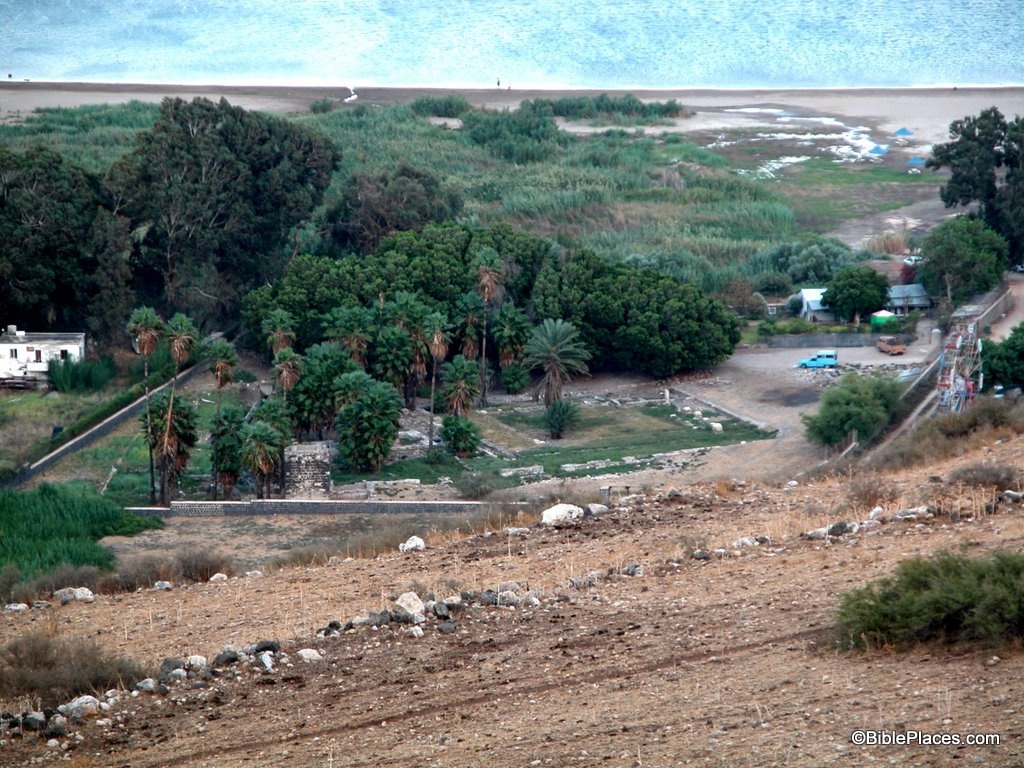
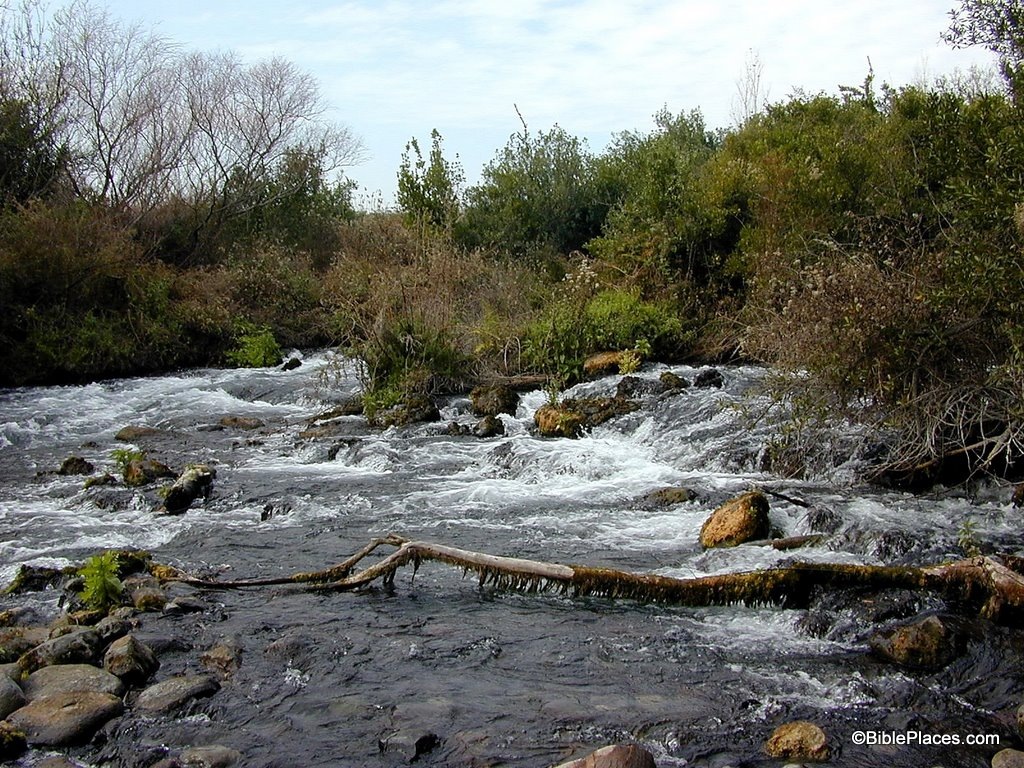
Dan headwaters of Jordan, tb011500028 Headwaters of Jordan River at Tel Dan

Since April 3 this year, the Sea of Galilee has dropped 6.4 feet (2.0 m), a new record for the size of drop in this amount of time.  Israel has had four years of below average rainfall.  If the water level drops another 2.6 feet (0.82 m), all pumping from the lake will cease.  The Jerusalem Post reports:

The water level in Lake Kinneret dropped two meters this year, the Water Authority said Thursday, a steeper annual drop than in any previous year.
The hydrological year ended on September 30 with the Kinneret at 214.05 meters below sea level, down from its height of 212.05 meters below sea level reached on April 3.
The Kinneret’s “black line,” newly coined this year, is 214.87 meters below sea level. When the black line is reached, the pumps in the lake are exposed to the air, and they can no longer send water into the National Water Carrier.
In July, the lake dropped below the “red line,” at which the concentration of pollutants rises to undesirable levels.
Since spring 2004 the Kinneret has lost 5.13 meters, which is equivalent to 850 million cubic meters of water, the authority said. That is roughly equivalent to an entire year’s worth of household water use.
This was the fourth consecutive year of dwindling rainfall and the forecast for the next couple of years is just as bleak.

You can read the rest here.

Sea of Galilee at dusk, tb040306012ddd

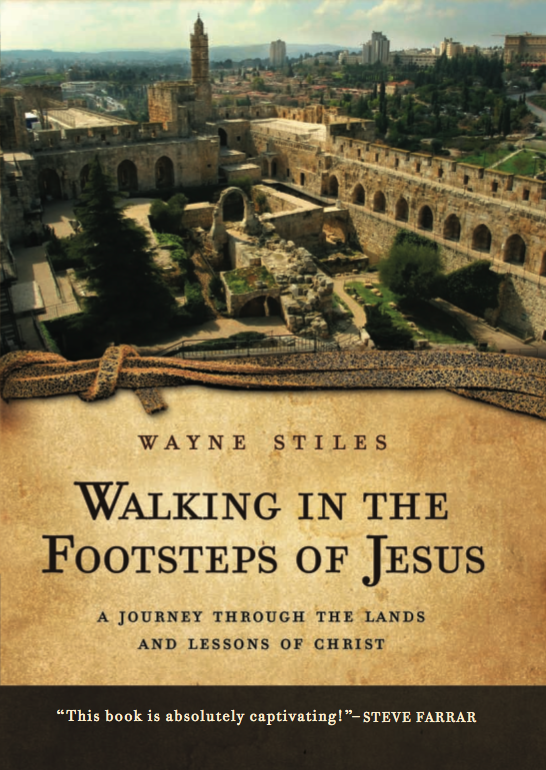
A new book is out this week that I want to recommend highly.  Walking in the Footsteps of Jesus: A Journey Through the Lands and Lessons of Christ combines passion with humor in a unique “tour” through Jesus’ life.  Author Wayne Stiles has not written a “life of Christ” book, nor has he produced a work recounting the geographical background of Jesus’ ministry.  What he has done, through his deep knowledge of Jesus’ life and land, is to take the reader on a delightful and challenging journey to the physical and spiritual places where Jesus lived and taught.Walking in the Footsteps of Jesus Cover

Stiles’ skill as a writer and “tour guide” makes the book engaging and rich with insights.  As a pastor for many years, Stiles is gifted in making lofty ideas of Scripture readily understandable to the average person, and he does so with many fun anecdotes and helpful analogies from his travels in Israel.

From Bethlehem, to Galilee and Jerusalem, and ending in Patmos, the book largely travels “in the footsteps of Jesus.”  Here is a snip related to the wilderness:

I have walked in the wilderness where Satan tempted Christ, just west of where He was baptized. Good grief, what a place. This is the wilderness of Judea where God shaped the character of the future King David in “the valley of the shadow of death” (Ps. 23:4). Here David prayed, “my flesh yearns for You, in a dry and weary land where there is no water” (Ps. 63:1). David wasn’t kidding. Endless piles of rocks, steep hills, no trees, modest vegetation, little water, slight shade, and lizards. As far as my eye could see, it was empty, dry, and depressing. I tried to imagine the silence, solitude, and struggle Jesus would have endured here for over a month. But I could not.
We can barely stand to fast for a day or two. Can you imagine fasting forty days? Jesus did so in preparation for temptation—and became desperately hungry and needy. And in His moment of need, the devil slipped in. He waits for moments like these.
“If You are the Son of God, tell this stone to become bread” (Luke 4:3).
The devil is no idiot—and also no gentleman. When he tempts, he plays dirty. No rules. No concessions. No mercy. He waited for a moment of vulnerability and then tempted Jesus to satisfy His legitimate need for food in an illegitimate way: “Turn this stone to bread—use your power to gratify your need.” What a cheap shot. Every stone would then become a temptation. And believe me, the Wilderness of Judea has plenty of stones! Jesus’ reply—although He was physically hungry—showed that He was spiritually full.
“It is written, ‘Man shall not live on bread alone.’”

If you haven’t yet been on a trip to the Holy Land, you’ll enjoy visiting it virtually through this book. 

If you have been, you’ll see it in ways that you haven’t before, even if you’ve visited countless times. 

This journey combines so many of my favorite things in one book: the places of the land of the Bible, the life of Christ, fascinating stories, excellent writing, and God-exalting, people-challenging truth. 

Pick this up for your next plane ride to Israel (or anywhere) and enjoy!

From Arutz-7:

Archaeologists have discovered three 9,000-year-old skulls at the Yiftah’el dig in the Lower Galilee, the Israel Antiquities Authority announced Wednesday. Experts said the placement of the skulls confirms the worship of ancestors from during that time, practiced by displaying skulls inside houses. The skulls were apparently placed on benches in a house where they would inspire the younger generation to continue in the ways of their forefathers. A similar custom was also identified in Syria, Turkey and Jordan. The skulls are 8,000-9,000 years old and were buried in a pit adjacent to an excavated large public building. They were discovered during excavations for a new highway interchange at the Movil Junction, a major intersection. “The skulls were found plastered – that is to say sculpted – which is a phenomenon that is identified with the New Stone Age,” said site director Dr. Hamoudi Khalaily. “The practice included the reconstruction of all of the facial features of the deceased by means of sculpting the skull with a variety of materials such as plaster that was specifically intended for this. On the skulls that were found in the excavation the nose was entirely reconstructed.”

The story continues here.

A Roman temple from the 2nd century A.D. has been excavated at Sepphoris.  The temple was about 40 by 80 feet (12 x 24 m) and its facade faced the decumanus, the main east-west street of the city.  A church was later built over the temple.  The story is reported by ScienceDaily, Physorg, and the Jerusalem Post.  The first two links each have a photo.

Zondervan Academic has a new blog and they have, among other things, links to the online programs for the national meetings of AAR, ETS, and SBL.  I also liked John Walton’s post on bad things people do in teaching children the Bible

The JPost has a short article about “Genesis Land,” a tourist site that recreates patriarchal life midway between Jerusalem and Jericho.

Some people know General Charles Gordon because of his work in China and Sudan, and others for his popularization of “Gordon’s Calvary” or the Garden Tomb.  NPR has a five-part series on China and Sudan, in which Gordon’s influence is discussed in part one.

From the archaeologists:

The co-directors of the Kabri Archaeological Project (KAP), Assaf Yasur-Landau and Eric H. Cline, would like to announce that a pdf of the preliminary results from the 2008 excavation season at Tel Kabri is now available at: http://digkabri.files.wordpress.com/2008/08/report-on-the-results-of-the-2008-excavation-season-at-tel-kabri1.pdf If the direct link does not work for some reason, go to http://digkabri.wordpress.com/ and click on the link there to download the pdf.   Links to the results of previous seasons (2005, 2006, and 2007) are also listed at http://digkabri.wordpress.com/ KAP Publications which have already appeared are:   E.H. Cline and A. Yasur-Landau, “Poetry in Motion: Canaanite Rulership and Aegean Narrative at Kabri,” in EPOS: Reconsidering Greek Epic and Aegean Bronze Age Archaeology: 157-165, S.P. Morris and R. Laffineur, eds.  Aegaeum 28.  Liège: Université de Liège.  2007.   A. Yasur-Landau, E.H. Cline, and G.A. Pierce, “Middle Bronze Age Settlement Patterns in the Western Galilee, Israel,” Journal of Field Archaeology

HT: Joe Lauer