A Roman temple from the 2nd century A.D. has been excavated at Sepphoris.  The temple was about 40 by 80 feet (12 x 24 m) and its facade faced the decumanus, the main east-west street of the city.  A church was later built over the temple.  The story is reported by ScienceDaily, Physorg, and the Jerusalem Post.  The first two links each have a photo.

Zondervan Academic has a new blog and they have, among other things, links to the online programs for the national meetings of AAR, ETS, and SBL.  I also liked John Walton’s post on bad things people do in teaching children the Bible

The JPost has a short article about “Genesis Land,” a tourist site that recreates patriarchal life midway between Jerusalem and Jericho.

Some people know General Charles Gordon because of his work in China and Sudan, and others for his popularization of “Gordon’s Calvary” or the Garden Tomb.  NPR has a five-part series on China and Sudan, in which Gordon’s influence is discussed in part one.
Share:

From the archaeologists:

The co-directors of the Kabri Archaeological Project (KAP), Assaf Yasur-Landau and Eric H. Cline, would like to announce that a pdf of the preliminary results from the 2008 excavation season at Tel Kabri is now available at: http://digkabri.files.wordpress.com/2008/08/report-on-the-results-of-the-2008-excavation-season-at-tel-kabri1.pdf If the direct link does not work for some reason, go to http://digkabri.wordpress.com/ and click on the link there to download the pdf.   Links to the results of previous seasons (2005, 2006, and 2007) are also listed at http://digkabri.wordpress.com/ KAP Publications which have already appeared are:   E.H. Cline and A. Yasur-Landau, “Poetry in Motion: Canaanite Rulership and Aegean Narrative at Kabri,” in EPOS: Reconsidering Greek Epic and Aegean Bronze Age Archaeology: 157-165, S.P. Morris and R. Laffineur, eds.  Aegaeum 28.  Liège: Université de Liège.  2007.   A. Yasur-Landau, E.H. Cline, and G.A. Pierce, “Middle Bronze Age Settlement Patterns in the Western Galilee, Israel,” Journal of Field Archaeology

HT: Joe Lauer

Share:

A “very formidable and rare olive press” was discovered recently in Western Galilee.  It is one of the largest known from Israel and dates to the 6th-7th centuries A.D.  From the Israel Antiquities Authority:

A unique and impressive complex for producing oil that dates to the Byzantine period, which is also one of the largest uncovered in the country so far, was discovered recently during trial excavations conducted by the Israel Antiquities Authority in Moshav Ahihud, in the Western Galilee. The excavations are being carried out as part of a development plan to enlarge the village….
In the middle of the building a central crushing mill (a large round stone) was uncovered upon which a millstone (referred to as a memel) was placed. It was customary to harness an animal to the axle of the millstone which would turn the stone and thereby crush the olives.
After crushing and breaking them, the olive pulp was brought for pressing in aqalim (baskets woven of coarse fabric or ropes). The aqalim were squeezed in a press and the olive oil was extracted as a result of this action. The baskets served as a filter whereby the liquid dripped out leaving the pits and pulp waste behind in the baskets. 
Three screw type press beds and a stone weight that was originally connected to the end of a. beam were revealed at the site.

The rest of the story, and photographs, are here.

HT: Joe Lauer

Share:

A Byzantine cemetery has been discovered in construction work at the hospital of Ashkelon (JPost).

An arsonist set several fires in the Tel Dan nature reserve, burning half of the 120-acre park.  They hope to re-open the park later this week (JPost).

A rare marble discus was discovered underwater at Yavne-Yam.  The disk, 8 inches in diameter, was used to ward off the evil eye in the 5th and 4th centuries B.C. (IAA; Arutz-7; Haaretz; JPost).

The hotel where Mark Twain stayed in Jerusalem has been identified (Haaretz).

Israeli, Palestinian, and German scholars will be studying bones unearthed at Jericho by Kathleen Kenyon in order to study the DNA so as to identify genes that made the ancient inhabitants more or less susceptible to tuberculosis (Guardian).

Stephen Gabriel Rosenberg discusses two Jewish temples known from Egypt, one at Leontopolis (Tell el-Yehudiyeh) and the other on Elephantine Island (Yeb, Aswan) (JPost).

Share:

From the JPost:

“This is the worst crisis since records started being kept 80 years ago,” Water Authority head Uri Shani declared Tuesday morning at a special press conference in Tel Aviv. “Like most countries, Israel is dependent on rainfall and the amount of rainfall is decreasing. There is a drop of 100 million cubic meters per year.”
Shani described a situation of increasing damage to Israel’s main natural water sources. The Coastal Aquifer “has dropped below its black line,” which means that it will suffer rapid damage, possibly irreversible damage, Shani said.
The water level in the Mountain Aquifer was currently a meter above its Lower Red Line, but was also expected to reach its bottom limit – the Black Line – by this year. He added that water levels in the aquifers had never been this low.
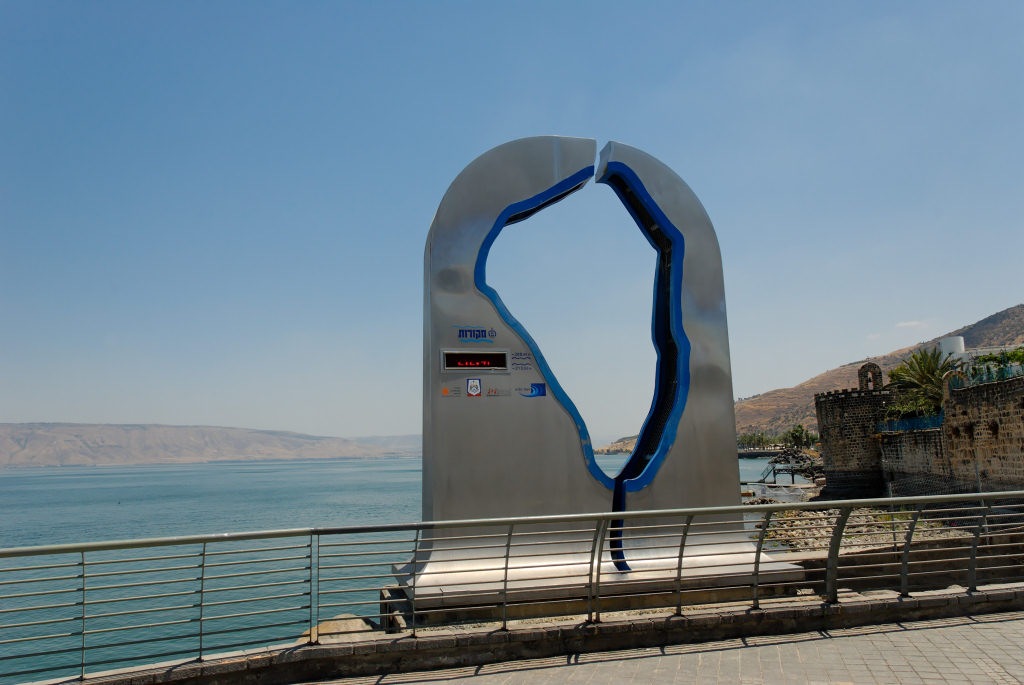
Shani predicted that Lake Kinneret [Sea of Galilee] would reach its Black Line by December 2008. The Kinneret dropped below its bottom limit on Monday, 213 meters below sea level. The lake’s Black Line is 214.87 meters below sea level.

The story continues here.

Sea of Galilee water level sign, tb052808512
New sign in Tiberias displays the present water level in the Sea of Galilee, a main source of fresh water for Israel today
Share:

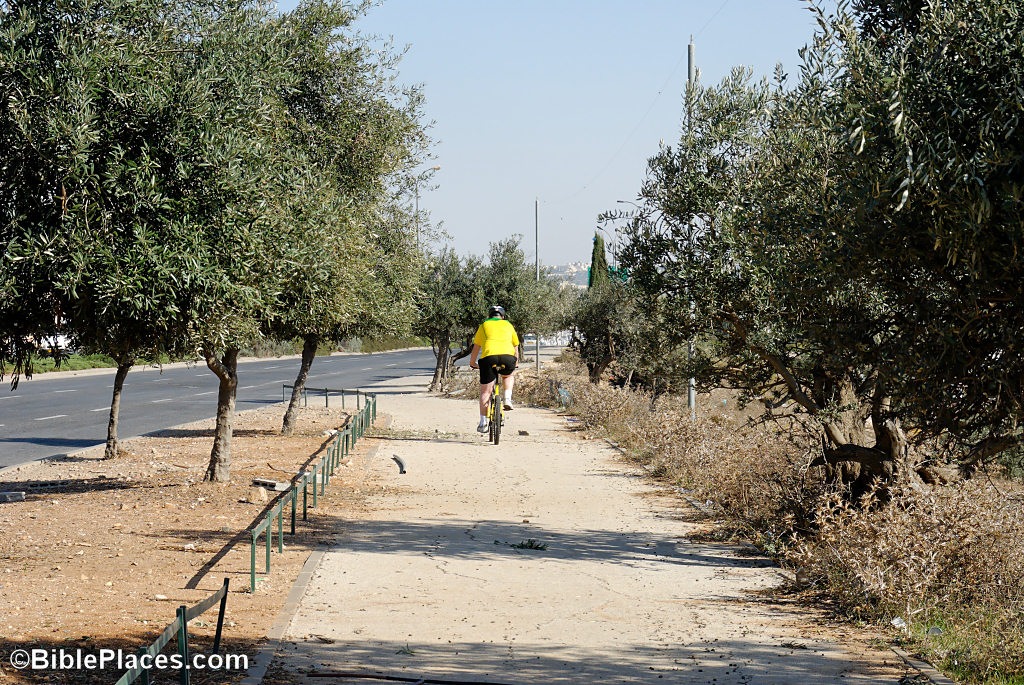
Arutz-7 reports on an up-coming bike ride in Israel:

From September 21-27, 2008, athletic tourists will be able to visit and tour the country in a unique style: Bicycling their way through the upper Galilee and the Golan Heights on the Jewish National Fund’s first annual Bike Ride Mission to Israel. “Participants will traverse over 200 miles of breathtaking terrain,” the JNF literature announces, “during four days of fully supported riding (all ability levels are welcome), and will be rewarded with exclusive accommodations at the 5-star Mitzpe Hayamim Hotel and Spa and The Carmel Forest Spa Resort.” The bicycle tours will include stops in towns, army bases, and JNF sites such as security bypass roads, forests, and nature reserves.  The participants will also hear talks from public officials and IDF officers, will learn about Israel’s water problems and the JNF’s efforts and successes in solving them, and will take part in rafting and wine-tasting activities. The cost: $3,600 per rider (double occupancy), not including airfare. Participants can either bring their own bicycle or rent one here…. For more information on the bike mission, visit www.jnf.org/bikeisrael.

Bicyclist on road of patriarchs, tb111106873

Share: