Aren Maeir and the excavations he directs at Gath are profiled in an interesting article at Israel 21c.

Wayne Stiles describes the biblical significance of Ein Harod. I would add that when I was at the site a few weeks ago, the gates were locked up tight. A call to the office revealed that the national park is closed “indefinitely.”

Being covered in the dust of your rabbi is not an urban legend.

Tom Powers takes his readers on a tour underneath the Lutheran Church of the Redeemer. The excavations are slated to open to the public later this year.

Shmuel Browns hikes Nahal Michmash. He notes some of the many biblical connections.

Ferrell Jenkins provides two helpful photos for the next time you’re studying or teaching the story of Samson tying the foxtails together.

The Bible Lands Museum Jerusalem is hosting a lecture this evening in English by Sarah Salon,
“Sprouting Stories – Medicinal Plants in the Bible and growing a 2,000 Year Old Date seed from Masada.”

Cliffs near Michmash and Geba from south panorama, tb092706105
Cliffs near Michmash and Geba, the area where Jonathan climbed to surprise the Philistines (1 Sam 14)
Share:

The “Roads of Arabia Exhibition,” mentioned here in February, opened this week in Berlin. The transfer of the collection from St. Petersburg was quite a challenge. In the fall the exhibition is
scheduled to move to Washington, DC.

Luke Chandler explains exactly where the Khirbet Qeiyafa ostracon was discovered.

The process of wine-making in ancient times is described in the Jerusalem Post (but the editor chose to illustrate it with a photo of an olive press).

Aren Maeir is always ahead of the curve, but now he outdoes himself by restoring pottery from the 2012 season. The photos show that they’re digging up some great artifacts.

Students of Ephesus may be interested in a new historical work by Hans Willer Laale. Ephesus (Ephesos): An Abbreviated History From Androclus to Constantine XI is now available from Amazon ($26-34 for paperback or hardcover; $4 for Kindle).

The Biblical Archaeology Society has produced a 9-minute video on the excavations at Bethsaida.
Zahi Hawass is writing a book.

The ASOR Blog has a round-up of news from the world of archaeology.

The Jerusalem Post has a story on the top 5 bookstores in the city.

Bethsaida Iron Age gate with stela replica, tb011412618

Iron Age gate at Bethsaida
Share:

A couple of new buildings in the Jewish Quarter provide good views from the rooftop or balcony.

Both cost but both provide unique perspectives that are worth the price of admission.

A one-hour tour of the Hurva Synagogue concludes on the balcony with views in all directions.

Jewish Quarter courtyard from Hurva Synagogue, tb010312412

Jewish Quarter from the Hurva Synagogue

For 10 shekels, you can get access to the rooftop of Aish HaTorah and its unobstructed view of the Western Wall plaza and Temple Mount.

Western Wall prayer plaza from southwest, tb010312492

Western Wall plaza and Temple Mount from Aish HaTorah

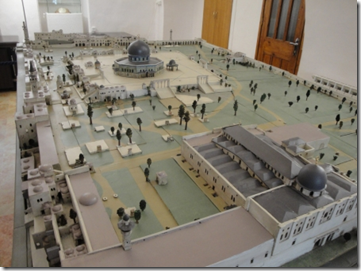
Aish HaTorah also has a model of the temple on display on the roof.

Temple model overlooking Temple Mount, tb010312511

Temple model on rooftop of Aish HaTorah

While on the rooftop a few weeks ago, I could see down into the area of the Temple Mount ramp that is otherwise blocked from public view by a fence. An archaeologist employed by the IAA was with a group of workers, leading me to wonder if any (quiet) progress is being made in the excavations there.

Share:

In his column today at the Jerusalem Post, Wayne Stiles traverses the length of the Western Wall underground, recommending this as an ideal way to get more out of your day in Jerusalem.

Traveling though these excavated tunnels a few weeks ago, I saw several discoveries made in recent years. The steps of a very large mikveh (ritual bath) are visible about 10 meters below the modern path (noted previously on this blog here).

Mikveh near Western Wall, tb010112167Eastern steps of mikveh built next to western wall of Temple Mount

Last month, they finished excavating and opened up to visitors a new portion of the Struthion Pool.

This is located to the east of the part of the pool that once served as the terminus of the tour.

Struthion Pool, tb010112215Struthion Pool
Excavations continue in the Great Hall, not far from the location of the largest stone in the Temple Mount.
New excavations in Western Wall tunnels, tb010112171Excavations in the Great Hall, January 2012
Share:

In Old City Odds ‘n Ends, Tom Powers reports on the clean-up of Hezekiah’s Pool, repairs at the Church of the Holy Sepulcher, and construction in Solomon’s Quarries. He also lists some posts he hopes to write in the months ahead.

Luke Chandler has some new photos of Khirbet Qeiyafa.

Over on the Accordance Forum, David Lang asks whether commercial graphics collections are useful in light of Google Images.

Larry Hurtado highly recommends the Atlas of the Early Christian World (1958).

The reformatted Soncino Babylonian Talmud is now available online.

In recent weeks, Wayne Stiles has taken readers of his column at the Jerusalem Post to Masada and the Citadel of David.

A 64th tomb has been discovered in Egypt’s Valley of the Kings. (The tomb of King Tut was number 62.)

Some thieves were caught looting a site in the Judean wilderness near Tekoa.

The Harvard Semitic Museum is baking thousands of ancient clay tablets.

HT: Jack Sasson, Joseph Lauer

Share:

Question: I read in a commentary the claim that the Dead Sea is visible from the top of the Mount of Olives. When I was there we didn’t go all the way to the top. Is this true? –K.P.


Answer: On most days you would not be able to answer this question because the air is so hazy. On a rare clear day, you would have this view just up the slope from Bethphage, with a sliver of the Dead Sea visible below the horizon.

Bethphage from Mount of Olives showing wilderness, mat02531

View of the Dead Sea from the Mount of Olives (photo source)
Share: