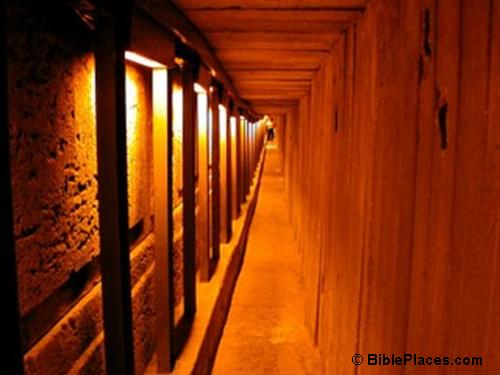
Alexander Schick passes on word that the excavated tunnel is now open that allows you to walk on the 1st-century street from the Pool of Siloam up the City of David to the area of the visitor’s center. 

(A previous report about these excavations is here.)

Leen Ritmeyer is in Jordan and has photos of the newly opened baptismal site at “Bethabara.”

Ferrell Jenkins reports that Egyptian authorities are now prohibiting cameras from entering the Valley of the Kings. 

The Ohel Yitzchak Synagogue in the Old City of Jerusalem was looted and vandalized during the Jordanian occupation (1948-67), but its renovation has restored some of its former beauty, as you can see in Shmuel Brown’s recent photos.

With the verdict about to be announced in the forgery trial in Jerusalem, Hershel Shanks has written an e-book entitled, James, Brother of Jesus: Forged Antiquities and the Trial of Oded Golan and Robert Deutsch. Shanks believes the James Ossuary inscription was not forged and he plans to release the e-book when the judge issues the verdict.  See the sign-up details here.

The eastern Mediterranean is overdue for a big earthquake, says the Jerusalem Post.  The area has not had a seven or eight magnitude quake in nearly a millennium.  The 1927 tremor was a mere 6.2 on the Richter scale.

The newly re-opened Israel Museum has served half of a million visitors in the last half year. 

The LandMinds radio show has interviewed the recently retired Amihai Mazar, reflecting back on the excavations he directed at Tel Qasile, Giloh, Beth Shean, and Tel Rehov.

A Swiss architect is hard at work restoring and protecting the beautiful mosaics of Hisham’s Palace in Jericho.  A new excavation began at the site last week and new Russian museum is now open.

The season’s excavations at Tall el-Hammam are wrapping up and the team has posted a couple of videos.  The first shows what they have identified as a Middle Bronze temple (with a 10-foot thick wall!) and the second summarizes the finds in the Roman area.  They suggest that this was the city of Livias in the Roman-Byzantine period.

HT: Ferrell Jenkins, Roi Brit

Share:

Israel Finkelstein has written a brief article explaining why he believes conclusions based on the lack of archaeological evidence trumps the biblical text every time. “Archaeology as a High Court in Ancient Israelite History: A Reply to Nadav Na’aman” (pdf) is published in the Journal of Hebrew Scriptures.

James Tabor has posted an update on the Mount Zion excavation project, including news that the 2011 dig season will be conducted at Suba (“Cave of John the Baptist”) instead of on Mount Zion.

Ferrell Jenkins explains why you should check out his extensive collection of links to Biblical Studies resources, especially the Bible Places and Scholarly categories.

Aren Maeir has posted the schedule for the Aharoni Symposium, to be held on February 17 at Tel Aviv University.

In response to the recent story about the “Small Kotel,” Leen Ritmeyer observes:

It is ironic to see that Haaretz is worried about a strong reaction from the Waqf (the Muslim religious trust), while the praying Jews are apparently oblivious to the fact that they are touching stones laid by Muslims, which may have been taken from a destroyed Christian church, in order to repair the ancient Jewish Temple Mount walls.

Western Wall, Kotel HaQatan, tb102903595

The “Small Kotel”
Share:

The latest nightmare for residents (and some tourists) in Jerusalem begins tomorrow.  From Arutz-7:

This weekend, the main street in Israel’s capital city will bid farewell to vehicular traffic and take on the official status of a pedestrian walkway.
Jaffa Road was constructed 150 years ago during the reign of the Ottoman Turks and so named because it  then led travellers out of the city to where the road to Jaffa port began and vice versa. It, runs from the Old City’s Jaffa Gate through the center of Jerusalem to the Central Bus Station  and the main intercity highway to Tel Aviv-Jaffa. There is not an inch of space along its length without a commercial establishment, many of which serve the millions of tourists who pass through the capital each year.
For the next four months, until the Jerusalem Light Rail project is completed, “Bus 11” – Israeli slang for a person’s two legs – will be the only means of transportation on the road. The sole light rail line, which will run from Pisgat Ze’ev, through the city center via Jaffa Road to Mount Herzl, is not expected to make its debut until April.
Mayor Nir Barkat is hoping that four months of free rides for residents – the light rail will begin charging fares in August — will ease the rage that is swelling among vendors, consumers and anyone else who is used to working and traveling on Jaffa Road.
It’s not at all certain that his plan will be a success, however, because that’s not all.
Due to the changes along Jaffa Road, traffic patterns on the two parallel streets – Rehov Agrippas, behind the Mahane Yehuda open-air market and which runs along the newly gentrified Nachlaot neighborhood, and Rehov Neviim, which runs along the super hareidi religious Geula neighborhood on the other side – are also going to be changed.
[…]
“Neviim is wide enough for two horses and wagons, approximately,” observed a Jerusalemite who asked not to be identified. “Agrippas will only have buses. No trains for another four months at least? Shopkeepers are aghast.”

The full story is here.  The Jerusalem Post has a similar story here.

Jaffa Road, main thoroughfare of new city, mat06541

Jaffa Road, view towards Jaffa Gate, in the quieter days
of the early 1900s
Credit: Library of Congress, LC-matpc-06541/ www.LifeintheHolyLand.com
Share:

Aren Maeir reports on several recent and one upcoming archaeological meetings in Israel.

For the retirement of Amihai Mazar, Maeir provides summaries of eleven presentations, including one by Ronnie Reich in which he:

proposed a new dating for the so-called Hezekiah tunnel. Due to his dating of a feature which he claims is the origin of the tunnel to the late 9th/early 8th centuries (“the round pool”), he believes that the tunnel could only have been made at a time earlier than Hezekiah. If I may note, now that there is a suggestion to date this tunnel to after Hezekiah (as I mentioned here) and now this suggestion to before, I think a defense of poor Hezekiah is required…

Another presentation of note was that of Israel Finkelstein who

reviewed the long debate that Ami and Israel have had on the chronology of the Iron Age, and, bottom line, suggested that they have both now reached the point where they have almost met in the middle. Time will tell…

Another conference honored the memory of Hanan Eshel, and Maeir writes briefly on a few of the presentations.  Ami Mazar presented a paper on seven 10th- and 9th-century inscriptions from his excavations at Tel Rehov. A paper by Shmuel Ahituv on the Kuntillet Ajrud inscriptions proposed that

the Asherah refers to an object and NOT to a female deity, partner of YHWH – as opposed to most scholars who have dealt with this topic.

Finally, Maeir provides information about the Annual Archaeological Conference in Israel, which will be held on April 14th at Bar-Ilan University.

Thank you, Prof. Maeir, for serving us so well with these reports.

Share:

Results of an archaeological survey of the northeastern slope of the Mount of Olives have identified numerous ancient burial caves, some cisterns, and the biblical site of Bahurim.

The report is published in Hadashot Arkheologiyot 122 with a number of photos and illustrations. 

The three areas surveyed are located around the eastern exit of the car tunnel passing through the Mount of Olives (map here, photo below).

The burial caves are from the Second Temple period and later, but in some places remains were preserved from the Iron Age.  Ras Tammim in the survey’s Area III has been identified with biblical Bahurim.  This site is best known as the place where Shimei cursed David when he fled from Jerusalem during Absalom’s revolt.

As King David approached Bahurim, a man from the same clan as Saul’s family came out from there. His name was Shimei son of Gera, and he cursed as he came out. He pelted David and all the king’s officials with stones, though all the troops and the special guard were on David’s right and left. As he cursed, Shimei said, “Get out, get out, you man of blood, you scoundrel! (2 Sam 16:5-7).

Bahurim also is mentioned in connection with the return of David’s wife Michal.  You cannot help but feel sorry for Michal’s second husband who followed, “weeping behind her all the way to Bahurim” (2 Sam 3:16).

About the site (Horvat Ras Tammim), the report states:

The site is situated on a hilltop (Spot Height 704), east of the Mount of Olives. The area at the top of the hill is cultivated farmland, whereas the slopes are covered with vegetation. Potsherds, mostly dating to the Iron Age and the Early Roman and Byzantine periods, were found within the precincts of the ruin. Twenty-one sites were identified.

More details of the survey, including 11 diagrams and illustrations, are published here.

HT: Bible and Interpretation

Mt of Olives, Wilderness, Rift aerial from nw, tb010703219_labeled

Mount of Olives, aerial view to southeast
Share:

Taking “Jerusalem” and “winter” rather broadly, the Jerusalem Post makes some suggestions.

1. Take a menorah tour

2. Jerusalem Lights the Night, Tower of David Museum

3. Tracking down the best Hanukka doughnut

4. Hearing Christmas Mass

5. New Year’s Eve, Sylvester style

6. Saturday cholent lunch

7. (Hopefully) playing in the snow

8. Lupine Hill in the Elah Valley

9. A Kube Fest

10. Succulent Strawberries

My three favorite are 7, 8, and 10.  See the story for all of the details.

tb121404783

Happy Hannukah!
Share: