Most of what is in this Arutz-7 interview with Dr. Gabriel Barkay is not new, but some things are worth hearing again.

Of the discoveries that have been made in the Temple Mount Sifting Project (unfortunately translated in the article as “Screening the Waste”!):

Barkai explained that despite the conditions, “We have made thousands of amazing finds that have changed the way we understand that period.”
Asked later to elaborate, he told Israel National News, “For instance, we have found many small floor tiles, of different colors, which confirm the Talmud’s description of the floor of the Second Temple as being reminiscent of the ocean.”
Other finds have included fragments of stone decorated with ornaments known to be from the Second Temple Period, arrowheads from Nebuchadnezzar’s army and also from the Romans, as well as coins and decorations from many periods. Among the most exciting finds were bullae (seal rings), ostracons written in ancient Hebrew script, seals, and more.

Of the agenda to rewrite history in order to eliminate a Jewish connection to the Temple Mount:

Barkai explained that in addition to building mosques on the site, the Moslems clearly have the goal of detaching Israel from its past and Holy Temple connections: “They wish to undermine Jewish ownership and bonds to the Temple Mount. They’ve built a giant mosque there in Solomon’s Stables [under the Temple Mount] and another one nearby – but aside from that, they have an ideological goal which is even making inroads to naïve circles in the west, and it is called ‘Holy Temple denial.’ They act as if there never was a Holy Temple. This is very very grave; regarding the Holocaust, there are living people who still remember it, but the same cannot be said regarding the Temple…”
“We must demand that Israeli law and sovereignty be enforced on the Temple Mount,” Barkai concluded.

The full article is here.

Share:

The Israel Antiquities Authority has uncovered an arched bridge in the Hinnom Valley that was built in the 14th century as a replacement of the Lower Aqueduct bridge from the 1st century.  From Arutz-7:

Two of the bridge’s original nine arches have now been excavated to their full height of about three meters.
In actuality, the newly-discovered bridge was built in 1320 C.E. by the sultan Nasser al-Din Muhammed Ibn Qalawun, as evidenced by its dedicatory inscription. However, it was apparently constructed to replace an earlier bridge dating to the time of the Second Temple period that was part of the original aqueduct.
Yechiel Zelinger, excavation director on behalf of the Israel Antiquities Authority, said, “The bridge, which could still be seen at the end of the 19th century and appears in old photographs, was covered over during the 20th century. We were thrilled when it suddenly reappeared in all its grandeur during the course of the archaeological excavations.”
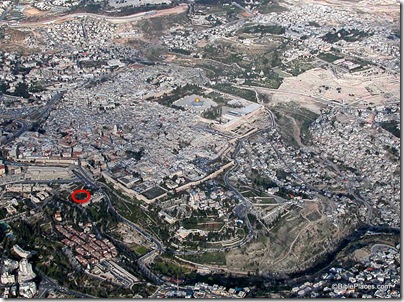
“The route of the Low Level aqueduct from the time of the Second Temple, beginning at Solomon’s Pools near Bethlehem and ending at the Temple Mount, is well known to scholars,” Zelinger said. “Substantial parts of it have been documented along the edge of Yemin Moshe neighborhood and on the slope adjacent to the Old City’s western wall. In order to maintain the elevation of the path along which the water flowed, a bridge was erected above the ravine.”

The story continues here.

Yesterday Tom Powers posted his observations of the excavation along with a couple of great photos. 

He wonders aloud if the earlier foundations of the bridge underlie the present one.  Perhaps the archaeologists will pursue this question.

Share:

Aren Maeir reports briefly on some archaeological meetings in Israel this week.  He’s also expecting to accomplish a lot at Gath this season with more than 100 registered for the first session.

Leon Mauldin has an interesting post with a map and photos of the city of Haran where Abraham and Jacob lived.

Ferrell Jenkins is back in Israel and posting daily of his travels.  Friday’s post included a photo of the restored Jaffa Gate.

UPDATE (5/10): Joe Lauer has noted that the Haaretz story on the Muslim prayer room is three years old(!), and thus I have deleted it.

Share:

Tours of the ancient sites in Iraq will begin this summer. A nine-day tour costs $3,375.

Hamas plans to regulate the trade of antiquities in Gaza.  Of 25,000 gold and bronze coins unearthed since 1990, 14,000 were sold on the black market. 

The Washington Post has the best article I’ve read on the restoration of Jaffa Gate.

Christianity Today has a story on the discovery of the “Miracle Boat,” also known as the “Jesus Boat.”  (Why not “Galilee Boat”?) The article also mentions the recent campaign to increase the number of visitors to the boat.  My suggestion: lower the outrageous entrance fee.

Tourists can now bring their iPad to Israel without fear of it being confiscated by customs authorities.

Israel’s Tourism Minister is vowing to stop the country’s degrading treatment of visitors. 

Leon Maudlin has been posting “two views” of Miletus, showing the dramatic differences in the ancient city in different seasons.

HT: Explorator, Paleojudaica, and Joe Lauer

Share:

From the Jerusalem Post:

A tourist visiting the Church of the Holy Sepulcher in Jerusalem was shot by a policeman and seriously wounded Friday night after allegedly threatening visitors with a knife and attempting to stab a police officer.
Police said the incident began at closing time when two priests and a policeman walked among the visitors, asking them to leave. The man then allegedly drew a knife and threatened them. The policeman drew his sidearm and instructed the man to put down the knife. Other officers arrived on the scene and, when the man refused to lay down his weapon, sprayed pepper spray on him. The man then reportedly tried to run and was shot after threatening one of the policemen with his knife.

Holy Sepulcher facade, tb011610699

Church of the Holy Sepulcher, Jerusalem
Share:

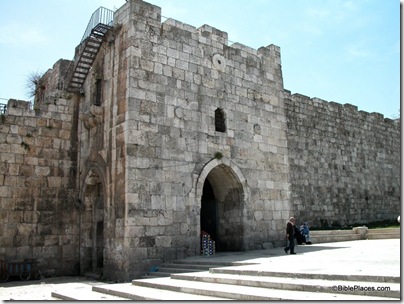
After months of repair, the scaffolding has been taken down from Jaffa Gate.  The restoration process included cleaning, filling gaps between stones, and replacing stones.  From Arutz-7:

The large black curtain covering Jaffa Gate, one of the two most famous gates leading in and out of the Old City of Jerusalem, was removed this morning at the official Jaffa Gate Rededication Ceremony. The celebrated large stone entrance underwent two months of preservation work, in the framework of a program to refurbish the Old City walls. The current walls of the Old City were built mainly by Sultan Suleimon of the Ottoman Empire in the 16th century. The current refurbishing work, which began three years ago, seeks to repair the damages of the ravages of time and neglect. At Jaffa Gate, large boulders and stones were strengthened, bullet marks were demarcated, designs and ornaments were restored, and the entire gate was cleaned.

The article includes a video interview of Yoram Saad of the Conservation Department of the Israel Antiquities Authority (3 min). 

Share: