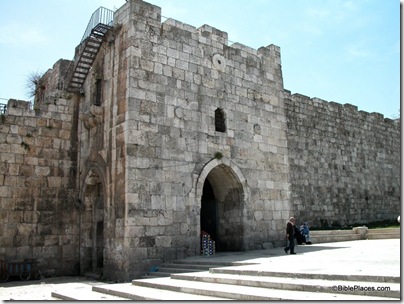
From the Jerusalem Post:

A tourist visiting the Church of the Holy Sepulcher in Jerusalem was shot by a policeman and seriously wounded Friday night after allegedly threatening visitors with a knife and attempting to stab a police officer.
Police said the incident began at closing time when two priests and a policeman walked among the visitors, asking them to leave. The man then allegedly drew a knife and threatened them. The policeman drew his sidearm and instructed the man to put down the knife. Other officers arrived on the scene and, when the man refused to lay down his weapon, sprayed pepper spray on him. The man then reportedly tried to run and was shot after threatening one of the policemen with his knife.

Holy Sepulcher facade, tb011610699

Church of the Holy Sepulcher, Jerusalem
Share:

After months of repair, the scaffolding has been taken down from Jaffa Gate.  The restoration process included cleaning, filling gaps between stones, and replacing stones.  From Arutz-7:

The large black curtain covering Jaffa Gate, one of the two most famous gates leading in and out of the Old City of Jerusalem, was removed this morning at the official Jaffa Gate Rededication Ceremony. The celebrated large stone entrance underwent two months of preservation work, in the framework of a program to refurbish the Old City walls. The current walls of the Old City were built mainly by Sultan Suleimon of the Ottoman Empire in the 16th century. The current refurbishing work, which began three years ago, seeks to repair the damages of the ravages of time and neglect. At Jaffa Gate, large boulders and stones were strengthened, bullet marks were demarcated, designs and ornaments were restored, and the entire gate was cleaned.

The article includes a video interview of Yoram Saad of the Conservation Department of the Israel Antiquities Authority (3 min). 

Share:

In late December, the exterior of the Jaffa Gate of Jerusalem was shrouded in scaffolding.  On Wednesday conservation work will be completed and the restored gate will again be visible to visitors.  From the Israel Antiquities Authority:

During the preservation work at Jaffa Gate, extensive conservation treatment was carried out on all of the gate’s facades and its interior: stones were reinforced and hazards that endangered the safety of the visiting public were removed, the bullet damage to the gate was preserved, weathered stones and decorations were treated and the gate underwent a thorough cleaning. Among other things, the gate’s dedicatory inscription, which was in a severely deteriorated physical state and was quickly becoming detached from the structure, was completely dismantled and conserved.
Jaffa Gate was first inaugurated in 1538. It constituted part of the city walls and in fact it was only toward the end of the nineteenth century did it become a center of bustling and prosperous activity. The period culminated in the year 1898, when it was decided to breach a wide entrance in the city wall of Jerusalem (as we know it today) and thereby allow the German Kaiser, Wilhelm II and his wife, Augusta Victoria, to enter the city in their carriage. Thus, for the first time in the history of modern Jerusalem, carts could enter the Old City.
In the War of Independence the gate was the focal point of some very harsh battles. During the war Jaffa Gate was completely blocked by an armored vehicle that had been damaged in the fighting and was wedged in the opening. In the cease-fire agreements between Israel and Jordan Jaffa Gate stood at the opening to the no man’s land that stretched from Jaffa Gate to Zahal Square and the Mamilla neighborhood and separated it from Jordanian controlled Jerusalem in the east. Consequently, the blocked armored vehicle was not removed, and the gate remained closed the entire period that the city was divided. The remains of the bullets that pierced the stones of the gate are clearly visible on the upper parts of the structure.

An inauguration ceremony for the gate will take place on Wednesday, April 21 at 11:30 a.m.

Jaffa Gate under scaffolding, tb011610598

Jaffa Gate under scaffolding, January 2010
Share:

Between the years 1907 and 1922, Jaffa Gate was home to an imposing 40-foot (13-m) clock tower. 

The Ottoman authorities erected the tower in honor of one of the anniversaries of Abdul Hamid.  Not all were impressed with the addition.  G. K. Chesterton described the timepiece as “an unnaturally ugly clock, at the top of an ornamental tower, or a tower that was meant to be ornamental” (The New Jerusalem [1920]). 

Jaffa Gate, breach in city wall, mat04933 Jaffa Gate with clock tower, 1918-1922 Source: Jerusalem CD (Library of Congress, LC-matpc-04933)

Soon after the British took control of Jerusalem, the tower was dismantled.  According to a 1922 report of the Pro-Jerusalem Society (cited in part here), the tower “has been bodily removed from the north side of the Jaffa Gate, which it too long disfigured, and is being set up again in fulfilment of a promise (less aggressively and shorn of its more offensive trimmings) in the central and suitable neighbourhood of the Post Office Square.”

Tom Powers has recently learned that the plan was carried out, and the clock tower was re-erected, in substantially different form, in Allenby Square.  But it didn’t stay there long, for about a decade later, the tower was demolished.  According to the Palestine Post (Sept. 27, 1934), the demolition was required by roadwork being done to relieve traffic congestion.  (75 years later, roadwork to relieve congestion is still being done in the area!)

The photo below, unearthed from the Library of Congress archives by Tom Powers, shows the tower before its demolition.

Allenby Square clocktower-1934

Allenby Square with clock tower (1934) Source: Diary in photos, Vol. 1, Library of Congress
Share:

Will Israeli tour guides be allowed to take their tour groups to Bethlehem and other West Bank sites?

The UK has banned images of the Western Wall from appearing in ads promoting tourism to Israel because it is deemed to be in “occupied territory.” 

Terror warnings in Sinai have caused most Israelis to cut short their vacations.

Remember the Jerusalem model at the Holyland Hotel? It was moved to the Israel Museum a few years ago, when the property owners began to construct luxury apartment towers, obviously more profitable than what they made from entrance fees to the model.  Israel is now reeling from charges of a new bribery scandal, this time alleging that former prime minister Ehud Olmert took hundreds of thousands of shekels in kickbacks in exchange for approving the apartment project.

If you try to bring your iPad along on your trip to Israel, it will be confiscated. (More here).

The 47th annual World Bible Quiz for Youth will take place in Jerusalem next week.  Among the 46 competitors is the son of Israel’s prime minister.  There’s also talk of reviving the Bible Quiz for Adults.

Share:

What tourist destinations inside Israel are the most popular for Israelis?  Dun and Bradstreet published the top spots for this year.  From Ynet News:

1. Biblical Zoo in Jerusalem

2. Ramat Gan Safari

3. Masada

4. Caesarea

5. Hamat Gader hot springs

6. Ein Gedi

7. Yamit 2000 Water Park

8. Underwater Observatory in Eilat

9. Banias Archaeological Site

10. Tel Aviv Luna Amusement Park

I haven’t been to numbers 7 or 10, but the others are all terrific places to visit with your family.  I would guess that the beaches around the Sea of Galilee are excluded from consideration, because they would certainly rank high on the list.  I’m surprised about Banias; I’d expect more people to prefer to picnic at Tel Dan.  That reminds me: what McDonalds in Israel has the best scenery?  I’d vote for the one next to the Senir stream (the headwaters of the Jordan River, just west of Tel Dan). 

Unfortunately I don’t seem to have a photograph.  I do have one of dinner time at the zoo.

HT: Paleojudaica

Hippopotamuses eating, tb082505678

Hippopotamuses at Biblical Zoo of Jerusalem

UPDATE (4/10): Randy Burk has sent a photo of the view from the McDonalds outdoor eating area. 

Nice!

Nahal Senir, view from McDonalds, Randy Burk, IMG_2975 Nahal Senir, headwaters of the Jordan River
Share: