An inscription with six paleo-Hebrew letters has been found in the City of David.  The Israel Antiquities Authority strangely has a press release after the item has already been published in the Israel Exploration Journal (58:48-50) and Biblical Archaeology Review (March/April 2009).  You can download a photo of the inscription here.  The question of interest to Bible readers is whether the inscription preserves three letters of the name of Hezekiah.  For analysis, I recommend Chris Heard’s blogpost and comments.

A press release from the American Friends of Tel Aviv University describes a Late Bronze Age plaque that may depict a female king, known in the Amarna Letters as the “mistress of the lionesses.”  A copy of the article includes a high-res version of the plaque drawing.

The British Museum has plans to expand, but the Louvre had more visitors in 2008.

The Turkish Riviera Magazine covers the ancient city of Perge (Perga) in an article that includes some good photographs and diagrams.  Paul visited the city on his first missionary journey (Acts 13:13-14; 14:25).

If you like to read the OT in Hebrew or the NT in Greek, but struggle with the vocabulary, you may have been attracted to one of the new “reader’s Bibles” that defines the less common vocabulary on the same page as the text.  Now John Dyer has created a “make your own” version that looks like it could be quite useful.  Even if you have a “reader’s Bible,” you could print off a chapter of the text instead of carrying multiple Bibles to church.  (It’s a new site, and there may be bugs.  Currently it’s not loading for me in Internet Explorer, but works in Firefox.  To change the reading, select the chapter at the top and type over it.)

Hattips to Joe Lauer, Explorator, and Justin Taylor
Share:

Restoration work is beginning at the Western Wall, and the Israel Antiquities Authority has more information in a press release.  More information about the project is available in two Word documents (zip) and 34 high-res photos are available here (zip).  The photos are identified as follows:

1-8 Western Wall Compound and the Western Wall
9-29 Conserve the Stones in the Western Wall
31 Western Wall Tunnels – Hasmonean aqueduct
32 Western Wall Tunnels – The Model Hall
34 Western Wall Compound Excavations

Most of the photos show general views of the Wall or of the current restoration, but a few are unique angles that you won’t see anywhere else (such as from the top looking down).  A couple of them may make you want to keep your distance from the Wall until the restoration is complete.

From the press release:

The Inauguration of the National Project to Conserve the Stones in the Western Wall and the Establishment of the Israel Antiquities Authority Conservation Department (Minhal Shimur) (April 5, 2009) 
The Western Wall and the monuments around it are among the most important cultural heritage sites in the world. Every year millions of people come to Jerusalem to see them. In order to ensure a safe and comfortable experience, the site should be constantly maintained and new services developed for the benefit of the visitors.
A year ago the Western Wall Heritage Foundation conducted a survey of the state of the wall, which revealed that the physical condition of the stones was deteriorating. It was against this background that the Israel Antiquities Authority decided to take urgent action: the Israel Antiquities Authority Conservation Department conducted an extensive physical and engineering survey of the Western Wall’s condition which culminated in the submission of a work plan. Conservation measures are currently being carried out there.
The work is focusing on the conservation treatment of the stones in the Western Wall and their stability, in accordance with their degree of preservation and the level of risk they present to the visiting public.
The project to conserve the stones in the Western Wall in particular, and the conservation and development of the Western Wall compound in general, is one of the most complex projects of its kind ever undertaken in Israel. The Western Wall compound project is an example of the enormous task that confronts us in conserving and presenting Israel’s cultural heritage. Such a cultural heritage site that is important on both a local and international level which involves large number of visitors, the need for constant maintenance, and the conservation of the Western Wall’s original appearance for us and for posterity, is first and foremost a challenge. This undertaking requires knowledge and professionalism in a wide range of fields.

The article continues here.  For more information and photos about the Western Wall, see this BiblePlaces page, or take a look at how the wall looked in the 1800s and the 1960s.

HT: Joe Lauer

Share:

The 2-hour movie narrates the history of the city. Beginning at 9pm Eastern/Pacific, the documentary is narrated by Ray Suarez, Senior Correspondent, The News Hour with Jim Lehrer. Susan Wunderink of Christianity Today reviews the film:

The film starts with Abraham leaving Ur at a time when Jerusalem was already settled by Canaanite tribes. The documentary embellishes biblical history, adding in traditions that say, for example, that Jerusalem is also where God created Adam. jerusalem_pbs Suarez goes into the details of the destruction and rebuildings of the Jewish Temple. Jesus’ short life is given about 15 minutes of the two-hour run time. For viewers who know what happens up to 70 A.D.—and then nothing—it will fill in some big gaps. The second half of the film explains how the city came to look as it does today, if you can keep up. Toward the end, the pace picks up as Suarez lists how “the world’s most contested piece of real estate” changes hands among multiple Christian and Muslim rulers. Christians, Muslims, Jews, and others fought, came, and went, sometimes leaving Jerusalem little more than a tourist trap. Mark Twain found it an unappealing, sleepy place when he visited. The Romans, after nearly wiping out the Jewish population, expelled the rest; Saladin’s Muslims let them re-settle.

The full review is here. The producer’s website includes a trailer.

Share:

From Arutz-7:

The ancient crevices of the Western Wall, filled with prayer notes tearfully tucked inside by tens of thousands of worshippers during the course of the year, underwent their twice-yearly cleaning-out on Sunday, under the watchful eye of the Rabbi of the Holy Sites, Rabbi Shmuel Rabinovich.
The notes are emptied out of the Wall just before Passover and just before Rosh HaShanah. The purpose is to make room so that people can “insert their prayer notes at the Wall without fear that the notes will fall out and be trampled upon,” Rabbi Rabinovich explained.
The notes, many of which contain the full names of family members, as well as requests for health, sustenance, a spouse, solutions for personal problems, and more, are treated with great respect by the workers.  The workers even immerse themselves in a mikveh (ritual bath) before beginning the holy work of removing the notes.
The notes are removed without the use of metal bars or utensils – which stand for warfare and the taking of life (see Exodus 20,22) – but rather with wooden rods.  Following their removal, the notes are taken to the nearby ancient Mt. of Olives cemetery for burial.

Western Wall men cleaning out prayers, tb090402207 Removing prayer notes from Western Wall
Share:

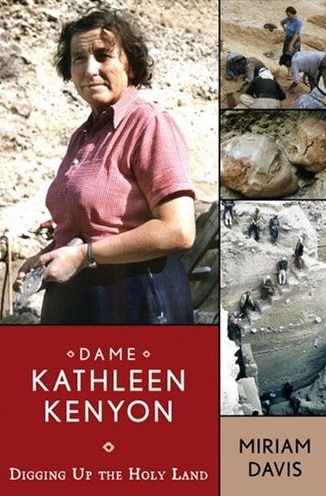
Kathleen Kenyon was recently the subject of a biography written by Miriam C. Davis.  Dame Kathleen Kenyon: Digging up the Holy Land was reviewed in Haaretz by Magen Broshi, an archaeologist and the former curator of the Shrine of the Book in Jerusalem.  His review begins:

She never married, and her friends described her as a person whose world consisted of three loves: archaeology, dogs and gin. Kathleen Kenyon was also the head of a women’s college at Oxford. She bombarded the press with anti-Zionist and anti-Israel articles and letters − she thought that the Muslims had preferential rights to the Land of Israel because they had been living there for 1,400 years, whereas the Jews had ruled the land only during the First Temple period (about 400 years) and for another 100 years, during the Hasmonean dynasty. She was, however, one of the most important archaeolokenyon_biography gists ever to dig in the Land of Israel.
That is not a negligible achievement, because more archaeological work has been done in the land between the Mediterranean Sea and the Jordan River, in other words in the State of Israel and the territories, than anywhere else in the world. There is no other country that has been so thoroughly researched, and the number of digs and surveys carried out here is incomparably greater than what has been done in far larger countries. Kenyon is not only one of the most important archaeologists to have worked here (and they number over 1,000), she is also the leading female archaeologist to have worked anywhere (along with the prehistorian Dorothy Garrod).

Broshi looks primarily at the three sites in the Holy Land that she excavated, Samaria, Jericho, and Jerusalem.  Concerning the last:

The final site excavated by Kenyon was Jerusalem, and here she was not so lucky. In effect, the digs there, as they are described in the book, were post-climactic. Despite the huge investment – seven digging seasons between 1961 and 1967 – with up to six sites operating simultaneously, employing hundreds of workers, the results were small in number and also unimportant. One reason for this is that while Jordan was still in charge of the old city, Kenyon was not permitted to work in the areas where other archaeologists – like Benjamin Mazar, who excavated south and southeast of the Temple Mount, and Nahman Avigad, who worked in the Jewish Quarter – later discovered many important finds. (Kenyon’s work was restricted because the Waqf Muslim religious trust was opposed to excavations in the Jewish Quarter, since there were Palestinian refugees living there).
The second reason is related to the limitations of her modus operandi, the Wheeler-Kenyon method, which relied on examinations in a limited zone and refrained from exposing a horizontal area. Careful examinations in pits, as meticulous as they may be, are likely to lead to a result similar to that of the Indian fable about the three blind men who fell on an elephant but were unable to identify it correctly: The person who fell on the tail shouted “ropes,” the one who encountered the legs declared “planks,” and the third, who climbed on the tusks, yelled “swords.” Only a dig that exposes a horizontal area is likely to take in the whole “elephant.”

The review concludes:

The figure of Kenyon as portrayed in the book is a model of diligence and dedication. The book is based on thorough research, including written and oral testimony. It is well-written and the story is appealing. In my opinion it deserves high praise.

HT: Joe Lauer

Share: