Excavations in the earliest part of Jerusalem have long been hindered by the presence of modern buildings. Many of the houses in the “City of David” were allegedly built without government permits, and the municipality has threatened to destroy them. This would allow for much more extensive excavation of the area. Recently, the city offered to transfer the affected families to another part of town. Naturally, the Arab residents are not enthusiastic about the plan. The article does not mention another reality: any Arab who gives up land to the Jews faces a death sentence. Haaretz reports:

The Jerusalem municipality may offer to voluntarily relocate some 1,500 Palestinian residents of the city’s Silwan neighborhood – currently living on top of an archaeological site – to alternative lots in East Jerusalem, residents say.
The option was brought up by city council and East Jerusalem portfolio holder Yakir Segev, in meetings with the residents.
The 88 houses at issue were constructed without permits in the Al-Bustan area of Silwan and are slated for demolition. They stand in an area known as the King’s Garden, defined as being of great archaeological importance by the Israel Antiquities Authority.
According to attorney Ziad Qa’awar, the last meeting took place early February and saw Segev proposing two alternative locations, one on a different hill in Silwan, and the other in the neighborhood of Beit Hanina, in the northeast of the city.
The proposition was unanimously rejected by the residents.
“We told him that these were lands we inherited from our parents, and we were not going to give them up,” said Fathi Abu Diab, a member of the residents’ committee. “We were born here, and our children were born here too.”

The story continues here.

HT: Joe Lauer
Share:

Hebrew University Professor Amihai Mazar has recently been awarded the Israel Prize.  Mazar is the excavator of Tel Qasile, Tel Batash (biblical Timnah), and Beth Shean.  He is presently excavating Tel Rehov in the Jordan Valley.  Mazar’s book, Archaeology of the Land of the Bible, has long been a standard in the subject.  Professor Mazar was my first archaeology teacher, and he gave me my first opportunity to volunteer in a dig at Beth Shean.  He represents the best of Israeli archaeology and is most deserving of this prestigious award.

HT: Aren Maeir

Share:

The current issue of Biblical Archaeology Review (Jan/Feb 2009) includes an article by Ehud Netzer on the size and location of the Antonia Fortress (teaser here).  Built by Herod the Great, this imposing structure both protected the Temple Mount on its vulnerable northern side and it served as a convenient monitoring station for potential uprisings in the Temple area.  When Paul was accused of bringing a Gentile beyond the Court of the Gentiles, a riot began.  Paul’s life was spared by Roman officials who arrested him and took him to the Antonia Fortress (Acts 21:27-22:29).

Netzer is a renowned scholar, whose work on the Herodian sites of Jericho, Herodium, Caesarea, Jerusalem and elsewhere has led some to dub him “Mr. Herod.”  He realized a lifelong dream in 2007 with the discovery of King Herod’s tomb.  He has not excavated in the area of the Antonia Fortress because the Muslim authorities forbid any scholarly activity on the Temple Mount.

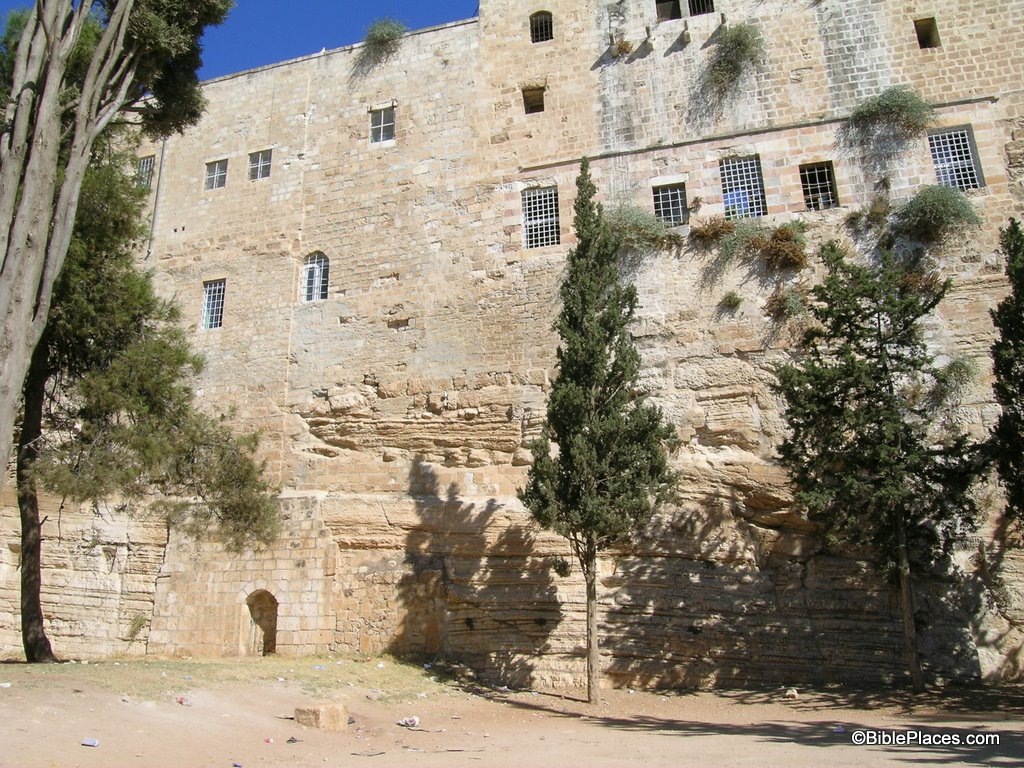
Leen Ritmeyer, a Temple Mount scholar, yesterday posted a response to Netzer’s article on the Antonia Fortress.  Ritmeyer believes that Netzer is mistaken both with regard to the size and shape of the building.  As always, Ritmeyer has beautiful and helpful illustrations.  The second diagram in his post reveals the existing remains of the fortress (in yellow).  The photo below shows the rock scarp and some of the Herodian masonry (on right).

Area of Antonia Fortress with bedrock, tb092103205

Remains of Antonia Fortress, north side of Temple Mount
Share:

The Israel Antiquities Authority has reported the discovery of an ancient marble figurine.  The bearded man may be a Roman boxer and is believed to date to approximately A.D. 200.

The figurine was used as a suspended weight together with a balance scale. This is probably the only find of its kind from excavations in the country.
A figurine (bust) made of marble depicting a miniature image of a bearded man’s head was discovered in the excavations that the Israel Antiquities Authority is conducting in the area of the Givati car park in the City of David, in the Walls around Jerusalem National Park.
According to Dr. Doron Ben-Ami and Yana Tchekhanovets, directors of the excavation at the site on behalf of the Israel Antiquities Authority, “The high level of finish on the figurine is extraordinary, while meticulously adhering to the tiniest of details. Its short curly beard, as well as the position of its head which is slightly inclined to the right, are indicative of an obviously Greek influence and show that it should be dated to the time of the emperor Hadrian or shortly thereafter (second-third centuries CE). This is one of the periods when the art of Roman sculpture reached its zenith. The pale yellow shade of the marble alludes to the eastern origin of the raw material from which the image was carved, probably from Asia Minor, although this matter still needs to be checked”.

The rest of the press release is here, and three photos may be downloaded in a zip file.  The story is covered by Haaretz and the Associated Press.  Reports of previous discoveries in this same excavation may be read here and here and here and here.

HT: Joe Lauer

Share:

NEW LIGHT ON THE PERIOD OF KING DAVID

In the Fields of Archaeology, Ancient History, and Epigraphy

INVITATION

Ben-Gurion University

‘David’s Victory’ Foundation

ACADEMIC CONFERENCE:

NEW LIGHT ON THE PERIOD OF KING DAVID

In the Fields of Archaeology, Ancient History, and Epigraphy

The conference will take place in the auditorium of the central building in the Industrial Park of Omer (near Beer-Sheva) on Thursday, February 12, 2009.

Program of the Conference:

16:00 – 16:30  Gathering and Light Refreshments

16:30 – 16:40  Greetings and Introductory Remarks:

  • Mr. Aharon Yadlin, Assistant Chairman of the Executive Board of Ben-Gurion University and 
  • Former Minister of Education and Culture of the State of Israel
  • Prof. Vladimir Berginer, President of the ‘David’s Victory’ Foundation
  • Chairman of the Session: Prof. Chaim Cohen, Academic Advisor of the ‘David’s Victory’ 
  • Foundation

16:40
– 17:30  Prof. Yosef Garfinkel and Mr. Sa`ar Ganor, The Institute of Archaeology, The Hebrew
University: “Sha`arayim – A Judaean City from the Time of King David in the Elah Valley”

17:30 – 18:05  Dr. Eilat Mazar, The Institute of Archaeology, The Hebrew University: “The Palace 
of David in the City of David”

18:05 – 18:40  Dr. Haggai Misgav, The Institute of Archaeology, The Hebrew University: “The 
Ostracon (the New Inscription) from Khirbet Qeiyafa”

18:40 – 19:00  Prof. Vladimir Berginer, President of the ‘David’s Victory’ Foundation: “The ‘David’s 
Victory’ Foundation and the Memorial Site Commemorating David’s Victory over Goliath in 
the Elah Valley” [including the screening of a new six-minute film]

FREE ADMISSION

Free parking is available alongside the entrance gate to the Industrial Park of Omer, opposite the
Luzzato Building.

The Academic Conferences Organized by the ‘David’s Victory’ Foundation:

2003 – First Academic Conference

2006 – Second Academic Conference

2009 – Third Academic Conference

HT: Agade (via Joe Lauer).

Share:

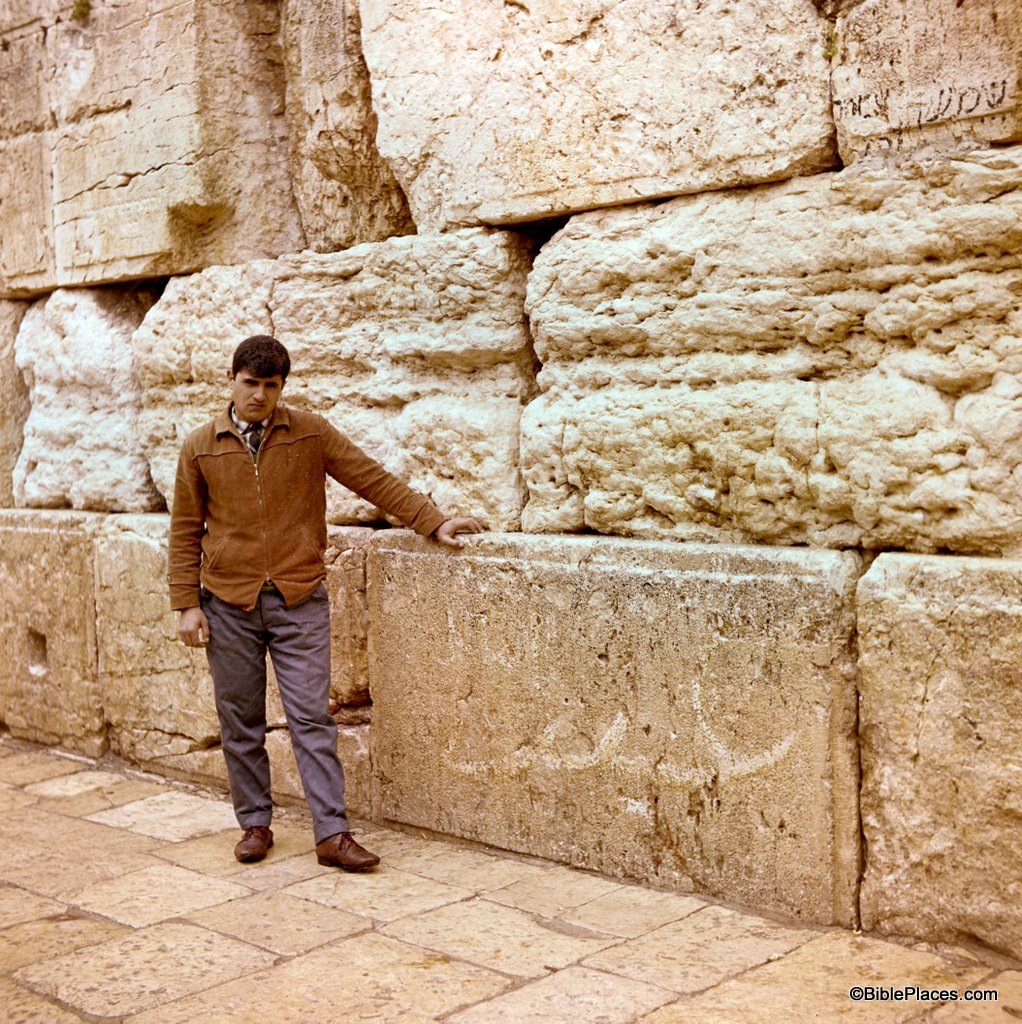
After the Israelis captured the Old City in June 1967, significant attention was given to the development of the Western Wall area.  During creation of the large prayer plaza that exists today, the ground level was lowered by about six feet (2 m).  Recently when working with the photographs of David Bivin, I came across this photo.

Wailing Wall with Nadir, db6401182012 Western Wall, January 1964

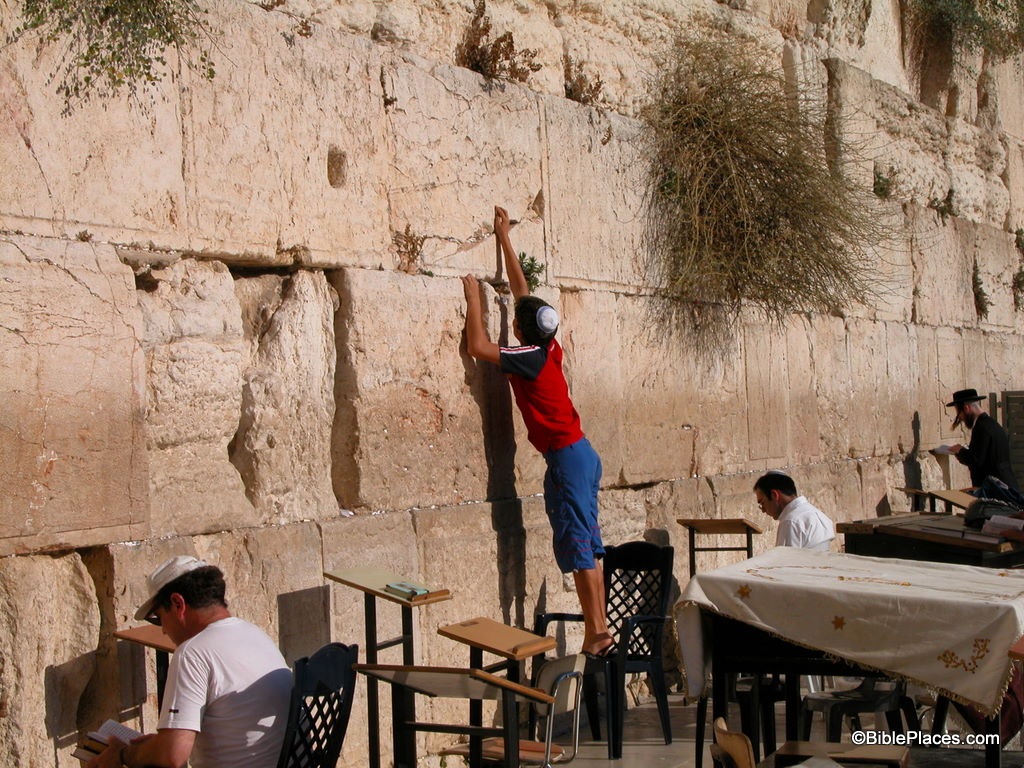
With the distinctive crack in the rock visible behind the young man’s legs, I set about finding a recent photo of the same rock.  The photo below shows the crack behind the man’s right hand.  In 1964, ground level was located at the position of his left hand.

Man putting prayer in Western Wall, tb092603035 Western Wall, September 2003

Note that he is standing on a chair.  This is the best illustration I know of that shows the change in plaza level after 1967.

You can see a photo taken by Amihai Mazar that shows a bulldozer clearing the area in the excellent book by Leen Ritmeyer, The Quest: Revealing the Temple Mount in Jerusalem, page 22.

Some other “Then and Now” photos from the Views That Have Vanished collection are posted here.

Share: