A friend who works for the Jerusalem Post has alerted me to the first in a new series of articles: perspectives on Israel from college students studying near Jerusalem.  You can read the first one about a visit to the Old City of Jerusalem here

The students writing in this series are studying at the Israel Bible Extension (IBEX) of The Master’s College.  The school is located in the Judean hills west of Jerusalem, and students come from the United States to study biblical geography, archaeology, history, Hebrew, and more.  The semester-long program is very popular among students, and, in my opinion, is one of the best things a college student can do, anywhere, ever.  I’m not unbiased; I taught at the school for many years until my present study leave. 

Share:

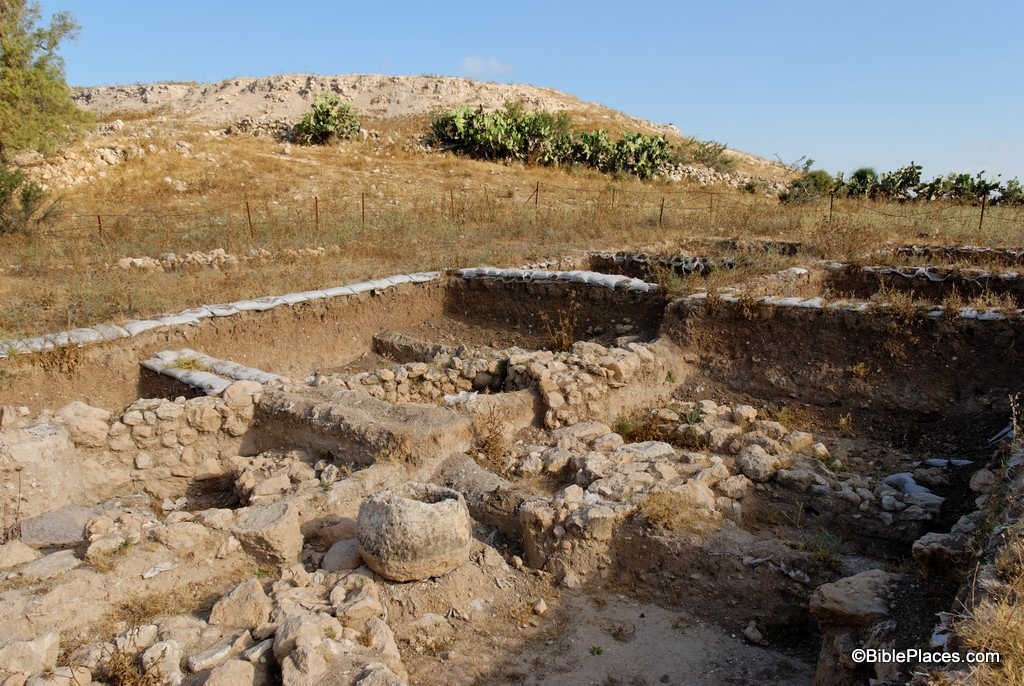
The Israel Ministry of Foreign Affairs has a press release today describing the discovery of part of the southern wall of Jerusalem during the time of Christ.  Built by the Hasmoneans sometime after 150 B.C., Josephus dubbed it the “First Wall,” in distinction to Herod’s (?) “Second Wall” and Herod Agrippa’s “Third Wall.”  The “First Wall” encompassed the city on all four sides (unlike the later two), and had sixty towers.  Archaeologists recently discovered one of those towers preserved to a height of 10 feet (3 m).  The wall was in use until the destruction of Jerusalem in A.D. 70.

Some more details:

  • The wall was discovered on “Mount Zion,” the modern name for Jerusalem’s Western Hill.
  • The results were revealed in a press conference on Mount Zion today.
  • The area had been excavated 100 years ago by Frederick Jones Bliss and Archibald Dickie, once described in the Jerusalem Post as “archeologist Blis Vediki.” No kidding! (In Hebrew, “ve” means “and.”)
  • Archaeologist Yehiel Zelinger lectured on his discoveries about 6 weeks ago at the Bible Lands Museum in Jerusalem.
  • Portions of this wall have previously been excavated in Area G, the Citadel complex, south of the Citadel underneath the Turkish wall, and near the Broad Wall next to the “Israelite Tower” (unfortunately closed to the public now for years).
  • The chief contribution of this discovery will not be in revealing where the wall was (we already knew that), but in giving us more details about that wall, by means of careful stratigraphic excavation.  Bliss and Dickie excavated by digging underground tunnels, hardly the method for understanding the history of a structure.
  • The archaeologist is impressed: “This is one of the most beautiful and complete sections of construction in the Hasmonean building style to be found in Jerusalem.”
  • Apparently the remains will be preserved in the Jerusalem City Wall National Park.
  • Remains were also unearthed of the Byzantine period wall constructed by Empress Eudocia.

The story is also carried by the Jerusalem Post, Haaretz, and BBC (with two great photos).

UPDATE: The Israel Antiquities Authority has made five photos available for download.  The aerial photo reveals that the excavation is on the west side of the Catholic cemetery on the south side of Mount Zion.  The most famous inhabitant of the cemetery is Oskar Schindler.  His tomb is visible on the lower right of the photo.

Share:

A new book is out this week that I want to recommend highly.  Walking in the Footsteps of Jesus: A Journey Through the Lands and Lessons of Christ combines passion with humor in a unique “tour” through Jesus’ life.  Author Wayne Stiles has not written a “life of Christ” book, nor has he produced a work recounting the geographical background of Jesus’ ministry.  What he has done, through his deep knowledge of Jesus’ life and land, is to take the reader on a delightful and challenging journey to the physical and spiritual places where Jesus lived and taught.Walking in the Footsteps of Jesus Cover

Stiles’ skill as a writer and “tour guide” makes the book engaging and rich with insights.  As a pastor for many years, Stiles is gifted in making lofty ideas of Scripture readily understandable to the average person, and he does so with many fun anecdotes and helpful analogies from his travels in Israel.

From Bethlehem, to Galilee and Jerusalem, and ending in Patmos, the book largely travels “in the footsteps of Jesus.”  Here is a snip related to the wilderness:

I have walked in the wilderness where Satan tempted Christ, just west of where He was baptized. Good grief, what a place. This is the wilderness of Judea where God shaped the character of the future King David in “the valley of the shadow of death” (Ps. 23:4). Here David prayed, “my flesh yearns for You, in a dry and weary land where there is no water” (Ps. 63:1). David wasn’t kidding. Endless piles of rocks, steep hills, no trees, modest vegetation, little water, slight shade, and lizards. As far as my eye could see, it was empty, dry, and depressing. I tried to imagine the silence, solitude, and struggle Jesus would have endured here for over a month. But I could not.
We can barely stand to fast for a day or two. Can you imagine fasting forty days? Jesus did so in preparation for temptation—and became desperately hungry and needy. And in His moment of need, the devil slipped in. He waits for moments like these.
“If You are the Son of God, tell this stone to become bread” (Luke 4:3).
The devil is no idiot—and also no gentleman. When he tempts, he plays dirty. No rules. No concessions. No mercy. He waited for a moment of vulnerability and then tempted Jesus to satisfy His legitimate need for food in an illegitimate way: “Turn this stone to bread—use your power to gratify your need.” What a cheap shot. Every stone would then become a temptation. And believe me, the Wilderness of Judea has plenty of stones! Jesus’ reply—although He was physically hungry—showed that He was spiritually full.
“It is written, ‘Man shall not live on bread alone.’”

If you haven’t yet been on a trip to the Holy Land, you’ll enjoy visiting it virtually through this book. 

If you have been, you’ll see it in ways that you haven’t before, even if you’ve visited countless times. 

This journey combines so many of my favorite things in one book: the places of the land of the Bible, the life of Christ, fascinating stories, excellent writing, and God-exalting, people-challenging truth. 

Pick this up for your next plane ride to Israel (or anywhere) and enjoy!

Share:

Excavations began in the parking lot below Dung Gate in 2003 and were resumed in 2007.  The Israel Antiquities Authority has just released a brief report on the discoveries from the 2007 season.  It should be noted that this report does not include results from 2008.

Excavations in Central Valley, tb051908109
Excavations of area in May 2008

The longest portion of the report concerns the Second Temple period, which is primarily the 1st century A.D.  It reports one of the discoveries:

A large impressive edifice, whose northeastern corner has only been revealed to date, was in the southern unit. The eastern wall of the building (exposed length over 14 m, thickness c. 2 m, height more than 5 m) was built of large roughly dressed fieldstones, some of which were hundreds of kilograms in weight. The northern wall (width c. 1 m) was also preserved to a substantial height. The interior portion of the building, within the limits of the excavated area, indicated that the structure was divided into elongated halls, oriented northwest-southeast.

This is what was hailed in the media as the “palace of Queen Helene of Adiabene,” though as the 1st century ruler’s name is not mentioned in this report, some may have missed the connection.

The period of greater interest given the current discussion of the nature of Jerusalem in the Old Testament period is the section on the Iron Age, quoted here in full.

The remains of the period, exposed in five strata that represented most of the Iron Age, were founded directly on bedrock, marking the earliest settlement in this part of the City of David. This period was mainly characterized in this area by relatively densely built houses of careless and poor construction. The houses, built of one-stone-wide walls, contained a variety of domestic installations. These indicate a residential quarter that existed in the area during this period.
The early phase of the Iron Age was noted for the use of bedrock the builders had employed for setting the buildings’ walls and incorporating it within their built complex of structures. Thus, ‘habitation pockets’, confined between the buildings’ walls and bedrock outcrops, were discovered. This phase was dated earlier than the eighth century BCE, based on the abundance of ceramic finds. The later phase of this period dated to the seventh–sixth centuries BCE. No building remains from Iron I were discovered.

There are several significant points to note here:

  • The discovery of houses from the Iron Age in Jerusalem is unusual.  In most places, later destruction removed traces of building except for monumental structure (walls, water systems).  The best examples of houses were found on the other (that is, east) side of the City of David in Shiloh’s excavation.
  • Caution should be taken before concluding that because some houses in Jerusalem at this time were of “poor construction,” all were.
  • Some of the material is “earlier than the eighth century,” which means 9th century (or possibly 10th, but distinguishing pottery between the two centuries is problematic at the moment).  This indicates that there was habitation in this area before the expansion in Hezekiah’s day (late 8th century) when the Western Hill was fortified.  This should not be surprising, given indications in the biblical text.
  • That no remains were found from Iron I (or Bronze Age; see end of report) also fits the biblical narrative.  The city of Jebus was small and more closely located to the Gihon Spring when it was captured by David.  The city expanded to the north as David prepared for the construction of the temple.

In other words, the biblical account would lead us to expect to find remains earlier than the 10th century in the City of David, remains from the 10th century and later at the Temple Mount, with a likely “filling in” of habitation between the two sometime after the temple’s construction. 

Admittedly, there are other possibilities, but this one seems quite reasonable, and it appears to fit with the results of this report.

Readers unfamiliar with the geography of the area and the location of these excavations will better understand the last two points with the graphic below, which shows that the excavation area was outside the boundaries of the “City of David.”

Aerial view of City of David, tb010703 givati parking diagram 
Jerusalem from the southwestClick on graphic for high-resolution
Share:

Haaretz:

Israel’s leading ultra-Orthodox rabbis are waging a new offensive against Jews visiting Jerusalem’s Temple Mount.
Rabbis Shalom Elyashiv, Chaim Kanievsky and Ovadia Yosef sent a letter recently to Rabbi Shmuel Rabinovich, the overseer of holy places in the Western Wall complex, urging him to reiterate the religious decree signed 40 years ago by most rabbis in Israel forbidding Jews from entering the Mount.
The rabbis’ efforts follow the publication in Haaretz last month of the visit of Rabbi Moshe Tendler, the son-in-law of prominent U.S. rabbi Moshe Epstein, to the Temple Mount.
Rabbi Tendler was photographed visiting the plaza atop the Mount, where the Dome of the Rock Islamic shrine now sits, igniting a firestorm of controversy in the ultra-Orthodox community. Several other prominent ultra-Orthodox rabbis have ascended the Mount in recent years, including Rabbi Dov Kook of Tiberias, the husband of Elyashiv’s granddaughter.
The rabbis’ statement calls for a complete ban on entering any part of the Temple Mount complex for fear of compromising the “purity” of the area.
The declaration stated that “as time passed, we have lost knowledge of the precise location of the Temple, and anyone entering the Temple Mount is liable to unwittingly enter the area of the Temple and the Holy of Holies,” referring to the inner sanctuary of the Temple tabernacle.

Temple Mount entrance forbidden by rabbis sign, tb122604453

The story continues here.

HT: Joe Lauer

Share:

The Jerusalem Post reports on the legal dispute over the building next to the Upper Room.

An ancient monastery adjacent to where, according to Christian tradition, Jesus ate the Last Supper, has turned into a legal battleground for Catholics and Jews. Last week the High Court of Justice issued a temporary restraining order halting construction work by a Jewish organization in a Franciscan monastery on Jerusalem’s Mount Zion adjacent to the Cenaculum, the Latin term for the room where the Last Supper was held. The court also issued an order preventing the Jewish organization – the Institute for the Study of the Family and Family Laws in Israel – from moving people in to live in the monastery, known as the Franciscan house, just outside the Dormition Church. David Bartholdy, spokesman for Tancredi, a Catholic organization that petitioned the High Court, said the construction infringed on Christians’ freedom of worship. “This is a holy place for Christians of all denominations,” Bartholdy said in a telephone interview with The Jerusalem Post on Thursday. “Work being done there is causing serious damage to a monastery with important historical and religious value. Construction workers have already uprooted ancient floor tiling, scraped off a layer of plaster from the walls, broken down antique, chiseled doors, and all this under the supervision of the Antiquities Authority. “The construction work going on at the site raises the suspicion that someone is trying to Judaize a Catholic site and prevent freedom of religious expression.”

The story continues here.

Share: