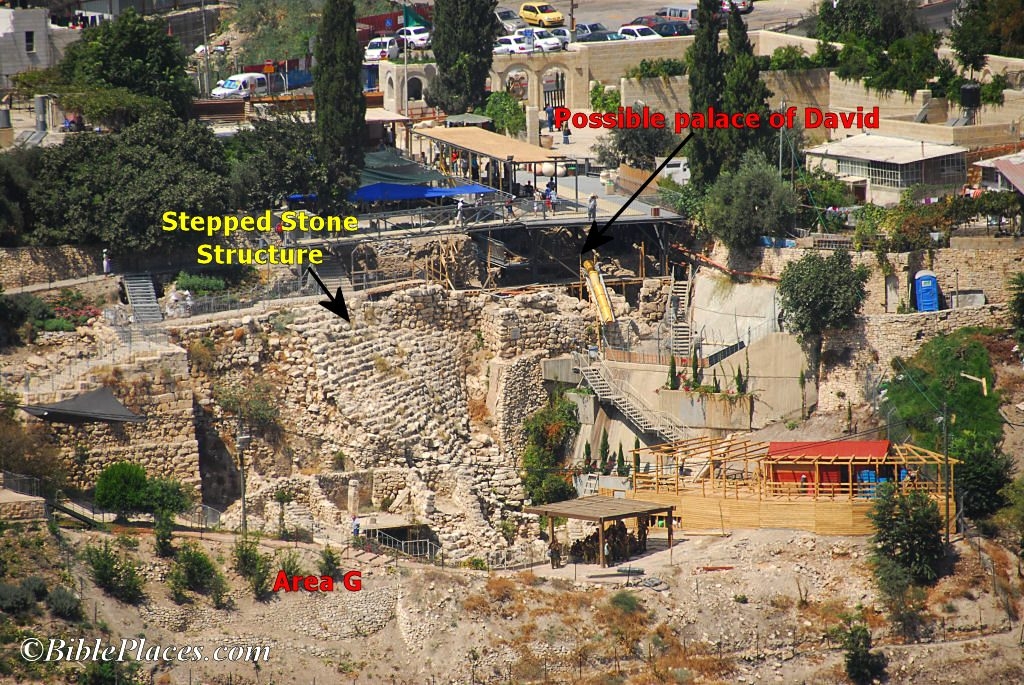
A few nights ago I was reading Hershel Shanks’ case (not online) for David’s tomb being the rock-hewn shafts excavated by Raymond Weill.  I think he’s wrong, but I think he has presented the best case that can be made.  And he can’t be far off geographically.

The traditional tomb of David is far off geographically, but it is the subject of a recent article that argues that it is authentic.  Most who hold to the Mount Zion location being accurate are ultra-Orthodox Jews who follow tradition without regard for the evidence.  This article, however, tries to make an intelligent case.  It fails, but if I was teaching Jerusalem archaeology now, I’d require my students to critique it as a useful exercise in thinking about what we know and don’t know about ancient Jerusalem.  I’m not going to comment on it myself, but if someone else takes up the challenge (and does a worthy job), I’ll either link to it or post it here.

UPDATE (8/6): Joe Lauer has mentioned below a previous article in the same publication on the tomb of David.  This article, by Ari Zivotofsky, is worth reading for any who want to know more about the subject. 

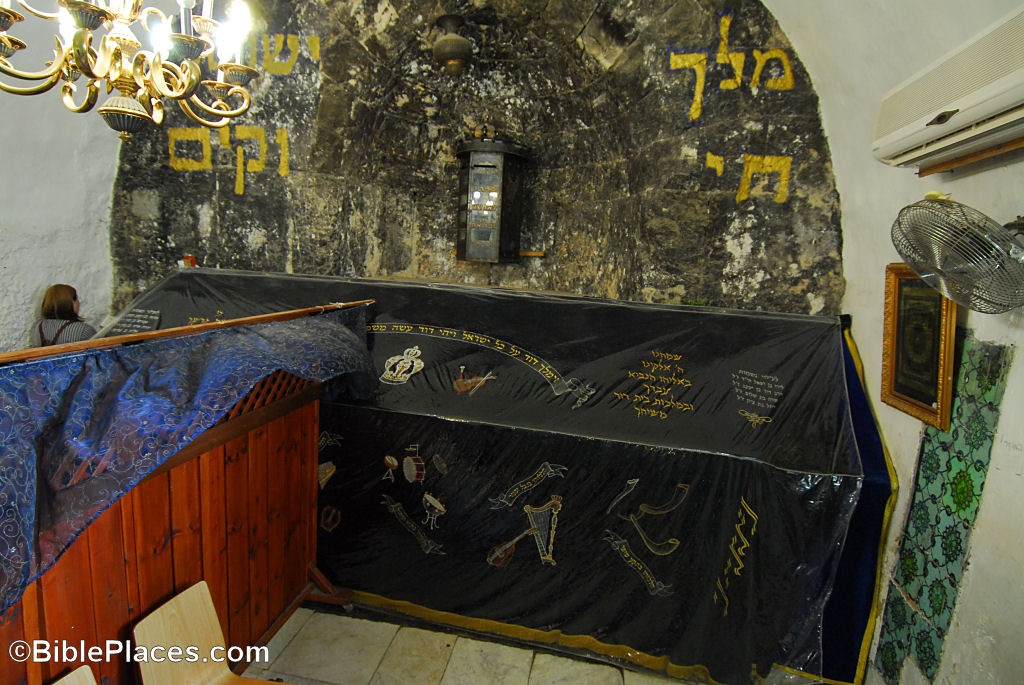
Tomb of David interior with cenotaph, tb070807983
The traditional tomb of David on Mount Zion
Share:

If you like virtual reconstruction models, there is information about a couple of new ones now online.
Virtual Qumran is being constructed by UCLA for the upcoming Dead Sea Scrolls exhibit at the San Diego Natural History Museum (June 28 – December 31, 2007).  The Quicktime movies are not yet available, but there are several dozen medium-resolution screenshots.  It is ironic how much attention Qumran gets in academia today.  Qumran is the ancient equivalent of Somis, California.  If you don’t know where that is, that’s the point.  It’s the Dead Sea Scrolls that give Qumran significance above the thousands of other ancient sites in the Middle East, but some scholars don’t believe the scrolls have anything to do with the site.

Rome Reborn is the title of a project from the University of Virginia.  They built a physical model of Rome in 320 A.D. from which a virtual model was then constructed.  “The goal of ‘Rome Reborn’ is to create a digital model illustrating the development of ancient Rome from the earliest settlement in the late Bronze Age (ca. 1000 B.C.) to the beginning of the medieval period.”  The website seems pretty spartan at this point.

One that’s been around for some years but is still a great resource is the site of the Jerusalem Archaeological Park.  This includes some nice panoramas.  They have several animations that show how the water system worked and how  large the city was in various periods.  You can also learn more about how they built the model.  I can’t seem to find the great screenshots that used to be available.

UPDATE (6/17): Those Jerusalem screenshots are here.

Share:

The Biblical Archaeology Society seems to have mastered internet marketing, judging from the frequent newsletters in my box. Usually there is at leasimaget 1/3 real content vs. sales pitches, but today’s was 100% ad. But I was happy to see “The City of David” for $50 off the regular price (now $100). I’ve been waiting to get this gem, and I can’t expect the price to get any lower. I’d be happy to tell you why it’s so great, but I’ll let you read about it yourself here.

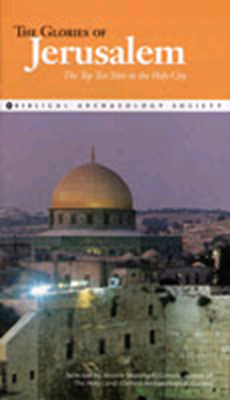
But when I clicked the ad, it brought me to the “Father’s Day” sale page (until 6/18), at the bottom of which was a promo to get you to subscribe to BAR. If you pay when you order, you get the free guide, The Glories of Jerusalem: The Top Ten Sites in the Holy City, by Jerome Murphy-O’Connor. I had not heard of this book before, and it motivated me to come up with my own list. My list is free to you, and you don’t have to subscribe to anything. If you want, you can subscribe to the BiblePlaces Newsletter, which itself is free and filled with 100% good content and no ads.image
I might preface my list by saying that while I am light years behind the distinguished author of the above guide, I have spent considerable time living in and teaching about Jerusalem. I gave my first college-level tours of the city soon after my 21st birthday, and I have taught a course on Jerusalem archaeology many times. This city is always fascinating, and there is always more to learn.

My top ten sites in Jerusalem are:


Temple Mount – this place really is the center of it all. Every time I am there, I am impressed with just how large the area is. Today it seems to be anything but a holy place, with kids playing soccer, women having picnics, and piles of trash unmoved for years. I still am inspired every time. (more)


Western Wall – large Herodian stones are cool, but this place gets a mention because of the people. Every sort of normal and strange person comes through the plaza, and they are interesting to watch and to talk to. (more)


Tomb of the Kings – most tourists never see this, because 1) the staircase is tough for old people; 2) climbing through tiny doorways inside the tomb is even more challenging; 3) it takes some work for the guide to explain what this tomb is all about; and 4) the owners of the site (the government of France) is positively rotten about allowing visitors. In my view, the government of Israel should force them to have regular hours, and they might, except for points #1-3 above. But the fact of the matter is, this is the best tomb in all of Israel, and it perfectly illustrates the types of burials in use at the time of Jesus. The tomb was carved ten years after the crucifixion of Christ and belonged to Queen Helene of Adiabene. See, I lost you already. (but more here)


Garden Tomb – it’s not the actual place of Jesus’ resurrection, but it sure feels more like it than anywhere else in the city. (more)


St. Etienne’s Iron Age tombs – forgive me for including yet a third tomb in the list, but I simply must. These are the best Old Testament period tombs in the city (probably in the country). A strange irony: these tombs are located on the property where Jerome Murphy-O’Connor has lived for many decades, but there is not a word about them in his excellent guide book, The Holy Land. Possibly they don’t want visitors (indeed, they don’t), and possibly he wants to avoid getting intoGihon Spring, tb110705566 hot water with intransigent French priests (his colleagues) who insist that these tombs are from the Roman period.
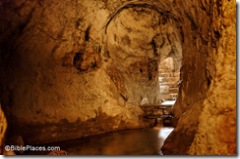

Hezekiah’s Tunnel – this is any kid’s dream – to walk through a rock-hewn tunnel for 1750 feet. Add to that the certainty that it was dug by King Hezekiah’s men and it is mentioned twice specifically in the Bible. (more)


Southern Temple Mount excavations – besides the impressive archaeological remains of streets, shops, staircases, and ritual baths, this is one area where you can be certain that Jesus saw in substantially the same form. That’s easy to miss in the rest of the dense buildings of the Old City. (more)


Mount of Olives – for the view, not the churches. (more)


Petra Hostel rooftop – ok, the view is actually better from the “Tower of David” (in the Citadel museum), but the entrance fee is less and thus I go here much more often.


Pool of Siloam – not the Byzantine one now covered with a mosqueJerusalem model from southeast, tb091506493 and reduced to a fraction of its former size, but the 1st century pool recently uncovered by archaeologists. (more)
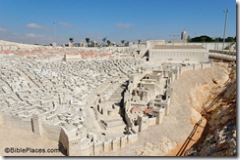

The Jerusalem model – formerly at the Holyland Hotel, now at the Israel Museum. I suppose this isn’t a “site” in its own regard, but it is such an excellent presentation of how the city used to look that I cannot omit it from the list.


Honorable mention:
St. Anne’s Church/Pools of Bethesda

Church of the Holy Sepulcher (more)

Broad Wall (more)

Herodian Quarter

“Solomon’s Quarries”

There are many books about Jerusalem that describe the above-mentioned sites, but you might consider purchasing the Jerusalem volume of the Pictorial Library of Bible Lands. This CD ($25) includes 650 photos of the city along with all of my teaching notes. You’ll like it! (Sorry for sneaking that ad in!)
Share:

The Edmond Sun has a brief article on three local college students who spent five months excavating the so-called “palace of David” in Jerusalem.  Much of the article is not new to those following the story, but some information that I haven’t seen elsewhere is the fact that phase 3 of the project will begin this summer, and only 20% of the excavation is considered complete.  Apparently the dig will continue to the west of the present area, if the comment about moving “inland” is any indication.  Mention is made again of a wall that is 7 meters thick and 20 meters long.

HT: Explorator

Share:

This story is about a week old, but I didn’t have time to comment on it before.  Here is the complete text from the Jerusalem Post.

First Temple wall found in City of David
A wall from the First Temple was recently uncovered in Jerusalem’s City of David, strengthening the claim that it is the site of the palace of King David, an Israeli archeologist said Thursday.
The new find, made by Dr. Eilat Mazar, a senior fellow at the Shalem Center’s Institute for the Archeology of the Jewish People, comes less than two years after she said she had discovered the palace’s location at the site just outside the walls of the Old City.
The monumental 10th century BCE building found by Mazar in 2005 following a six month dig has ignited debate among archaeologists about whether it is indeed the palace built for the victorious David by King Hiram of Tyre as recounted in Samuel II:5.
A 20-meter-long section of the 7-meter-thick wall has now been uncovered. It indicates that the City of David once served as a major government center, Mazar said.
Mazar estimates less than a quarter of the entire wall has been uncovered so far, and says that it is the largest site from King David’s time ever to have been discovered.
The dig is sponsored by the capital’s Shalem Center, with academic backing from the Hebrew University of Jerusalem.

A few comments:

1) As noted elsewhere, the headline is unfortunate.  Mazar did not find, and does not claim to have found, any portion of a wall of a temple.  The missing word is “period” – Mazar found a wall from the “First Temple period,” which is equivalent to Iron Age II (1000-586 B.C.).

2) This story strikes me as a publicity-getter, as it lacks much substance.  No photos or diagrams are included, and details are sparse.  This accords with the rather secretive approach being taken in this dig.  I can give personal examples, but will not.

3) I have trouble believing that a 7-meter-thick wall was found, and if it was, I hardly believe that it belonged to a palace (and not to the city itself). That’s the same thickness as the Broad Wall, which is one of the largest fortification walls in the entire country.  The City of David is a small area; a 7-meter wall would take away a significant percentage of the living area.

4) I am also suspicious of Mazar’s dating until more is published (and the experts confirm it). That’s not because I don’t believe in the biblical account of David (actually, I do), but because I think that sometimes archaeologists jump to desired conclusions too quickly.

5) I have significant objections to Mazar’s interpretation of the Bible as regards David’s palace.  Elaboration on that will have to wait for another time.


Excavation area from the east

Share:

Aren Maeir has posted a short report from his visit to Eilat Mazar’s excavation in the City of David. 

Mazar just concluded a six-month season and has uncovered more of the monumental building that she believes may be identified with the palace of David.  Maeir says:

The structure is in fact very impressive, and it appears, based on the finds from below this astounding structure, that it was built no later than the late Iron Age I, since no later finds were found in the fills below this structure. Also, in one area, Iron Age IIA pottery was found in a context of secondary construction and use of the building. What this clearly means is that in the verly late Iron Age I, or the very early Iron Age IIA (whether you date this to late 11th/early 10th, or late 10th), there were substantial public architectural activities in Jerusalem. 

Read the whole post and the comments, especially the one by Zachi Zweig.  This is the sort of stuff that newspapers should be covering, not the silly nonsense so often featured.  Mazar’s findings may radically affect our understanding of Jerusalem in ancient times, and that’s without regard to whether she has found David’s palace or not.

Elsewhere, Ronny Reich told a group of us today about some 200 bullae, a beautiful carved pomegranate, and a huge quantity of fishbones that have been discovered in the City of David in the last couple of years.  These are significant because they date to the 9th century B.C. and have Phoenician elements.  Reich suggests that these may be related to influence from the northern kingdom via Queen Athaliah.  An article is due out on this in Qadmoniot (Hebrew) in the near future, with an English translation to follow in another journal.

Share: