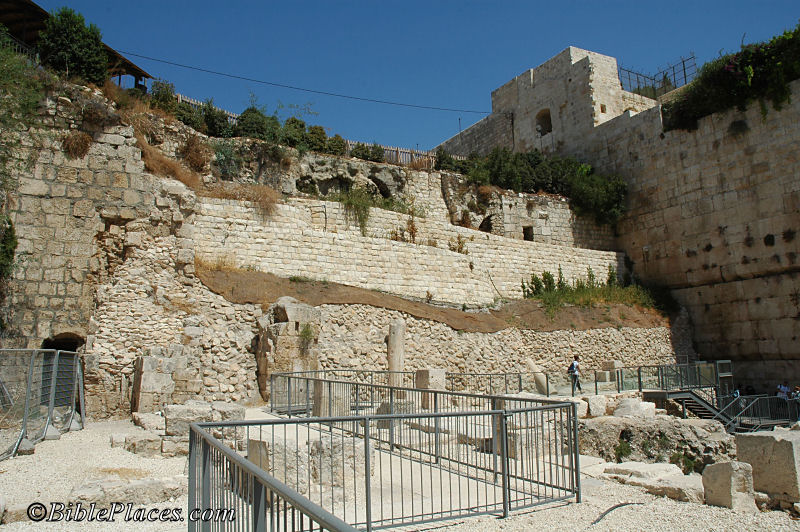
Archaeologists have recently uncovered a large cemetery where the Jerusalem model of the Holyland Hotel once sat. Hundreds of thousands of tourists have flocked to the site, never knowing that they were standing on top of a remarkably well-preserved Intermediate Bronze cemetery.
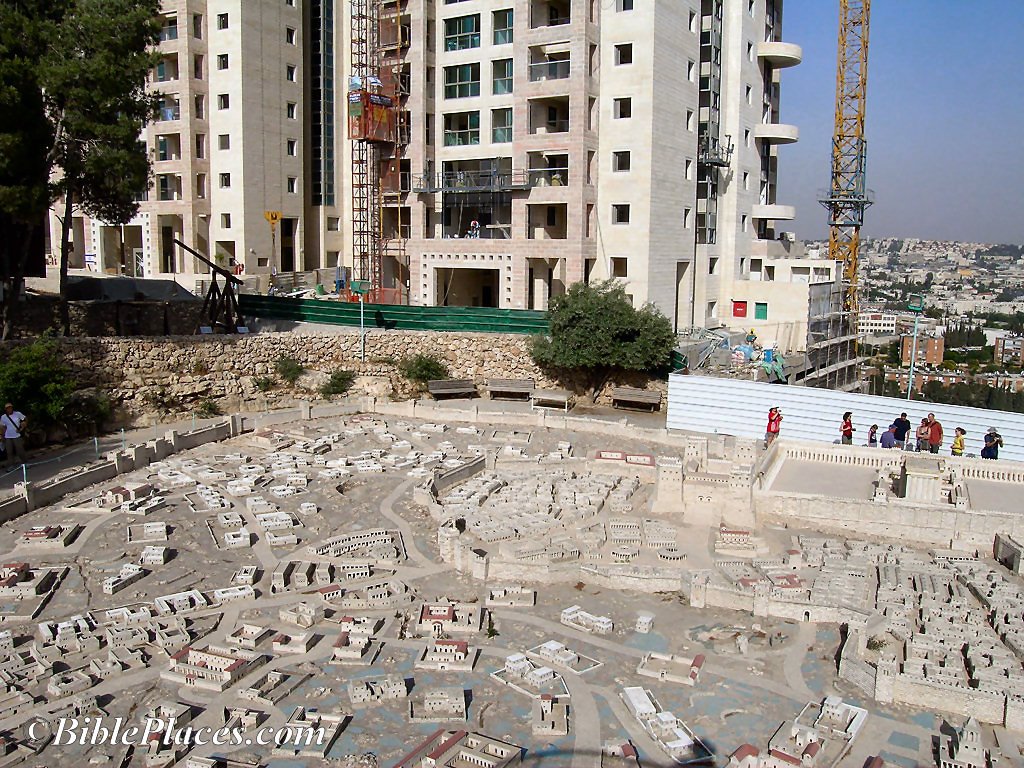

For forty years, the Holyland Hotel model was a highlight of many tourists’ visits to Jerusalem. But then the owners decided they could make more money if the land was developed into high-rise apartment buildings. Construction began while an alternate location for the model was sought.


Earlier this year the model was transported from its original location to the Israel Museum where it is now on display to the public. What no one knew is that the model site was a cemetery during the Intermediate Bronze Age.
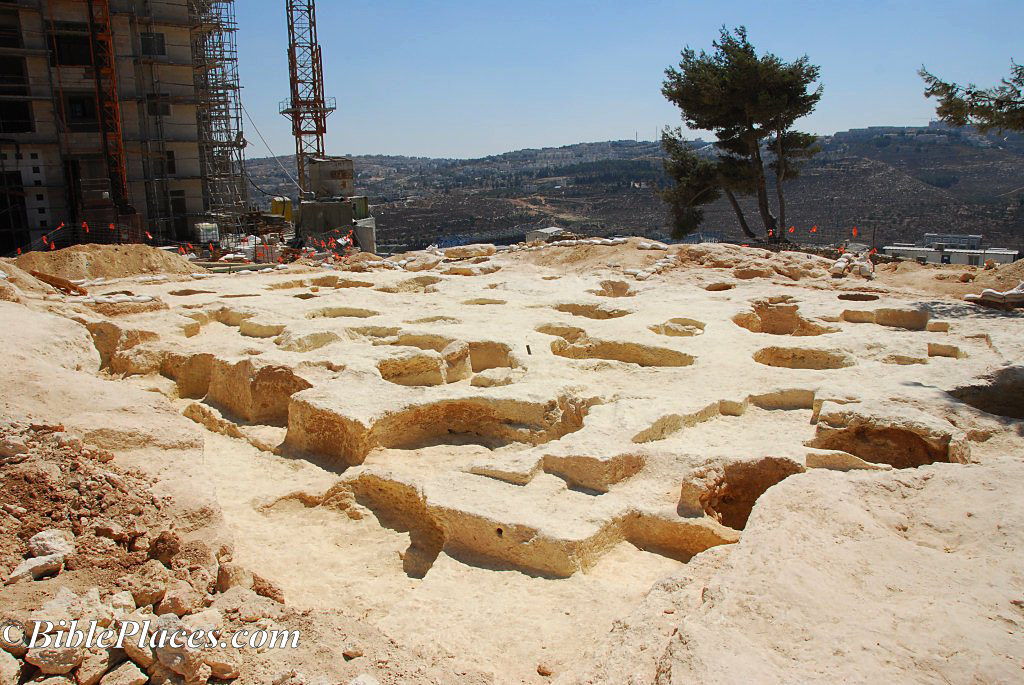
About 20 shaft graves have been excavated so far, but it is estimated that there are 50 tombs in the area.
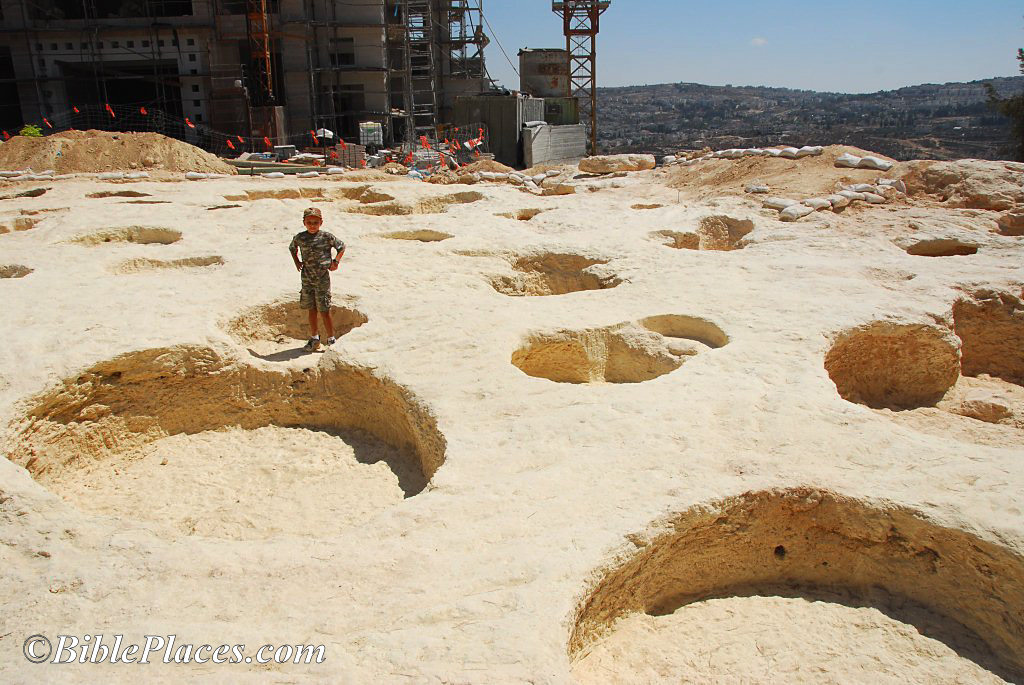
Shaft graves are the most common type of tomb from the Intermediate Bronze Age. This period dates from approximately 2300-2000 B.C., and has also been known as Early Bronze IV and Middle Bronze I.

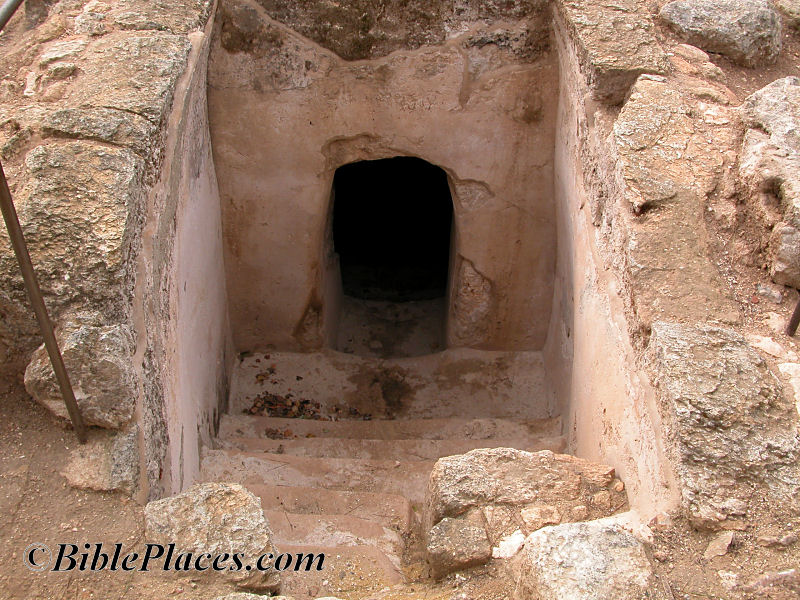
A shaft grave consists of two sections: a shaft and a burial chamber. The photo above shows a tomb with most of the top missing, but gives a good top-plan of the tomb. The shaft is in the back and the burial chamber is in the foreground.
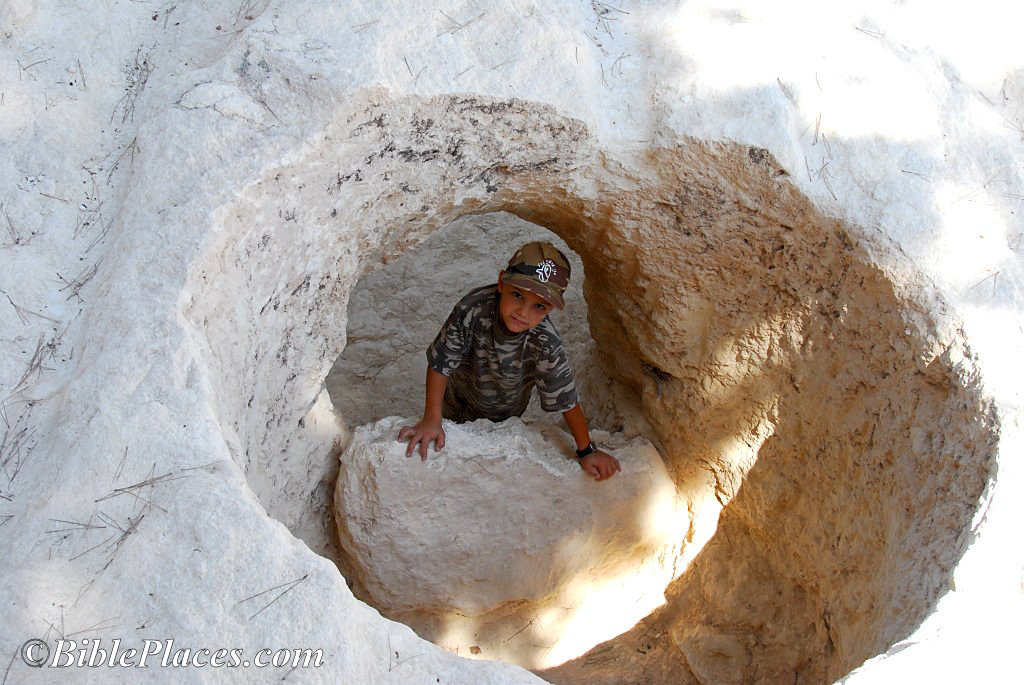
More of this tomb is preserved, including about 5 feet (1.6 m) of depth of the shaft. Typically the shafts are about 6 feet (2 m) deep. The burial chamber was sealed off from the shaft by a blocking stone, which is visible below the boy’s hands.
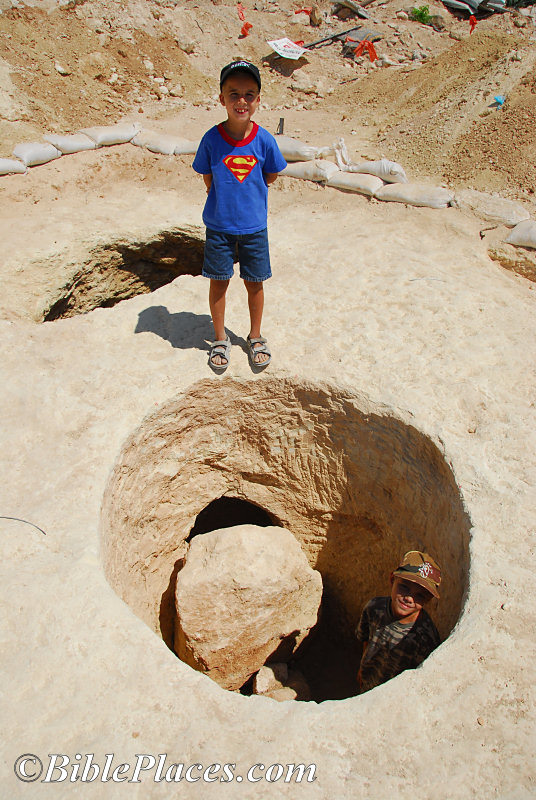
In this tomb, a larger blocking stone has been preserved in the shaft. Visible behind Superman is an opening to the burial chamber.
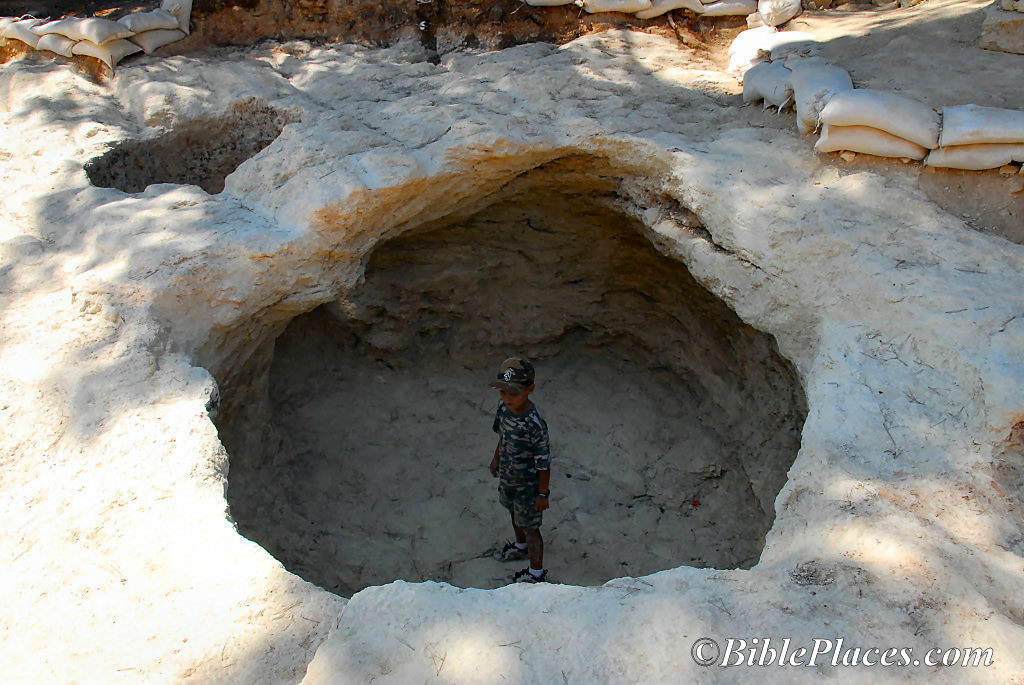
This burial chamber was preserved to a greater height, but the large hole in the ceiling gives a good view. Other burial chambers are preserved intact, but dark caves don’t look as interesting in a photograph.

Finds from the tombs indicate that they continued in use into the Middle Bronze period (2000-1550 B.C.). The Mount of Olives is also home to a cemetery from this period, but less is known about it because later cemeteries were built over it (in the Second Temple and modern periods). This cemetery is located 3 miles (4.8 km) west of the Temple Mount (here’s the kmz file for those with Google Earth).

As far as we know, this discovery has not yet been reported in the media.
Share:

The Guardian has an article ostensibly about Jerusalem, but which seems to have been the result of a tour with archaeologist Gabriel Barkay. This is one of those articles that reminds you not to believe everything that you read. Among the errors in the first two paragraphs, Barkay worked in Silwan (not the City of David) in 1968-1970 (not in the 1970s) conducting a survey (not an excavation).

The author writes, “In the 1970s, he led a group of school children on a tour of first Temple tombs above the Valley of Hinnom….” The year was 1979 and he was conducting an archaeological excavation, not leading a tour. Some school children did join the excavation as volunteers, but I can hardly imagine Barkay leading some tour when “one of the pupils started hammering at a stone slab which suddenly gave way” – yikes! Not exactly how one should do archaeology, but, of course, it didn’t happen that way at all. Instead of this sloppy journalism, I recommend an article on Barkay that was published last year in Haaretz starting here and continuing here.

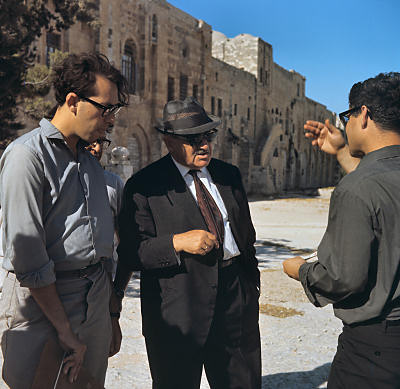
Gabriel Barkay and Michael Avi-Yonah, 1968
Unpublished photo from a forthcoming BiblePlaces.com photo CD
Share:

Statistics may be boring to many, but a survey conducted by Dr. Maya Hoshen relating to the history of the population of the historic Old City of Jerusalem revealed that in 2004 the residents within the main part of the walls numbered 131,400 – “out of whom 16,200 were Jewish (12%), 115,200 Arabs (88%). 93% of the Arab population was Muslim, the rest Christian” (Kol Ha’Ir, August 11). In other words, of the Arab population of the Old City, only 7% were Christians.
Source: Caspari Center Media Review

UPDATE (9/12): The above numbers are incorrect. According to data from the Israeli Central Bureau of Statistics from 2003 (as cited in a Peace Now report), the Old City population is 35,372 people, not 131,000! The Muslim percentage is about 77%. The report gives other interesting statistics of the population of each quarter.

With 35,372 residents and a total area of about 900 dunams, Jerusalem’s Old City is one of the most densely populated areas in Israel, and the Muslim Quarter is the most densely populated area of the Old City. Population density varies dramatically within the Old City; details for each quarter, and for Jerusalem as a whole, are as follows:

Jerusalem: Jerusalem (not including the Old City) is about 125,398 dunams in size, with 657,845 residents, for a population density of about 5 persons per dunam.

The Jewish Quarter: The Jewish Quarter is 122 dunams in size and has 2,387 inhabitants, for a population density of around 20 persons per dunam. Of these residents, 1,811 are Jewish, 560 are Muslim, 12 are Christian, and 4 are “unclassified.” According to a 2002 report by the Jerusalem Institute for Israel studies, the Muslim population is composed of around 100 families living mainly on the edge of the Quarter, in homes that were designated for expropriation after 1967, but never actually taken from their owners.

The Christian Quarter: The Christian Quarter is 192 dunams in size and has 5,276 residents, for a population density of around 28 persons per dunam. Of these residents, 3888 are Christian, 1,242 are Muslim, 143 are Jewish, and 3 are “unclassified.”

The Armenian Quarter: The Armenian Quarter is 126 dunams in size and has 2,461 residents, for a population density of around 20 persons per dunam. Of these residents, 1205 are Christian, 748 are Jewish, 504 are Muslims, and 4 are “unclassified.”

The Muslim Quarter: The Muslim Quarter has a population of 25,248 residents and is 461 dunams in size, of which about 142 dunams is taken up by the Temple Mount/Haram al Sharif – an area not available for residence. This yields an overall population density (for the habitable 319 dunams) of about 79 persons per dunam. Of these residents, 23,461 are Muslim, 431 are Jewish, 1354 are Christian, and 2 are “unclassified.”

HT: Carl Rasmussen of Holy Land Photos for catching the error.

Share:

Discoveries from the current season of excavations at Ramat Rahel are featured in this Jerusalem Post article. The most interesting paragraphs are these:

A highly sophisticated ancient water system dating back to the end of the Kingdom of Judah in the Seventh Century BCE….

The water system, cut deep into the rock foundation, includes large underground water reservoirs, five open pools, small canals that transported water between the pools and three underground canals. The system continued to be functional, although with some alterations, during the Persian Era, the return to Zion after the destruction of the First Temple, the Fifth and Fourth Centuries BCE and through the Hellenistic Era in the Third Century BCE.

Along with 18 Jewish ritual baths from the Hellenistic Period, the archeologists uncovered a bathhouse and villa, and a large Byzantine village with a church, monastery, rooms and halls.

I suspect that the journalist got the date of the ritual baths mixed up; they are almost always from the late Hasmonean or Herodian period. About a dozen were known at the site before the present excavations, dated to the Herodian period. For more about previous excavations at the site, see the current issue of Biblical Archaeology Review for an article by Gabriel Barkay.

Share:

We’ve reported in multiple BiblePlaces Newsletters and here about the plan to excavate the collapsed earthen ramp leading from the Western Wall plaza to the Temple Mount. This ramp gives access to the only Temple Mount gate open to non-Muslims. Haaretz reports today that the Israel Antiquities Authority will begin digging in a few days.

The ramp, which leads from the Western Wall plaza to one of the Temple Mount Gates, is located in one of the most sensitive places in the world, and plans to carry out excavations under it have therefore been held up by the Shin Bet security service and the prime minister’s military secretary for the past two years, for fear of Muslim riots.
Archaeologist Meir Ben-Dov warned yesterday that any digging in the area could lead to bloodshed. 


“Digging in this place goes way beyond the archaeological sphere. This place is far too sensitive and the price would be much too high,” he said.
However, a reliable source told Haaretz that “now that the Palestinian Authority is paralyzed and incapable of resisting, it’s an excellent opportunity to carry out the plan.”

These photos were taken in the last year.
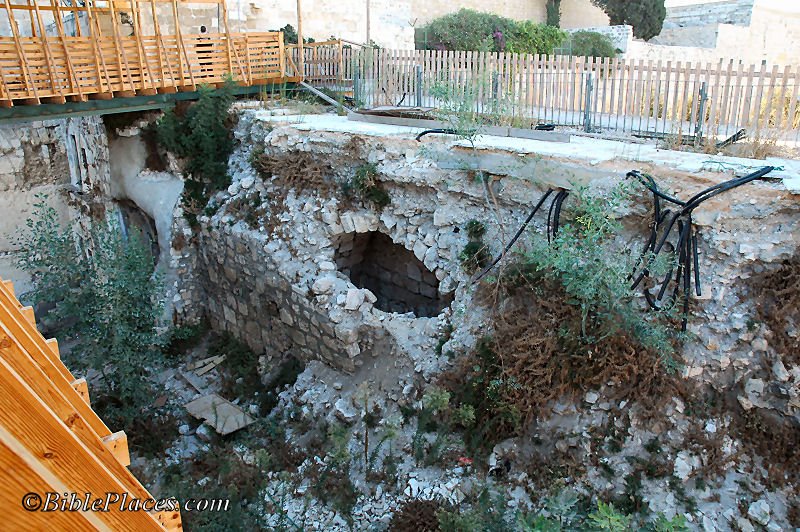
The temporary wooden ramp is on the left side of the earthen ramp to be excavated.

The north side of the earthen ramp collapsed after a snowfall in February 2004.

The ramp is more prominent when viewed from the south side. The new excavations will apparently create a connection between the Western Wall prayer plaza and the Jerusalem Archaeological Park (aka Southern Temple Mount Excavations).

Share: