The Jerusalem Post has a lengthy article on the recent excavations in the City of David. Though there are some basic factual errors, the article does a good job of informing the reader of some of the different views about the latest archaeology in the oldest part of Jerusalem. The two major excavations in the last decade are those of Eilat Mazar (“palace of David”) and Ronny Reich and Eli Shukrun (Warren’s Shaft, Siloam Tunnel, Pool and Spring Towers, Pool of Siloam). According to these excavators, the biblical accounts are essentially supported by the archaeology. According to Israel Finkelstein, an archaeologist at Tel Aviv U., “all of the recent discoveries from Ir David are merely ‘Messianic eruptions in biblical archeology.'” Perhaps the article’s writer misunderstood him, but if not, it’s really a stunning statement by one who has received major awards for his archaeological contributions. More accurately, it is a foolish statement.

I shouldn’t be surprised, because this is the trend. The trend used to be (unfortunately) that when anything was discovered it was immediately connected to the Bible and claimed to “prove” the Bible.  
This itself is foolish, as often errors in identification and dating were made. Proof was desired so badly that caution wasn’t exercised.

The trend now is the opposite. Scholars who distrust the Bible respond in knee-jerk fashion to deny any biblical connection regardless of the evidence. Is the discovery of the “Pool of Siloam” really a “Messianic erruption”? How so? I’ll tell you what it is – a massive and impressive reservoir that dates (no doubt) to the time of Jesus and is the area where ancient sources describe (photos). It doesn’t prove that Jesus healed the blind man there, and no one is claiming that it does prove that. But some scholars are apparently so scared of anything that may relate in any way to the Scriptures that they dismiss them with a passing insult.

Perhaps Finkelstein wasn’t referring to the Pool of Siloam, but only to the “palace of David.” Now, I am not certain that the monumental building that Eilat Mazar discovered was David’s residence. And Finkelstein isn’t either. But you wouldn’t know it from the way he talks.

“Because there was no floor discovered and no pottery assemblages or olive pits or seeds, the building could be from the ninth century or the eighth or the eighth, or from two minutes ago, there is no way to know.”

But it also could have been from the 10th century. The reason that it “isn’t” is because Finkelstein’s mind is already made up. [Did he really say the building could have been from “two minutes ago” or is that just incompetent journalism?]

The article tries to spin this as Mazar and the sponsoring institution already having their minds made up. But no one has their mind made up more than Finkelstein, who published his elaborate theory in The Bible Unearthed. He argued, on the basis of the absence of evidence, that there was no great united monarchy in Jerusalem. Who has the most to lose? He does. Mazar’s discovery would pull the bottom card from his stack of cards. But the article doesn’t say that, and Finkelstein for certain doesn’t want to draw attention to that.

There is additional folly in the notion implied in this article that the sponsoring institution (which has right-wing views) could somehow change the discoveries in the excavation. It’s almost as if completely different things would be discovered if the dig was sponsored by a left-wing institution than if it was sponsored by the Shalem Center. Does anyone really believe that a respected archaeologist like Eilat Mazar would fabricate her findings? Does anyone really believe that if she did that she could get away with it? Archaeologists have voices and they have journals and they are not afraid to speak up.

Here’s a good rule of thumb for reading articles like these in the future: if the only nay-sayer is Israel Finkelstein, he can safely be ignored.
Share:

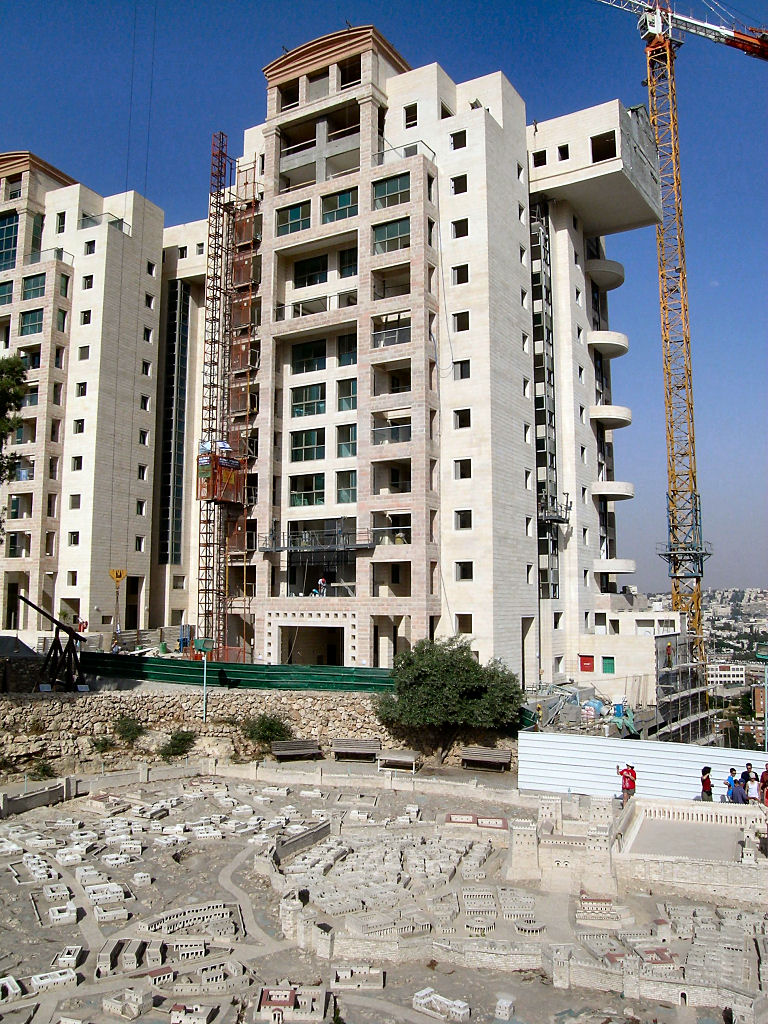
I’ve been talking about this for much of the last year in BiblePlaces newsletters, but now it’s in process. The Holyland Hotel model is leaving the Holyland Hotel, in route to the Israel Museum. 

This recent Haaretz article certainly has a catchy first sentence, if you don’t realize what she is talking about.

At the end of January, the Temple Mount will be sawed into pieces and carted away. Not the real Temple Mount, of course, but its miniature model on the hillside next to the Holyland Hotel in southeast Jerusalem. The mountain and the temple compound built by King Herod are part of a model of Jerusalem in 66 C.E., on the eve of the revolt against the Romans that ended in the destruction of the city.

Last week I was at the museum and peeked over the wall and saw that parts of the city had been put in place. But it still looked like parts of the foundation were incomplete. It will take some time, I imagine. Hopefully it will be open before the summer tourists arrive.

The model is moving because of the construction of high-rise apartment buildings near it.

UPDATE: Ferrell Jenkins has a photo of the model being dismantled on his Biblical Studies Info Blog.

Share:

The Jerusalem Post has a follow-up story with photos on the excavation of an apparently Jewish town near Jerusalem. What makes this one remarkable is that it was inhabited between the First and Second Jewish Revolts (70-132 A.D.), at a time when little is known about Jews in Judea archaeologically. One problem with this identification is that no mikva’ot (Jewish ritual baths) have been discovered, but this may be owing to the limited excavation area. In fact, the entire dig is being conducted on a traffic island on the ancient “Road of the Patriarchs” (Watershed Ridge). That makes the excavation six meters wide and 360 meters long. Alas, the site will probably be destroyed when the light rail is constructed in 2007.

Share:

I suppose I should send out a BiblePlaces Newsletter for this one, but time is short with a group arriving tomorrow and I don’t know that I will. But putting it on the blog is easy…

A month ago a friend alerted me to a new “virtual tour” of the Church of the Holy Sepulcher. It was selling for $20 and I downloaded the demo and was impressed. But I didn’t want to spend the $20 at the moment. A few weeks later I heard that the price was down to $10 and so I went and bought it. Now I just happened to check the site again to see if the special was still on and I see the price is down to ZERO. Until Jan 2. 

You can’t beat that price. And it comes with an 89-page essay about the church written by an expert on it, Tom Powers (whom I also am happy to count a friend).

I know that if you’re a Protestant, the church probably doesn’t give you the warm fuzzies. But it probably is built on the actual place of the crucifixion and burial, and it certainly is an interesting and historic building.

It’s free here. Until Jan 2 Jan 8.

Share:

Paleojudaica points to a new article in Haaretz on the Pool of Siloam. It’s basically an update of things since the last big reporting in August. There are a few new things of note, which I may or may not have mentioned here before. This includes:

  • The discovery of the 1st century street near the pool. For those of you who know, they found this street in the excavations underneath the road/path that runs between the old pool and the garden which covers the new pool. The archaeologist told me that he would like to reveal the entire length of the road from the Pool of Siloam to the Temple Mount. I told him he was crazy. Unless he is thinking of digging a tunnel underneath all of those houses. Then he’s still crazy :-).
  • The recovery of “cylinder seals.” This is clarified in a post to the ANE list that the Hebrew original has “seals and bullae.” (Bullae are seal impressions.) The archaeologist told me that these date to the 9th century and do not contain personal names (as do most of the bullae found in Area G, dating to the early 6th century B.C.). The importance of these seals, if they date to anything before the mid-8th century, is that they will give evidence of an administrative center in Jerusalem at that time. Many scholars reject the biblical evidence for that, and there’s not much else evidence for it outside the Bible. The article doesn’t say, but I can tell you that these seals were found around buildings which were constructed inside the Middle Bronze pool, which is just to the north of the Gihon Spring and protected by the Pool Tower. That’s the area shown in this photo.


Boy, here’s a line that I can’t believe. At least it wasn’t true a few weeks ago. “Garbage is being collected on a regular basis.” Or maybe they’re collecting the garbage, but they just can’t get the residents to understand that they have to put it in those large containers.

UPDATE: The Hebrew version of the article has a photo montage which shows some of the seals.

Share:

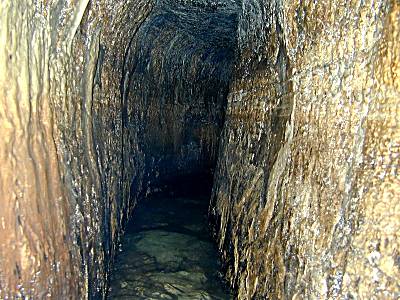
I used to think that I took good photos in Hezekiah’s Tunnel. I remember when most people’s photos didn’t come out and mine did (because of the difficulty of focusing in the dark). That was back in the days when I was mainly shooting students in the tunnel for the early IBEX website. But yesterday I had the chance to shoot some photos of the tunnel without students; ones that should have more general use.

As of a few years ago, this was my best shot (currently on the Hezekiah’s Tunnel page at BiblePlaces.com). It was used a few years ago by NationalGeographic.com when they did an article about the tunnel.

This is one of the shots I took yesterday. I think it’s better.


Curiously enough, some poster on a forum at dpreview.com asked a question a couple of days ago about how to get a good photo in Hezekiah’s Tunnel. Now that I had done some experimenting, I had an answer for him.

Share: