Many plans were announced over the year that we linked to in weekend roundups. You can decide for yourself what you would consider most important and what you think will never materialize. And you can check back in a few years and see what dreams have come true.

Israel’s Tourism Ministry has approved construction of a 4-mile-long cable car line connecting Upper Nazareth and the lower slopes of Mount Tabor.

Construction has begun on the “Sanhedrin Trail,” running from Beth Shearim to Tiberias. It will be a “smart” trail that “will communicate with the hikers using an innovative, augmented reality-based application.” The project also includes the building of a visitor’s center in Tiberias.

Solomon’s Pools will be renovated with a $750,000 grant from the US Consulate in Jerusalem with hopes of turning it into a major tourism site.

A $14 million elevator will be built at the Western Wall Plaza to allow the elderly and disabled to go to the Jewish Quarter.

Authorities are planning to stop the flow of sewage down the Kidron Valley.

“The ancient city of Ephesus . . . is set to once again have a harbor on the Aegean coast, according to an ambitious new project.”

Turkey is planning to restore and open the stadium of Perga.

The 7-year long excavation project of Carchemish has ended and the Karkamış Ancient City Archaeological Park is supposed to open on May 12, 2018.

Plans are underway for a restitution (reconstruction?) of the Mausoleum at Halicarnassus.

Share:

Yehiel Zelinger discusses the excavations of Bliss and Dickie on Mount Zion and shares a great photo of his own excavations there. (I’d love to see a labeled version, if anyone knows of such or can create one…)

Archaeologists working in Turkey have uncovered evidence related to the collapse of the Assyrian empire.

The first phase of the renovation of St. Catherine’s Library is complete.

The BBC tells the story of the relocation of the modern inhabitants of ancient Gadara through its former security guard.

The third issue of the newsletter of Tel Aviv U’s Institute of Archaeology includes field reports from this year’s work at Ashdod-Yam, Kiriath Jearim, Beth Shemesh, and the City of David.

And now Hollywood gives us . . . Samson. (Whether you are interested in the trailer or not, click the link to see how archaeologist Aren Maeir keeps his volunteers in line.)

Ferrell Jenkins shares a beautiful aerial photo of Jerusalem from the west.

A writer for Haaretz (premium) asks, Why doesn’t Israel have a museum for Jesus?

LiveScience looks into the backstory of a bone that Oxford scientists believe comes from the real St. Nicholas.

The city of Nazareth has cancelled Christmas celebrations in protest of Trump’s decision to recognize Jerusalem as Israel’s capital.

Was the census that brought Jesus to Bethlehem a coincidence?

Among the specials for Accordance’s 12 Days of Christmas is the Biblical Archaeology Review (1975-2012).

We’ll have part three of the roundup tomorrow with another dozen stories.

HT: Ted Weis, Joseph Lauer, Agade, Mark Hoffman, Charles Savelle, Explorator, Chris McKinny,
Mike Harney

Share:

Underwater excavations of Corinth’s harbor at the port of Lechaion have exposed five-ton stone blocks and a perfectly preserved wooden post. This article has lots of illustrations. A 2-minute video takes you there.


The New York Times reports on the numerous ancient finds from Rome’s ongoing subway project.

Archaeologists have been excavating a large Byzantine church complex near Beth Shemesh.

Excavations have revealed that the population of Shiloh switched from Gentile to Jewish following the Maccabean Revolt.

New excavations have revealed a Hasmonean-era settlement at Susiya near Hebron.

Israel’s Culture Minister is initiating a $70 million plan to uncover, preserve, and develop historical sites in Jerusalem and vicinity.

The Israeli government has approved funding for a hiking trail through the West Bank and Golan Heights.

“The ancient city of Hazor in the Galilee seems to have muscled its way to fame and fortune partly by developing a unique business in farming sheep, instead of goats like everyone else in Canaan 3,700 years ago.”

Recent excavations at Jericho show a close relationship between the city and Egypt.

Archaeologists have traced the history of a menorah relief in various buildings in Tiberias.

A young girl discovered a Hasmonean-period oil lamp in a porcupines’ den near Beth Shean.

Elsewhere antiquities thieves denied their activities by claiming that they were “just hunting porcupines.”

New book, with free ebook download: Finding Jerusalem: Archaeology between Science and Ideology, by Katharina Galor.

Cuneiform cookies are all the rage this Christmas. This video will teach you how to bake Ugaritic
Tablet Biscuits.

HT: Ted Weis, Joseph Lauer, Agade, Mark Hoffman, Charles Savelle, Explorator, Chris McKinny,
Mike Harney

Share:

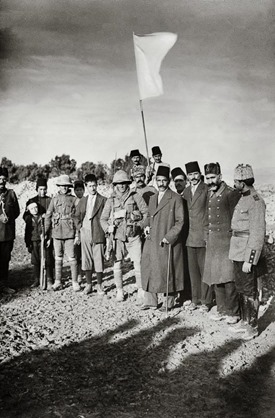
One hundred years ago today, British General Edmund Allenby entered Jerusalem on foot and issued a proclamation declaring British control of the city. Two days earlier the Turkish authorities had surrendered, ending 400 years of Ottoman rule (1517-1917).

The photographic department of the American Colony was on hand to capture these historic moments. The most famous photo shows the mayor of the city surrendering to the British with a white flag.

Surrender to British, 1917, mayor with white flag, mat00162

Below is a photograph of the letter of surrender.

Surrender 1917, copy of letter of surrender, mat02222

General Allenby was advised to make a contrast of his entrance into Jerusalem with the rather ostentatious ceremony of the German Kaiser Wilhelm II in 1898, and he dismounted his horse to walk through Jaffa Gate into the city.

Allenby entry 1917, troops entering Jaffa Gate, mat02225

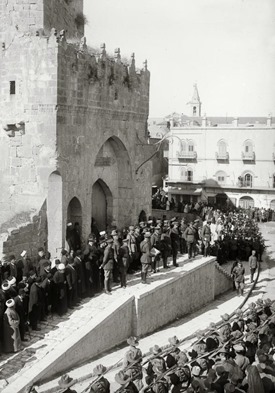
Around the corner stands the entrance to the historic “Citadel of David,” and on its podium Allenby read a proclamation.

Allenby entry 1917, Pasha reading proclamation, mat02228

The proclamation was translated into six other languages and posted throughout the city.

Allenby entry, proclamation of martial law, mat05790

The text of the proclamation, read by Allenby 100 years ago today, is as follows:

To the inhabitants of Jerusalem the Blessed and the people dwelling in the vicinity: The defeat inflicted upon the Turks by the troops under my command has resulted in the occupation of your city by my forces. I therefore here and now proclaim it to be under martial law, under which form of administration it will remain so long as military considerations make it necessary. However, lest anyone of you be alarmed by reason of your experience at the hands of the enemy who has retired, I hereby inform you that it is my desire that every person should pursue his lawful business without fear of interruption.
Furthermore, since your City is regarded with affection by the adherents of three of the great religions of mankind, and its soil has been consecrated by the prayers and pilgrimages of multitudes of devout people of these three religions for many centuries, therefore do I make known to you that every sacred building, monument, holy spot, shrine, traditional site, endowment, pious bequest, or customary place of prayer, of whatsoever form of the three religions, will be maintained and protected according to the existing customs and beliefs of those to whose faith they are sacred.”

Thus Allenby declared that while the city was under martial law (as the Great War continued for another year), he guaranteed the status quo for places of worship.
After the proclamation, Allenby was photographed riding his horse away from Jaffa Gate.

Allenby exit, on horseback at Jaffa Gate, mat00169

This photograph below was taken on the day of Jerusalem’s surrender and shows five British generals.

Surrender of Jerusalem, 1917, British generals, mat05788

A monument to the surrender was later erected in Romema in west Jerusalem where it still stands until today.

Monument of Jerusalem's surrender to British in Dec 1917, tb060601206

All of the black and white photos above come from the Early 20th-Century History volume of the American Colony and Eric Matson Collection. The complete PowerPoint file of the 1917 Turkish
Surrender is available as a free download.

For more information, see:

The story of the surrender at the blog of the Israel State Archives (ISA)

“General Allenby Shows How a Moral Man Conquers Jerusalem”Haaretz (premium)

General Allenby’s Entry into Jerusalem – a 14-minute film held by the Imperial War Museum (details here)

Picture of the Week: Surrender of Jerusalem, 1917 – a post on this blog by Seth M. Rodriquez
Share:

Israeli archaeologists have found that early Muslim coins and vessels were inscribed with menorahs.

Scholars have discovered more than 1,000 seal impressions from the 2nd-3rd centuries AD in southeastern Turkey.

“An Egyptian-European archaeological mission working in Luxor Governorate uncovered a collection of 27 fragmented statues of the lioness goddess Sekhmet.”

The gate of Amenemhat I is being moved from north Cairo to the Grand Egyptian Museum.


Haaretz (premium) reports on a new study of the decoration of the Temple Mount by Orit Peleg-Barkat. Leen Ritmeyer considers her work on the Royal Stoa and proposes another plan.

On Academia: Yosef Garfinkel argues for the identification of Khirbet Qeiyafa as an Israelite site.

The excavations of the Galilean synagogue of Huqoq are summarized following a recent lecture by Jodi Magness.

Shmuel Browns shares a beautiful photo of a supermoon rising over the Dead Sea this week.

Now released: The second and third videos of Wayne Stiles’s new series, “The Promise That

Changed the World: A Journey through the Birth of Christ.”

Barnes & Noble has a 25% off coupon, good in store or online (GETGIFTING), valid through Sunday. Here are four recommendations:

HT: Joseph Lauer, Agade, Rodger Young, Steven Anderson

Share:

Last year scientists conducted a first-ever examination of the traditional tomb of Jesus inside the Church of the Holy Sepulcher in Jerusalem. Test results now reveal that the mortar used to secure a slab over the traditional burial bench of Jesus dates to the 4th century. This confirms that this is the tomb venerated by Christians when Constantine built the first church here.

The story is reported by various sources, including National Geographic. This paragraph is the most important:

While it is archaeologically impossible to say that the tomb is the burial site of an individual Jew known as Jesus of Nazareth, who according to New Testament accounts was crucified in Jerusalem in 30 or 33, new dating results put the original construction of today’s tomb complex securely in the time of Constantine, Rome’s first Christian emperor.

Elsewhere the article several times mentions “surprises” from the investigation. But I think those are best understood either as journalistic editorializing or perhaps the researchers trying to justify the expense. The best word for this study is “confirmation.” We now have physical evidence for what historians have long thought: the Church of the Holy Sepulcher was first built in the 4th century over a tomb believed to have been used by Jesus.

HT: Wayne Stiles, Ted Weis

Share: