As excavations get underway at Kiriath Jearim, Haaretz (premium) reports on a 9-foot-wall discovered there and Finkelstein’s belief that the site held a temple that competed with Jerusalem.

The “ancient coin” the 9-year-old girl found last week is in fact a modern souvenir.

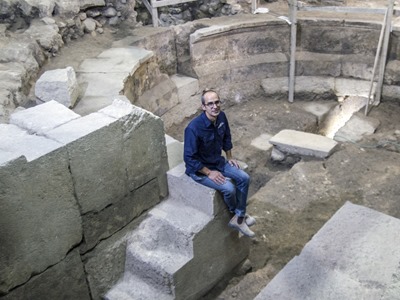
The bones of people killed at Khirbet el-Maqatir during the First Jewish Revolt were recently reburied in Ofra. Leen Ritmeyer posts more information and images.

Leen Ritmeyer shares a photo of a Temple Mount model made of Legos.

Wayne Stiles explains the significance of the Gezer boundary stones.

John DeLancey explains Hezekiah’s Tunnel, with help from a couple of videos including one narrated by Ronnie Reich.

Bill Schlegel has created a 5-minute video about Bethsaida in which he uses aerial footage to explain the two candidates and identify which site is most likely Bethsaida.

Lois Tverberg shares her experience and photos from the el-Araj dig this summer.

G. M. Grena has created a video tutorial on how to identify a LMLK seal impression. (Is his computer running Windows 95?)

R. T. France identifies seven differences between Galilee and Judea in the time of Jesus.

Israel’s Good Name describes his experience as a square supervisor at the Gath excavations.

Accordance has a big sale that includes a couple of collections from Carta, including the Carta Super Combo and the Carta Select Combo.

HT: Mike Harney, Agade

Share:

A 6th-century mosaic discovered near the Damascus Gate in Jerusalem has a Greek inscription mentioning Emperor Justinian. A 1.5-minute video is here.

At Neve Tzuf, an 8-year-old girl discovered a coin from the Jewish Revolt inscribed “Holy Jerusalem.” (But I’ve heard doubts that the coin is genuine.)

Haaretz: “The discovery of masks and more cultic vessels has bolstered confidence that ritual activity was taking place 3,200 years ago at Libnah, a Canaanite city that would become Judahite in the biblical era.”

Ahramonline: “An Egyptian archaeological mission from the Ministry of Antiquities has uncovered five Roman tombs during excavation works carried out in Beir Al-Shaghala site in Dakhla Oasis in Egypt’s Western Desert.”

The pottery restorer of the Gath excavations shows how to restore an ancient pot in in a 1.5-minute video (but you might want to turn the sound off first).

Authorities have frozen plans to build a new neighborhood over the abandoned Arab village of Lifta.

Those who know the history here may get a kick out of Rami Arav’s declaration that “Archaeologists should be led by the evidence, and not force the evidence into their theories.” His new piece entitled “Bethsaida Controversy” is a frontal attack on the recent el-Araj claims.

Check out the latest www.HolyLandPhotos.org Newsletter from Carl Rasmussen here.

If you like this blog and you use Facebook, you might consider joining the “Nerdy Bible Backgrounds and Bible Geography Majors” group.

“Ancient Babylonians living almost 4,000 years ago could have predicted Monday’s total solar eclipse.” Here’s how.

Two of my partners on the new Photo Companion to the Bible witnessed the eclipse in different parts of the United States. Steven Anderson shares his experience here, and the photo below was taken by A.D. Riddle.

HT: Joseph Lauer, Mike Harney, Ted Weis, Agade

Total solar eclipse, totality, from center line in Makanda IL, adr1708215777
Total solar eclipse on August 21, 2017
Photo by A.D. Riddle
Share:

Three major salvage excavations in Israel may be excavated by private companies and directed by archaeologists with little experience. (Haaretz premium)

They’re already recruiting for next summer’s excavations in Israel, and you can get all the information for digging at Shiloh here.

Aren Maeir visited the new excavations of Kiriath Jearim and was very impressed with what he saw, suggesting that the site “will become one of the most important excavations in Israel.”

Carl Rasmussen explains how a solar eclipse in 763 BC helps us to establish an absolute chronology for OT events.

Steven Weitzman answers the question, “Can Genetics Solve the Mystery of the Lost Ten Tribes of Israel?”

Israel’s Good Name reports on his Bar Ilan U tour of the City of David.

Ferrell Jenkins explains the Megiddo water system with a drawing he made and several photos (including a labeled aerial photo).

Wayne Stiles shows how Banias Falls is a picture of despair.

We were very encouraged by some positive words about the new Photo Companion to the Bible by Ferrell Jenkins, Andy Naselli, Leen Ritmeyer, Charles Savelle, and Luke Chandler. Luke writes,

There is nothing like this resource available for teachers today. I cannot recommend the Gospels Photo Companion to the Bible strongly enough.

The introductory special continues through Monday, August 21.

Share:

The suggestion that el-Araj could be New Testament Bethsaida received lots of media attention, not all accurate. I’d recommend this report by Jeffrey Garcia and Steven Notley at the CSAJCO website.

An on-site interview with archaeologist Mordechai Aviam is posted at CBN’s Facebook page. The Today show sent a correspondent to the site. National Geographic sets some of the record straight. The Times of Israel looks at the two sites laying claim to the name of Bethsaida.

Jonathan Adler guides a video tour of a 2,000-year-old stone quarry that he excavated in Galilee. The Jerusalem Post provides a written report on the excavations.

The Abel Beth Maacah team shares a photo album from the 2017 season.

Nadav Na’aman argues that Khirbet Qeiyafa was not a Judahite city in a recent article in the Journal of Hebrew Scriptures.

Authorities are planning to stop the flow of sewage down the Kidron Valley.


The Wall Street Journal (subscription req’d) traces the path in which ISIS looted artifacts make their way out of the Middle East.

“Researchers have unearthed a 1,800-year-old writing tool, or stylus, at the Assos archeological site in northwestern Turkey.”

Excavations at Carchemish have uncovered 250 Hittite bullae this year.

Excavators at Tell Tayinat found fragments of a large female statue at the citadel gate complex.

Now online: Egypt’s Ministry of Antiquities’ Newsletter for July 2017.

Wayne Stiles considers the strategic value of the International Highway (aka Via Maris).

Ferrell Jenkins shares a couple of beautiful photos of ibex at En Gedi and Ein Avdat.

Leon Mauldin explains the location and importance of Akeldama, the Field of Blood.

Cynthia Shafer-Elliott is on the Book and the Spade discussing “Canaanite DNA” and her excavation work at Tel Halif.

We will be making a big announcement in the BiblePlaces Newsletter on Monday. You can sign up for a free subscription here.

HT: A.D. Riddle, Lois Tverberg, Chris McKinny, Charles Savelle, Agade, Ted Weis, Joseph Lauer

Share:

For the last four months, the Israel Antiquities Authority has been excavating on the east side of the City of David, and today as the traditional anniversary of the temple’s destruction approaches they announced the discovery of evidence of the city’s fall in 586 BC.

The press release includes a 2-minute video of Joe Uzziel explaining what they found and questions that have been raised.

In the excavations – concentrated on the eastern slope of the City of David, dwelling places 2,500 years old, once covered by a rockslide, have been revealed. Nestled within the rockslide many findings have surfaced: charred wood, grape seeds, pottery, fish scales and bones, and unique, rare artifacts. These findings depict the affluence and character of Jerusalem, capital of the Judean Kingdom, and are mesmerizing proof of the city’s demise at the hands of the Babylonians.
Among the excavation’s salient findings were dozens of jugs which served to store both grain and liquids, a stamp seal appearing on some of them. Furthermore, one of the seals discovered was that of a rosette, a six-petal rose. According to Ortal Chalaf and Dr. Joe Uziel, Israel Antiquities Authority excavation directors: “These seals are characteristic of the end of the First Temple Period and were used for the administrative system that developed towards the end of the Judean dynasty. Classifying objects facilitated controlling, overseeing, collecting, marketing and storing crop yields. The rosette, in essence, replaced the ‘For the King’ seal used by the previous administrative system.”
The wealth of the Judean kingdom’s capital is also manifest in the ornamental artifacts surfacing in situ. One distinct and rare finding is a small ivory statue of a woman. The figure is naked, and her haircut or wig is Egyptian in style. The quality of its carving is high, and it attests to the high caliber of the artifacts’ artistic level and the skill par excellence of the artists during this era.
According to Ortal Chalaf and Dr. Joe Uziel, Israel Antiquities Authority excavation managers, “The excavation’s findings unequivocally show that Jerusalem had spread outside of the city walls before its destruction. A row of structures currently under excavation appears beyond the city wall that constituted the eastern border of the city during this period. Throughout the Iron Age, Jerusalem underwent constant growth, expressed both in the construction of the city wall and the fact that the city later spread beyond it. Excavations carried out in the past in the area of the Jewish Quarter have shown how the growth of the community at the end of the 8th Century BCE caused the annexation of the western area of Jerusalem. In the current excavation, we may suggest that following the westward expansion of the city, structures were built outside of the wall’s border on the east as well.”

The story is reported by the Jerusalem Post, Arutz-7, and other outlets.

Shattered jugs attesting to the destruction (COURTESY OF ELIYAHU YANAI / CITY OF DAVID ARCHIVE)
Shattered jugs destroyed in Babylonian conquest
Photo courtesy of Eliyahu Yanai, City of David Archive
Share:

Archaeologists working near biblical Aphek have discovered a large water reservoir dating to about the time of King Hezekiah. The press release includes a one-minute video.

They found Roman remains at el-Araj, a candidate for New Testament Bethsaida. Here’s a photo of some of the Roman mosaic floor.

The third week of the excavations of Gath has ended, and they found an inscription.

Chris McKinny summarizes the results of the third week at Tel Burna. And if you missed the second week review, you can find it here.

The Temple Mount Sifting Project has discovered a Doric capital dating to the 2nd century BC.


The Times of Israel profiles ABR’s new excavation project at Shiloh.

The Greek Orthodox Church has sold the amphitheater and hippodrome of Caesarea in a secretive manner that raises lots of questions.

Archaeologists have found 8 more ancient shipwrecks off the coast of Greece, bringing the total number now discovered there to 53.

“Egyptologists have discovered what they believe is the burial chamber of Ankhesenamun, Tutankhamun’s wife.”

Here are five surprising inventions of ancient Rome, including luxury cruise ships.

Ferrell Jenkins shares his experience and photos with camel caravans in the Sinai.

John MacDermot will lecture on “Olga Tufnell – The Life of a Petrie Pup” at the British Academy in
London on September 20.

Recent Shroud of Turin Research is the top of this week’s edition of The Book and the Spade.

I thought the Kindle sale for Eric Cline’s Three Stones Make a Wall: The Story of Archaeology was for one day only, but the $1.99 deal was still good the last time I checked.

HT: Carl Rasmussen, Charles Savelle, Joseph Lauer, Agade, Mike Harney

Share: