Robert Mullins has written an update on the major discoveries at Abel Beth Maacah after 5 years of excavation.

A head of an Akhenaten statue has been discovered in excavations at Tel el-Amarna.

Some medieval artifacts were seized in Turkey, including a gold seal attributed to Solomon. James Davila provides some commentary.

The Jerusalem Post profiles the Temple Mount Sifting Project.

Mordechai Aviam and R. Steven Notley make a case that el-Araj should now be considered the leading candidate for the site of Bethsaida-Julias.

Appian Media has released a “sneak peek” from an upcoming upside in the “Following the Messiah” series with an acoustical experiment at the Cove of the Sower.

With the water level of the Sea of Galilee nearly at an all-time low, Ferrell Jenkins illustrates the dramatic difference with several photos of Heptapegon.

David Moster will be lecturing on “The Jordan River and the Two Half-Tribes of Manasseh” in NYC on Nov 14. (We noted some of David’s work on the Jordan River here last year.)

Ben Witherington is on The Book and the Spade talking about his newest book, A Week in the Fall of Jerusalem.

HT: Paleojudaica, Joseph Lauer, Agade

Share:

I was asked recently if I had a recommendation for a good book on the Temple Mount. I love easy questions! Here’s the short answer: http://amzn.to/2xZqkkf.

And here’s a slightly longer answer if you’re not sure which book of Leen and Kathleen Ritmeyer to start with:
The Quest: Revealing the Temple Mount in Jerusalem. This is the reference book that describes the sacred compound through the centuries. I doubt it will ever be surpassed. (I see that at the moment, Amazon has it for sale at more than 50% off.)

Image result for leen ritmeyer quest

Jerusalem: The Temple Mount. This newer Carta Guide is a quick and easy read that you can use to walk yourself around the complex. (You might not be allowed to carry it on the mount itself, but you can do what I did and read it first and take notes of what to look for.) This guide is full of fascinating details you probably will never learn otherwise.

Image result for leen ritmeyer temple mount guide

In addition to these two, Carta Jerusalem has published a number of shorter, subject-specific books that cost about $15 each. All are full-color and filled with the beautiful reconstructions that the Ritmeyers are known for.

Understanding the Holy Temple of the Old Testament (2017)

Jerusalem in the Time of Nehemiah (2nd ed., 2015)

Jerusalem in the Year 30 AD (2nd ed., 2015)

Understanding the Holy Temple Jesus Knew (2017)

The Ritual of the Temple in the Time of Christ (2015)

Several of these books are available in Accordance. (I don’t see any available from Logos or Olive Tree at present.)

If you’re looking for beautiful images to use in personal study and teaching, check out the Image Library of Ritmeyer Archaeological Design for a large selection of unique images at very reasonable prices.

Share:

The biblical Feast of Trumpets, usually observed now as the Jewish New Year, was celebrated on Thursday. Ferrell Jenkins shares some photos of the ram’s horn.

With the ending of year 5777, the Temple Mount Sifting Project identifies the “top 10 topics” over the past year.

Ferrell Jenkins explains how Dr. James Turner Barclay is honored in the Cathedral of St. George in Jerusalem.

Israel’s Good Name describes his experience on the Horvat Midras excavation.

The re-dating of the Gihon Spring fortifications is the topic on this week’s edition of The Book and the Spade.

The latest issue of Tel Aviv includes an article on the “Monumentality of Iron Age Jerusalem Prior to the 8th Century BCE.”

There have been a number of wolf attacks in the Judean wilderness in recent months. The article includes a video of a wolf chasing a young ibex.

“Dr. Scott Stripling and Dr. Craig Evans headline the upcoming Text and Trowel symposium on archaeology and the Bible at the University of Pikeville on Oct. 20-21, 2017.”

HT: Agade

Share:

Israel’s Tourism Ministry has approved construction of 4-mile-long cable car line connecting Upper Nazareth and the lower slopes of Mount Tabor.

Tomb raiders have vandalized the Judean desert fortress of Hyrcania.

Reader’s Digest suggests 10 sites (mostly eateries) to visit in Israel that you (probably) have never heard of before.

Leave it to Wayne Stiles to figure out a way to make good use of my photos of Horeshat Tal (and make an important application).

“All the stone inscriptions from ancient Athens in UK collections are to be presented in English translations for the first time, thanks to a new project undertaken by Cardiff University.”

The aim of Israel’s Academy of the Hebrew Language’s Historical Dictionary Project is to document and define every Hebrew word ever used.

The Times of Israel reports on Lawrence Mykytiuk’s study that confirms the historical existence of 53 individuals mentioned in the Old Testament.

The New York Metropolitan Museum has acquired a rare gold gilded Egyptian coffin from the 1st century BC.
David Moster will be lecturing on “Etrog: How a Chinese Export Became a Jewish Fruit” at Columbia University on Tuesday, 9/19.

Steven Notley will be lecturing on “Unearthing Bethsaida-Julias: Has the City of the Apostles been Found?” at Nyack College on September 28.

Aren Maeir has posted the schedule for the 11th annual conference on “New Studies in the Archaeology of Jerusalem and Its Region,” to be held Oct 18-20.

Charles E. Jones’s “Working Bibliography of Autobiographies” continues to grow.

Bible Story Map has released a new resource: Bible Story Places, a series of 12 posters of sites including Jericho, Valley of Elah, Mt. Sinai, and the Sea of Galilee.

Individual books in the Expositor’s Bible Commentary, Revised Edition, are available for Kindle for $4.99 until tomorrow.
HT: Charles Savelle, Ted Weis, Agade
Share:

The discovery of a Neolithic model of a clay silo from Tel Tsaf is leading scholars to rethink the history of food storage.

Gabriel Barkay recently gave a tour of the Temple Mount to members of the US Congress.

John DeLancey is blogging about his Israel tour, and on Wednesday he took his group to el-Araj, a candidate for New Testament Bethsaida.

Students from Oakland University involved in the Lachish expedition this summer gained knowledge and experience.

Shmuel Browns shares some photos of sinkholes at the Dead Sea.

The Anglo-Israel Archaeological Society has posted its schedule of fall lectures.

If you’re not familiar with Solomon’s failure in establishing his 12 administrative districts, take a look at Wayne Stiles’s post and map.

I’ve been waiting for Craig Keener’s four-volume commentary on Acts to be available in digital format, and Accordance has it first, and at a great introductory sale price.

Accordance also has a sale on the NICOT and NICNT bundle at about half of what I paid for it on Logos.

Phillip J. Long has written the first full-length review of the Photo Companion to the Bible.

Two of my favorite Bible teachers, both born in 1928, died this week: Stanley Toussaint (DTS) and Robert Thomas (TMS).

HT: Joseph Lauer, Agade

Share:

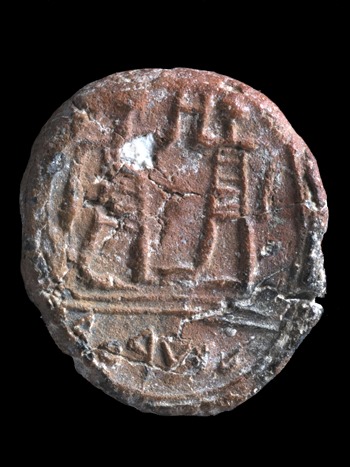
Several dozen seal impressions have been discovered in excavations in the City of David. These bullae date to the period after the fall of the northern kingdom in 722 BC and the archaeologists suggest that the names on them may belong to refugees who immigrated to Jerusalem at that time.

The IAA press release is here, and the story is reported in a number of news sources. The Times of Israel incorporates many photographs and one video into its story.

The dozens of clay imprints were used on letters and documents which were bound by string and sealed by wet clay pressed with the sender’s mark or name. The impressive trove was discovered at recent digs uncovering three Late Iron Age buildings frozen in time by the destruction caused by the 586 BCE Babylonian siege. The discovery was made by a team of Israel Antiquity Authority archaeologists led by co-directors Dr. Joe Uziel and Ortal Chalaf.
Among the dozens of bullae is a rare find of an intact sealing, bearing the name “Ahiav ben (son of) Menahem,” referring to two kings of Israel but found in the capital of the Kingdom of Judah, Jerusalem.
[…]
According to co-director Ortal Chalaf, these Israelite names and other findings point to the possibility that after the destruction of Israel, refugees fled the Kingdom of Israel for the Kingdom of Judah, and settled in Jerusalem. After settling, the use of their names on official correspondence shows that these Israelites gained important roles in the Judaean administration, said Uziel.
“These names are part of the evidence that after the exile of the Tribes of Israel, refugees arrived in Jerusalem from the northern kingdom, and found their way into senior positions in Jerusalem’s administration,” according to the two co-directors.

The full story is here.

Share: