In the final season of the Tel Gezer Project, archaeologists have found evidence of Merneptah’s fiery destruction of the city, including the skeletons of an adult and child. The capture of Gezer is mentioned in the famous Merneptah Stele, along with the slaughter of Israel.
Norma Franklin explains why the winery they discovered at Jezreel fits the time and place of Naboth’s vineyard.

The IAA has posted a 3-minute video on the “Siloam street” and drainage channel that is being excavated between the Pool of Siloam and the Temple Mount.

Gabriel Barkay is interviewed on the World Affairs Report (28 min, mp3).

Did Jeremiah bury his loin cloth at the Euphrates or at Ein Perat? Ferrell Jenkins provides photos of both and some evidence for the latter.

Carl Rasmussen shares photos and reflects on his time in Jerusalem during the Six Day War.

Photorientalist exhibits photographs from the 19th and 20th centuries, including a number of exhibitions that tell a story, such as “Palestine’s Nativity Trail.” They are accepting submissions.

One of your considerations in choosing a summer excavation to join is the field school. Year after year, the Tell es-Safi team has one of the best schedules of lectures and field trips.

The PEF’s refusal to accept papers which discuss Jewish excavations in Jerusalem ultimately led to its cancellation of the conference on “Anglo-German Exploration of the Holy Land 1865-1915.”

The Book and the Spade reposts a Dead Sea Scrolls Documentary, produced for the 50th anniversary of the discovery and including audio from Albright, Yadin, Trever, DeVaux, and others.

J. C. McKeown writes about famous doctors in the ancient world on the Oxford University Press blog.

Gary Rendsburg has recently posted his 1998 interview of Cyrus Gordon on YouTube.

A new program at Leiden University seeks “to show the great potential video games have for archaeology in terms of public outreach, heritage preservation, and education, but also for actual research.”

Eisenbrauns has a big sale going in July, with 60 titles at 60-80% off. Here are a few recommendations:

HT: Joseph Lauer, Agade, AWOL, John DeLancey

A lot happened while we were traveling in June, and I think it is going to take us four roundups to catch up. Today we begin with stories related to Israel.

Archaeologists have discovered a Crusader-era tunnel in Tiberias that apparently led from the fortress to the harbor.

Students excavating in Modiin discovered a collection of women’s jewelry from the Crusader period.

Excavations at the site of Huqoq in Galilee have discovered agricultural installations in use in either the Middle Bronze Age or the Roman-Byzantine period.

Weekly reports are available for ABR’s first season at Shiloh: Week 2 by Mark Hassler, Week 3 by

Andrew Kvasnica, and Week 4 by Gary Byers.

Scholars at Tel Aviv University have used multispectral imaging to reveal text on ancient “blank” potsherds from the First Temple period.

Emek Shaveh has petitioned Israel’s high court to halt excavations in the Western Wall tunnels.

An alert hiker reported suspicious activity which led to the capture of two antiquities thieves near the site of Sepphoris.

The new National Campus for the Archaeology of Israel remains unopened due to a lack of donations. This article in Apollo magazine reviews the controversy over moving archaeological material from east to west Jerusalem.

Haaretz reports on a new exhibit at the Israel Museum, “Faces of Power: Coins from the Victor Adda Collection.” These 75 gold coins depict Roman emperors and their wives and have never been publicly displayed before.

A nighttime audiovisual show at the City of David begins later this month.

The Israeli government has temporarily restricted civilians from visiting the Golan viewpoints overlooking Qunetra.

Appian Media has released a free (and downloadable), 10-minute video on Magdala.

Wayne Stiles notes the irony that “the Church of the Holy Sepulchre demonstrates the need for the place it hallows.”

There are several coming Israel tours of note. Wayne Stiles is taking a group October 26–November 6 and another March 16-27, 2018. Joel Kramer (SourceFlix) is leading a trip March 11-24.

This weekend, fans are reenacting the Battle of the Horns of Hattin in which the Muslims defeated the Crusaders in 1187.

HT: Joseph Lauer, Charles Savelle, Agade

The massive “Spring Tower” built over Jerusalem’s Gihon Spring was originally dated by archaeologists to the Middle Bronze Age. A new study, however, indicates that the fortifications were constructed in the 9th century BC, the time when Jerusalem was ruled by Jehoshaphat and Joash. The new dating is based on radiocarbon dating of material found in sediment underneath boulders at the tower’s base.

The previous discovery and dating to the 18th century BC radically changed our understanding of the development of the city, suggesting that Jerusalem was home to an advanced civilization about eight centuries before David’s conquest. This new re-dating will force the re-writing of the city’s history, not only in Canaanite times but in the Judahite period as well.

One can speculate what might have prompted such construction and which king it occurred under. I haven’t read the full study (available here for $35), but from other research I wouldn’t put too much weight on the date, as radiocarbon dates in the 9th century usually have quite a bit of flexibility. But if the tower dates earlier than the time of Hezekiah, one can only wonder why he considered the relatively recent fortification insufficient and the need to construct a water tunnel essential.

A summary of the research is posted at the website of the Weizmann Institute of Science.

HT: Joseph Lauer

Spring-Tower,-tb022304573
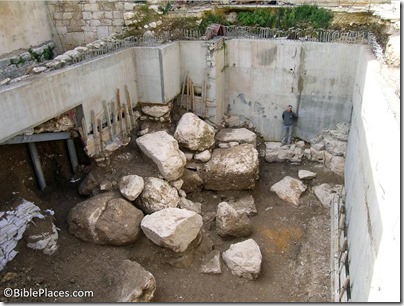
The north wall of the Spring Tower during excavations in 2004

A 3,700-year-old Egyptian burial chamber containing the remains of a ‘Pharaoh’s daughter’ was found south of Cairo at Dahshur’s royal necropolis.

Archaeologists have discovered “a cachette of non-royal mummies of men, women and children buried in catacombs eight metres below ground level in the desert neighbouring the bird and animal necropolis at the Tuna Al-Gabal archaeological site” in Egypt.

Two Egyptian men illegally digging for antiquities were killed when their house collapsed. And the
Egyptian government has increased the penalty for antiquities theft for a maximum of a life sentence.

An international team of experts met in Cairo to determine how best to transport King Tut’s artifacts to the new museum.

Egypt has begun to register its Jewish sites and antiquities.

An exhibit of recently discovered artifacts is now on display at the Luxor Museum.

Turkey is planning to restore and open the stadium of Perga.

Carl Rasmussen recently visited a new archaeology display in a station for the metro tunnel that connects Europe and Asia.

The city of Rome has begun restoration works on the Mausoleum of Augustus with the plan to open it to tourists by 2019.

John DeLancey shares a new video of a recent performance of “Jerusalem of Gold” by the Portney
Brothers and he explains the song’s significance.

The diet of Jerusalemites in the first century AD was primarily sheep and goats, followed at a distance by cows and chickens.

“Methuselah,” the date palm tree sprouted from a 2,000-year-old seed, is now 12 years old.

I’m traveling much of the month of June and will post as I am able. Roundups will probably resume in July.

HT: Joseph Lauer, Ted Weis, Charles Savelle, Agade, Explorator, Paleojudaica

Archaeologists have revealed new evidence for the Roman destruction of Jerusalem in AD 70 from the excavations of the road from the Siloam Pool to the Temple Mount.

The tomb of an unknown saint has been unearthed at Hippos.

A stone slab with two indentions was used to start fires in the Neolithic period.

The Associates for Biblical Research have completed Week 1 of Season 1 in their excavations of Shiloh.

A network of caves and tunnels at Khirbet Burgin in Judah’s Shephelah has been opened to the public.

An archaeological garden has been opened in the Davidson Center south of the Temple Mount of Jerusalem.

A study to be published in Palestine Exploration Quarterly observes that the large number of reservoirs made Jerusalem unique in the Second Temple period.

International Museum Day has passed, but this is a handy list of museums in Israel.

The Temple Mount Sifting Project met their first goal of 250,000 NIS and is now working to a second, much larger goal.

Aren Maeir shares some photos from the opening of an exhibition of discoveries from Gath (Tell es-Safi) in the Bar Ilan University Library.

Ferrell Jenkins recently was able to visit inside the Dome of the Rock and take photos. He shares some.

A $14 million elevator will be built at the Western Wall Plaza to allow elderly and disabled to go to the Jewish Quarter.

A Russian lawmaker vacationing in Israel drowned in the Dead Sea.

Accordance is having a big sale on many excellent archaeological and geographical resources through Monday.

HT: Joseph Lauer, Ted Weis, Charles Savelle, Agade, Explorator, Chris McKinny, Paleojudaica

The big story of the week is the discoveries made in excavations at Caesarea, including the altar of Herod’s temple, an inscribed menorah, and a statue of Asclepius. You can read the press release here or download high-res photos here. Haaretz has the best illustrated story. The Times of Israel emphasizes the discovery of an inscribed menorah. The Jerusalem Post focuses on the $27 million project. Art Daily provides another brief summary.This 3-minute video includes English subtitles.

A colossus of Ramses II has been re-erected in front of Luxor Temple’s first pylon.

Ten nations have created an “Ancient Civilizations Forum” to work together to protect ancient heritage from Islamic extremism.

Israeli police arrested a man in Hawara and confiscated hundreds of antiquities they discovered in his house.

A petition is now circulating to save the Yale Babylonian Collection.

A first-century AD bust of Drusus Minor will be returned to Italy by the Cleveland Museum of Art.

Should Egypt sell some of its artifacts to raise money?
BBC: “Madain Saleh isn’t as well-known as Petra, but the Nabateans’ second-largest city played a
crucial role in their mysterious empire.”

Simon Gathercole looks at the historical evidence for Jesus’s life and death.
BAS has published online a web-exclusive chart of 53 biblical people who have been confirmed in inscriptions.

Wayne Stiles’s recent post on Mount Carmel includes photos of its beauty and its burning.

Leon Mauldin visited Bethphage yesterday.

What happened to the cross that Jesus died on?

Mark Hoffman suggests that you may want to download Google Earth before it’s gone.


The Corinth Excavations Archaeological Manual has been published and a pdf has been made available for free. The post includes a link to previously published archaeology manuals.

The four-volume Dictionary of Daily Life in Biblical and Post-Biblical Antiquity is available on
Logos at a pre-pub price of $51. I recommend it.

I’ll be traveling much of May and June, so I probably will not be able to do many roundups.

HT: Joseph Lauer, Agade, Ted Weis, Charles Savelle