In Pompeii, a pre-Roman tomb dating to 4 B.C. has been found in perfect condition by French archaeologists.

A newly discovered tablet of the Epic of Gilgamesh preserves nearly twenty lines previously unknown.

The UNC Charlotte magazine features a story on the Mount Zion excavation.

Eldad Keynan examines a unique mikveh in Upper Galilee—one with a cross inscribed on the wall.

Dr. Ben Witherington paid a visit to the Greco-Roman Collection at the Art Institute of Chicago and demonstrates how artifacts illuminate our understanding of the New Testament.

Why study biblical geography? Barry Britnell suggests one, two, and three reasons.

Bryant Wood reexamines the blockage of the Jordan River.

Ferrell Jenkins explains the significance of Adullam and shares several photos of the cave.

The Virtual World Project presents interactive virtual tours of archaeological sites in Israel and Jordan. The project is designed to aid in the teaching and study of antiquity.” There’s some background here.

“Koç University’s Research Center for Anatolian Civilizations (RCAC) in Istanbul has begun an exhibition celebrating the immense contribution of John Garstang, a British scholar, on archaeology in Turkey.”

With only 2,000 gazelle remaining in Israel, the species will probably be classified as endangered.

Logos has pre-publication pricing on a new video course, AR101 Archaeology in Action: Biblical Archaeology in the Field ($50).

The early bird discount for Wayne Stiles’s Holy Land Tour ends on Monday.

HT: Agade, Ted Weis, Chris McKinny, David Bivin

Share:

Archaeologists have been sifting debris discarded from illegal excavations on the Temple Mount for more than a decade now. Yesterday they announced the discovery of a seal dating to the 10th century BC. From a press release from the Temple Mount Sifting Project:

“The seal is the first of its kind to be found in Jerusalem,” stated Dr. Gabriel Barkay, the co-founder and director of the Temple Mount Sifting Project. “The dating of the seal corresponds to the historical period of the Jebusites and the conquest of Jerusalem by King David, as well as the construction of the Temple and the royal official compound by his son, King Solomon… What makes this discovery particularly significant is that it originated from upon the Temple Mount itself.”
The seal was discovered by Matvei Tcepliaev, a ten year old boy, visiting the Temple Mount Sifting Project from Russia, and was only recently deciphered by archeologists. Since the project’s inception in 2004, more than 170,000 volunteers from Israel and around the world have taken part in the sifting, representing an unprecedented phenomenon in the realm of archaeological research.
[…]
“The discovery of the seal testifies to the administrative activity which took place upon the Temple Mount during those times,” said Barkay. “All the parallel seals with similar stylistic designs have been found at sites in Israel, among them Tel Beit Shemesh, Tel Gezer, and Tel Rehov, and were dated to the 11th – 10th centuries BCE,” asserted Barkay.
“Upon the base of the seal appear the images of two animals, one on top of the other, perhaps representing a predator and its prey. Additionally, the seal is perforated, thus enabling one to hang it from a string,” said Barkay.
Aside from the seal, which was likely used to seal documents, hundreds of pottery sherds dating to the 10th century BCE have been discovered within the soil removed from the Temple Mount. Additionally, a rare arrowhead made of bronze and ascribed to the same period by its features, has been discovered.

The press release includes photos of the seal and other finds from the same period. The organization recently released a video which documents the success of the project in a bid to raise additional funds.

HT: Joseph Lauer

Sifting Temple Mount debris, tb110906723
The Temple Mount Sifting Project in 2006
Share:

Just posted: Preliminary Report of the 2015 Jezreel Expedition Field Season

A full schedule of speakers and topics for the Annual Bible and Archaeology Fest is now online. Eric Cline is the plenary speaker.

After the heat wave and brutal sandstorm, Israel this past week experienced lightning, hail, and flash floods. This is not typical September weather.


Near Eastern Archaeology‘s latest issue is devoted to “The Cultural Heritage Crisis in the Middle East.” It is available online for free to all.

Eisenbrauns has just released its fall catalog.

A new book: Distant Views of the Holy Land, by Felicity Cobbing and David Jacobson. 330 pages, 350 illustrations, $200. A free sample is available here.

Here’s more about Penn Museum’s new exhibit, “Sacred Writings: Extraordinary Texts of the Biblical World.”

This Wednesday, Sept 23, Brent Strawn of Emory University will give a lecture at Trinity Evangelical
Divinity School entitled “The Historical Psalms, Iconographically Considered.” The event will take place at 7:00 pm on Trinity’s campus, Hinkson Hall in Rodine Building. The lecture is free and open to the public.

Clashes on the Temple Mount have caused damage to Al Aqsa Mosque.

Aren Maeir is on the Book and the Spade talking about his excavations of Gath and the discovery of a large gate this season (part 1, part 2).

Egyptian security officials have ordered the shutdown of St. Catherine’s Monastery.

From ASOR: Can you pass this Sea of Galilee quiz?

The latest issue of Popular Archaeology includes articles on Gath and Magdala.

Ferrell Jenkins explains the significance of Mahanaim (mentioned 13x in the OT) and shares some photos.

HT: Agade, Charles Savelle, A.D. Riddle, Paleojudaica

Share:

This week’s sandstorm in Israel is the worst it has experienced since the nation was founded in 1948.

Air pollution in Jerusalem was 173 times higher than average. Carl Rasmussen shares a video showing how bad it was on the Mount of Olives.

What exactly is a 100-foot-deep shaft doing next to the Rockefeller Archaeological Museum in Jerusalem?

Andrew Bernhard posts on the End of the Gospel of Jesus’ Wife Forgery Debate.

Thieves in Galilee were caught removing a sixth century mosaic church floor in Gush Tefen.

The cisterns at Arad are now open to visitors.

Muslim “sentinels” protecting the Temple Mount from “sacrilege” have now been outlawed by Israeli police.

If your interest is in exotic shofars and what Jewish halakah has to say about it, Zoo Torah has a free pdf on the subject.

The BBC reports on six “lesser-known wonders of the ancient world,” including the site of Baalbek in Lebanon.

The Jerusalem Post Magazine reports on sinkholes around the Dead Sea. (At the moment of posting this, the link is not working. Perhaps it will return.)

ISIS is destroying ancient buildings in order to conceal evidence that they are looting for profit.

The Institute for Digital Archaeology plans to distribute 10,000 3-D cameras in the coming year in
order to document archaeological sites and objects in West Asia before they are destroyed.

A luncheon will honor James F. Strange at this ASOR meeting in Atlanta.

Ferrell Jenkins illustrates what David meant when he wrote about “a dry and weary land where there is no water.”

Did you know that the Upper Room is located directly above David’s Tomb?

The Dead Sea Scrolls scam at the California Science Center closed this week.

“The Manar al-Athar open-access photo-archive (based at the University of Oxford) aims to provide high resolution, searchable images, freely-downloadable for teaching, research, heritage projects, and publication. It covers buildings and art in the areas of the former Roman empire which later came under Islamic rule (e.g. Syro-Palestine/the Levant, Arabia, Egypt, and North Africa), from ca. 300 BC to the present, but especially Roman, late antique, and early Islamic art, architecture, and sacred sites.”

HT: Charles Savelle, Ted Weis, Agade, Joseph Lauer, Jared Clark

Our Facebook photo with the most clicks in the past week was the final one in our “holy rocks” series.

Gezer standing stones, bowing down, tb091405098
Standing stones at Gezer
Share:

The excavation season at Magdala has concluded, and the wrap-up describes the major findings, including a fourth mikveh that was fed by spring water.

The Temple Mount Sifting Project has just released a video about their work, its importance, and the need to keep it going.

Leen Ritmeyer offers his thoughts and diagrams on the recent discovery of the stepped podium in the City of David.

The cross-border environmental organization EcoPeace has opened two hiking tours, a bike route, and a walking path in Israel, the West Bank, and Jordan. The two hiking tours each take eight days.

Arutz-7 reports briefly on the Studies of Ancient Jerusalem’s 16th Annual Conference in the City of David.

A study of 15 Roman-era Egyptian mummy portraits and panel paintings reveals that the artists used Egyptian blue, contrary to what has been long believed.

British conservation specialists have restored some Hellenistic-era paintings from Petra.
‘Atiqot 82 is now online.

Attempts by ISIS to blow up the Temple of Bel at Palmyra have apparently failed.

The Codex Sinaiticus will leave the walls of the British Library for only the second time since 1933, this time headed down the street for display in an Egyptian exhibit at the British Museum.

The Philistines introduced new plants to the coastal plain when they migrated from the Aegean.

HT: Ted Weis, Joseph Lauer, Agade

Share:

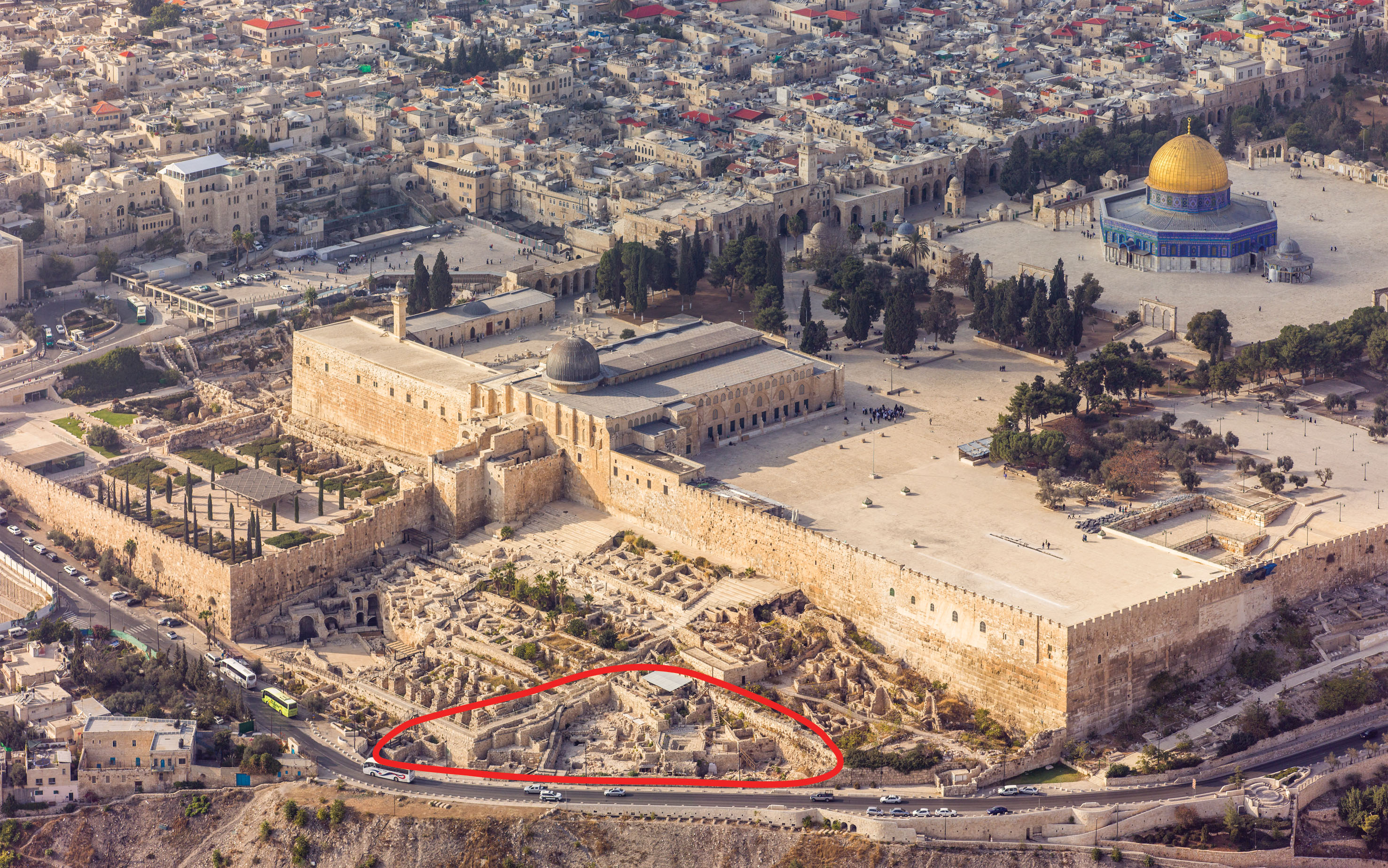
Excavations in the City of David have revealed a pyramid-shaped staircase believed to belong to a first-century podium. The discovery was made along the street that runs from the Pool of Siloam up to the Temple Mount.

From the Israel Antiquities Authority:

According to archaeologists Nahshon Szanton and Dr. Joe Uziel, who direct of the excavation on behalf of the Israel Antiquities Authority, “The structure exposed is unique. To date such a structure has yet to be found along the street in the numerous excavations that have taken place in Jerusalem and to the best of our knowledge outside of it. For this reason, its exact use remains enigmatic. The structure is built along the street in a place that is clearly visible from afar by passers-by making their way to the Temple. We believe the structure was a kind of monumental podium that attracted the public’s attention when walking on the city’s main street. It would be very interesting to know what was said there 2,000 years ago. Were messages announced here on behalf of the government? Perhaps news or gossip, or admonitions and street preaching – unfortunately we do not know. Bliss and Dickie, two British archaeologists who discovered a small portion of this structure about 100 years ago, mistakenly thought these were steps that led into a house that was destroyed. They would certainly be excited if they could come back today and see it completely revealed”.
We know from rabbinic sources there were “stones” that were used for public purposes during the Second Temple period. For example, one source cites the “auction block” in connection with the street: “[a master] will not set up a market stand and put them (slaves) on the auction block” (Sifra, BeHar 6). In the Mishnah and Talmud the “Stone of Claims” is mentioned as a place that existed in Jerusalem during the Second Temple period: “Our Rabbis taught: There was a Stone of Claims in Jerusalem: whoever lost an article repaired thither, and whoever found an article did likewise. The latter stood and proclaimed, and the former submitted his identification marks and received it back. And in reference to this we learnt: Go forth and see whether the Stone of Claims is covered” (Bava Metzia 28:B).
On Thursday (3.9), at the City of David Studies of Ancient Jerusalem’s 16th Annual Conference that will be open to the public, Nahshon Szanton and Dr. Joe Uziel will present their findings from the excavation and the different interpretations regarding the nature of the podium. According to them, “Given the lack of a clear archaeological parallel to the stepped-structure, the purpose of the staircase remains a mystery. It is certainly possible the rabbinical sources provide valuable information about structures, such as this, although for the time being there is no definitive proof.”
Information about the conference can be found on the City of David website: www.cityofdavid.org.il.

The story can also be read at the Jerusalem Post and Haaretz, and the Times of Israel.

HT: Joseph Lauer

1
Photo by Gil Mezuman, courtesy of the Israel Antiquities Authority
Share: