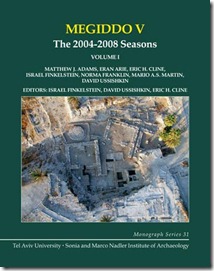
Several significant excavation reports will be published in the next couple of months and Eisenbrauns is offering major discounts on pre-orders.

Megiddo V: The 2004-2008 Seasons

Gezer VII: The Middle Bronze and Later Fortifications in Fields II, IV, and VIII

Sepphoris I: The Pottery from Ancient Sepphoris
MegiddoVcover.indd
With the ongoing debate over the chronology of the Iron Age II, the Megiddo volumes may receive the most attention from scholars.

Eisenbrauns has a number of other excavation reports on sale, including volumes on Bab edh-Dhra, Lahav (volumes I-II), Tell el-
Hesi (volumes II-V), Gezer (volumes I-III, V), and Dothan. For those interested in a popular work, the Timnah volume is now marked down 50% (to $15).

There doesn’t seem to be a direct link to the sale page, so go to the home page, read about their phenomenal new “Online/Offline
Backup Service” (announced on April 1), and follow the link to the sale from there.

A couple of recently published excavation reports are reviewed in the current issue of Biblical Archaeology Review. In the article now available online, William G. Dever reviews Ashkelon 3: The Seventh Century B.C. and Hazor: The 1990–2009 Excavations: The Iron Age.

Share:

You might want to put down your coffee before you read how David Ussishkin classifies himself in relation to other archaeologists. This description is from his chapter in Understanding the History of Ancient Israel. He writes:

“The biblical archaeologists of our time can in fact be divided into three groups according to their approach to the use of the biblical text.610ojNdqnGL._SS500_


“The first group includes the fundamentalists, who believe in the reliability of the biblical text in all its details, and that the text forms the basis and guide for their archaeological work. I can mention, for example, Bryant Wood and his work on Jericho (e.g. Wood 1990), and Adam Zertal, who restored an imaginary altar on Mount Ebal on the basis of the biblical text (e.g. Zertal 1986–87). Both of them, as well as other scholars of this group, are good, professional archaeologists, but their archaeological work is clearly biased and distorted by their views on the biblical text.


“The second group should be termed the ‘Followers of Albright’. This group includes the majority of biblical archaeologists practising today. Prominent among them are the American scholars who have been introduced to archaeology through theology and biblical studies. I can mention people like Albright himself, Ernest Wright or William Dever. The ‘Followers of Albright’ also dominate biblical archaeology in Israel. Yigael Yadin, who was a follower of Albright, was the leader of this school of thought in Israel, and its present centre is Jerusalem. Significantly, neither Yadin nor the majority of Israeli biblical archaeologists are religious, hence their adherence to this school of thought does not stem from religious beliefs.

“The basic concept of the ‘Followers of Albright’ is the acceptance of the framework of biblical history as the basis for their archaeological studies. They take the archaeological data and fix them into this framework in exactly the same way that children assemble a jigsaw puzzle: also in this game one follows a known general framework, and then whenever an additional piece is identified, one puts it into its proper position in the framework.


“The third group includes a small number of scholars, whom I labelled ‘the Followers of Hercule Poirot’ for lack of a better term, and at present their centre is at Tel Aviv. I shall mention here Aharon Kempinski, Ze’ev Herzog, Israel Finkelstein and myself, and there are several others. These scholars believe that in recent years the discipline of biblical archaeology has developed tremendously and reached maturity, that huge amounts of significant data have accumulated, and also new research techniques and methods have been adopted and applied. As a result, biblical archaeology has slowly become an independent discipline, and archaeological research can now be conducted in an objective manner without leaning on the biblical text.”

Source: David Ussishkin. “Archaeology of the Biblical Period: On Some Questions of Methodology and Chronology of the Iron Age.” In Understanding the History of Ancient Israel, ed. H. G. M. Williamson, 131–41. Proceedings of the British Academy, vol. 143. Oxford: Oxford University Press for The British Academy, 2007. (Amazon, Worldcat)


Comment: If only those backward fundamentalists would come around to realizing that biblical archaeology has reached maturity, that huge amounts of significant data have accumulated, that new research methods have been adopted, and that objective archaeology doesn’t lean on the biblical text.
Ussishkin’s dating of the Jezreel compound to the time of Ahab is a parade example of leaning (falling? laying prostrate?) on the biblical text. I think he’s right to do it, but it does call into question his categories.

Share:

Tel Kison (Tell Keisan): Two excavation areas revealed remains from the Chalcolithic, Iron I-II, and Persian-Hellenistic periods, including a rich repertoire from the Persian era. The site may be identified with biblical Achshaph and may have been one of the cities of Cabul given by Solomon to Hiram.

Dabburiya: A survey of the area revealed 11 ancient sites including caves, industrial installations, and a quarry. The site preserves the name Deborah and is located on the western side of Mount Tabor.

Ramla: Excavations southeast of the city uncovered 11 strata, the most important dating from the Early Islamic period. An impressive Roman pottery kiln was also discovered.

Regevim, West: Located near remains of a Roman road connecting Caesarea and Megiddo, this site was the location of 6 limestone quarries and 6 tombs, one of which had a rolling stone in situ. The quarries may have served for construction of the Roman road.

Shihin: James Strange directed a survey of the area northwest of Sepphoris which identified 111 ancient features and indicated the site’s prominence in the Early Roman period.

Tell Jatt: Excavations on this tell 6 miles (10 km) northwest of Karmiel exposed three strata from the Middle Bronze IIA and Iron I-IIA.

Megiddo: An excavation north of Kibbutz Megiddo identified 22 quarries, 2 tombs, and a road, all probably used primarily by the Sixth Roman Legion stationed here in the 2nd-3rd centuries AD.

iaa-5680-12
Roman burial cave near Megiddo.
Photo by Israel Antiquities Authority.
Share:

This is a series I should have done on this blog. But BibleX has done it first and quite well: Picture Taking Tips for the Holy Land, Part 1, Part 2, and Part 3. Thank you, Dr. Savelle.

The Shephelah is a great place to live. The ancients knew it and now modern people are catching on.

That’s bad for those who care about the preservations of ancient sites, as Luke Chandler explains in his well-illustrated post, Khirbet Qeiyafa to be Enveloped by City Expansion.

Beth Shean—A Place for Happy Explorers: Check out the photos, the video, and the city’s lingering lesson.

“Huge flocks of synchronized starlings that appear like a black cloud returned to Israel last year for the first time in 20 years.” This free Haaretz article includes impressive photos.

Jerusalem Online has a 4-minute video on The Search for Herod’s Grave. You can read the transcript at the same link.

The ancient Corinthians liked to feast, a fact confirmed by the recent excavation of more than 100,000 bones excavated in the abandoned theater.

The Guardian reports on Turkey’s on-going efforts to blackmail museums around the world.

For more, check out the Archaeology Weekly Roundup at the ASOR Blog.

HT: Joseph Lauer, Jack Sasson

Beth Shean aerial from northeast, tbs118210011
Beth Shean aerial from northeast.
Photo from Samaria and the Center.
Share:

The Times of Israel is reporting that Muslim authorities moved tons of illegally excavated earth from the Temple Mount into a city dump.

Aren Maeir posts an astounding video of a flood in the Harod Valley this week.

Frankincense has returned to Israel after 1,500 years.

More tourists visited Israel in 2012 than in any year before.

An Israeli committee will review modern prohibitions against mixed prayer at the Western Wall.

Jean Perrot died this week. Among other things, Perrot excavated several Chalcolithic sites near
Beersheba.

Marked down to $1.99 for Kindle: The Aleppo Codex: A True Story of Obsession, Faith, and the 
Pursuit of an Ancient Bible, by Matti Friedman. These sales are brief.

HT: Jack Sasson, Joseph Lauer

Western Wall prayer area from south, amd042108530
Segregated prayer areas at Western Wall.
Photo by Austen Dutton (source).
Share:

Most of the settlement layers of Tel Afula were destroyed by construction activity in the 1950s, but a recent salvage dig found remains from the Early Bronze I and Roman period.

Archaeologists working in the Ir Gannim neighborhood of Jerusalem excavated a winepress possibly first used in the Iron Age II and again in the Hasmonean period. A large storage pool was built here in the first century AD.

A preliminary report from the 2011 season at Horbat Huqoq describes the project’s goals (synagogue and 2-3 houses) and reports on the initial progress including the excavation of a mikveh. This report does not describe the beautiful mosaic floor depicting Samson that was found in the 2012 season.

Excavations near a site that Charles Wilson incorrectly thought was Capernaum have exposed three strata from the 13th-14th centuries. The dig at Huqoq Beach is 80 meters east of the entrance to the Khirbet el-Minya Umayyad palace.

Excavations on the east side of the Mount of Olives were prompted by the chance discovery of a relatively rare Armenian mosaic from the Byzantine period.

Two adjacent quarries were excavated in Beit Hanina north of Jerusalem. They provided Jerusalem with maleke limestone from the time of Jesus until modern day.

beit-hanina-quarry-iaa-6415-4
Quarry K in Beit Hanina, looking north. Photo by IAA.
Share: