The Jerusalem Post reports on a new museum that has opened at the traditional Inn of the Good Samaritan.

The Museum of the Good Samaritan, which is located on the Jerusalem-Jericho Road near Ma’aleh Adumim, was officially opened Thursday evening after a nine-year archeological excavation at the site.
The official dedication of the NIS 10 million museum, which displays mosaics from the West Bank and Gaza, coincided with US President Barack Obama’s long-touted Middle East speech in Cairo in which he reached out to the Muslim world….
The site, known as the Inn of the Good Samaritan, received its name in the Byzantine period when it was identified with the inn mentioned in the Parable of the Good Samaritan in the New Testament.
The site lies on the upper end of the ascent on the main road from Jericho to Jerusalem, which pilgrims followed when traveling from the Galilee and Transjordan to the Holy City.
Over the last decade, archeologists have uncovered remains dating back to the Second Temple period at the site.
During the Byzantine period, the site was revived as a way station for Christian pilgrims, and an inn was constructed that included a large church, a cistern, residential quarters, and a fortress to protect pilgrims from brigands.
In the Crusader period, with the expansion of pilgrimage to Jericho and especially to baptismal sites on the Jordan River, the inn was renovated and a fortress erected above it to guard the road to Jerusalem.
The structure housing the museum was built in the Ottoman period as a guard post, which remained in use until recently.
The mosaics on display at the museum were discovered in the West Bank and Gaza and belong to Jewish and Samaritan synagogues – including a mosaic from a Gaza synagogue – as well as churches.

The full story is here.
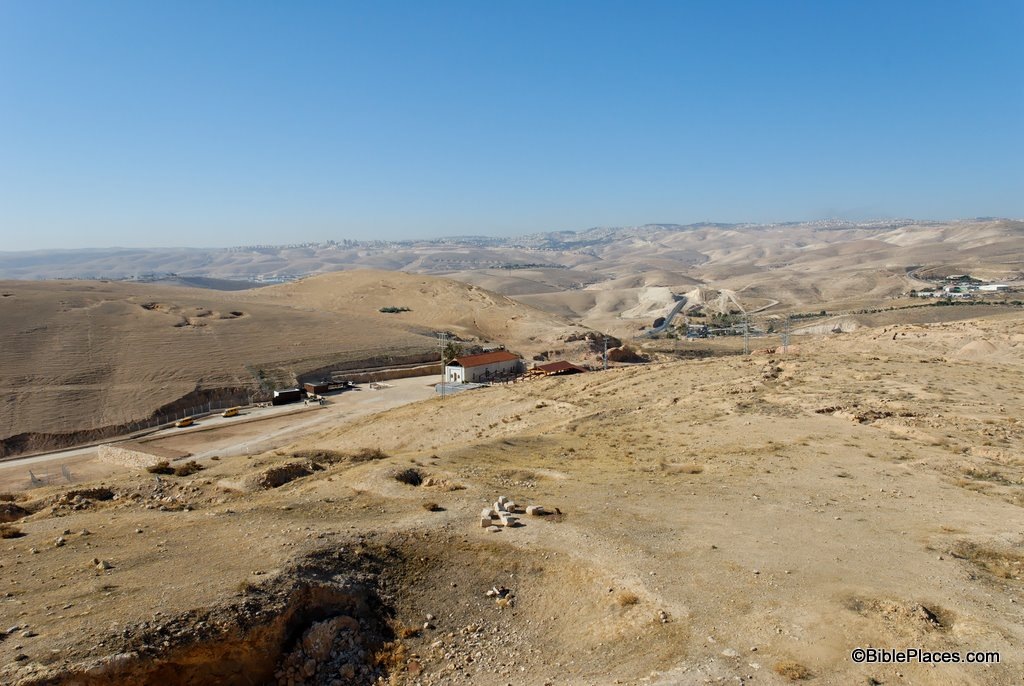
Good Samaritan inn, tb113006626dxo Traditional Inn of the Good Samaritan with Jerusalem in the distance
Share:

The Israel Museum in Jerusalem is in the midst of a $100 million renovation and the Jerusalem Post has an update on the transformation.  Here are some snips:

There are two main aspects to the renewal project. The first is to create a completely new approach from the entrance of the museum to the center of the museum campus. To do this, the museum has hired New York architect James Carpenter, who has worked on a variety of high-profile projects, such as the new Hearst headquarters (which involved saving the original facade of an existing building), the podium light wall of the Seven World Trade Center building in New York, a proposed multi-use sports enclosure for the Brooklyn Bridge Park, and the Madison Square Garden renovation…. This second main aspect of the campus renewal – the reconstruction of the original museum complex from within – has been taken up by Tel Aviv-based Zvi Efrat of Efrat-Kowalsky Architects. Efrat, who is also the head of the architecture department at the Bezalel Academy of Art and Design, has created a central circulation point from which all the museum’s main exhibit wings – Archeology, Judaica and Jewish Ethnography, Fine Arts, and Temporary Exhibitions – are accessible on the same level. To achieve this internal redesign without, in Snyder’s words, "increasing the breadth of the existing envelope," the museum is being gutted from the inside, its exhibit halls are reconfigured, and a number of connecting passages are being added. The key to the project, though, is turning an area previously dedicated to internal museum service activity into exhibition spaces, resulting in an additional 9,290 sq.m. of gallery space that does not involve expanding the museum campus…. One of the final touches to the renewal project was a revamping of the museum’s central outdoor plaza, raising two-thirds of it by a meter to improve its position as a vista point, and to split its length to make it more human-sized. The east side will lead to the underground passage that connects with the museum entrance, and the west side will open up on a wide staircase that feeds into the Isamu Noguchi-designed sculpture garden, making it more central to the campus.

The TimeOnline has a story about the new Egyptian gallery at the British Museum in London.  (HT: Explorator)

Share:

Daily Mail has a report and photos of the stunning model of Herod’s Temple Mount being constructed by Alec Garrard.  At 30 years and counting, Garrard has worked longer on his model than Herod did on the original (at the time of his death).

Sunday’s Zaman has a review of the “Top 10 Museums” in Turkey.  Most, but not all, of the museums are related to the ancient world.  HT: Explorator.

Dr. Platypus (Darrell Pursiful) has posted the Biblical Studies Carnival XXXIX.  As always, the carnival is a great way to see what is going on in the wider blogosphere.

John Walton posts on what the Bible means in its description of “the land flowing with milk and honey.”

Arabia meets America in the Wild Wadi Water Park.

Share:

The press release of the Israel Antiquities Authority:

Two Exhibitions from the Vast Collections of the IAA in New York City Beginning September 21, 2008


The Metropolitan Museum of Art will exhibit the dazzling Gold – Glass Table from Caesarea.  

The Gold Glass Table will be on display in the Byzantine Galleries of the Metropolitan Museum.

Dating to the late 6th, early 7th century CE, this extraordinary, one of a kind panel was excavated in a Byzantine period mansion in the coastal city of Caesarea, when a large mosaic floor known as the Birds Mosaic, was exposed for conservation in 2005. The nearly intact panel is shaped like the letter sigma and made of small glass pieces using the opus sectile technique. The panel was discovered with its face down directly on the mosaic floor and was covered by ashes and debris from the ceiling and the second floor. It comprises a wide frame surrounding the central part, both made of a combination of delicate, translucent gold – glass pieces and opaque, colored mosaic glass pieces. The square gold – glass pieces were decorated with a stamped design of flower or cross. A workshop for wall opus sectile made of stone panels was recently excavated in Caesarea, and one can assume the Gold Glass Table was produced by local artists. The conservation, restoration and exhibition of the Gold Glass Table, was made possible by generous funding from the Margot and Tom Pritzker Foundation. Also at the Met, in the Ancient Near Eastern Art Galleries, are remarkable Chalcolithic period objects on long-term loan to the museum, including examples from the Nahal Mishmar treasure such as the Hippopotamus tusk with circular perforations, and the wonderful copper standard, as well as ivory figurines from Beer-Sheva.


Separately, at the Jewish Museum, a wonderful exhibition – The Dead Sea Scrolls: Mysteries of the Ancient World, will include six Dead Sea Scrolls from the collections of the Israel Antiquities Authority – the largest and most comprehensive collection of Dead Sea Scrolls in the world. The scrolls on display represent the important transformation that occurred in Jewish worship from sacrifice to Bible study and prayer, the debates among Jewish groups of the Second Temple Period, and the indirect connections between the scrolls and early Christianity. The scrolls on display include a part of one of the earliest copies of the Hebrew Bible, the Book of Jeremiah, which dates to 225-175 BCE. Other texts include an apocryphal Jewish work, the Book of Tobit, which was rejected for the Hebrew canon but eventually accepted into the Christian Old Testament; an early example of a prayer from Words of the Luminaries; and Aramaic Apocryphon of Daniel, which mentions a son of God.

Also shown will be excerpts from two sectarian compositions.

The Israel Antiquities Authority is the pre-eminent organization in the field of Biblical and Israeli archaeology, custodian of more than 1.5 million objects among them 15,000 Dead Sea Scrolls, and 30,000 archaeological sites. These exhibitions are part of our continued effort to share the archaeological treasures of the Land of Israel with audiences around the world.

For downloading images please click here [ http://www.antiquities.org.il/images/press/iaa.zip ]

1. The Gold Glass Table – Photo by Niki Davidov, Israel Antiquities Authority

2. A Fragment of a 2,000 Year Old Psalm Scroll- Photo by Tsila Sgiv, Israel Antiquities Authority

HT: Joe Lauer

Share:

From the Daily Democrat:

Soon, Yolo County residents won’t have to travel to Israel for a tour of the Holy Land. Locals will be able to stop by the Woodland Museum of Biblical Archaeology at Woodland United Fellowship, 240 N. West St., to visit a collection of artifacts from Biblical times.
The museum’s humble beginnings began in the foyer of Woodland United Fellowship a year ago.
Pastor Carl Morgan began a display case with a few juglets and lamps from archaeological digs he participated in, and the collection continued to grow.
“We live in a time when the Bible has come under a lot of criticism and attack as not being reliable or authoritative,” Morgan said. “Archaeology allows us to see the geography and historicity of the Bible is correct. Many times, we’ve been able to find a name or a city (on a dig) associated with a Biblical event, and we’re able to say to the critics, ‘They’re not myths. The Bible is accurate.’ It also helps build your faith.”
On the west wall of the museum artifacts from mainly the Middle Bronze Age (2200 BC to 1550 BC) will be displayed. Visitors will find sling stones, which were used as weapons and swung with a leather strap. They will also see swords from 2000 BC and a sacrificial knife from the time of Abraham.
There is pottery dated beyond 3000 BC and a battle-axe on display that dates at least 500 years before the time of Abraham.
“That’s the oldest piece of metal you’ll ever hold,” Morgan said.

The story continues here.  If they’ll let you hold it, they’ll probably let you take a picture of it as well. 

Which is something you won’t get at many other museums.  Woodland is 20 miles northwest of Sacramento.

HT: Joe Lauer

Share:

The International Herald Tribune has the story:

It may sound like the escapist indulgence of a well-fed man fleeing the misery around him. But when Jawdat Khoudary opens the first ever museum of archaeology in Gaza this month, it will be an act of Palestinian patriotism, showing how this increasingly poor and isolated coastal strip ruled by the Islamists of Hamas was once a thriving multicultural crossroad.

Now only if there was a way for non-Palestinians to get there.  If he’s depending on revenue from Palestinians interested in history, he is going to be a poor man.

The exhibit is housed in a stunning hall made up partly of the saved stones of old houses, discarded wood ties of a former railroad and bronze lamps and marble columns uncovered by Gazan fishermen and construction workers.
And while the display might be pretty standard stuff almost anywhere else – arrowheads, Roman anchors, Bronze Age vases and Byzantine columns – life is currently so gray in Gaza that the museum, with its glimpses of a rich outward-looking history, seems somehow dazzling.
“The idea is to show our deep roots from many cultures in Gaza,” Khoudary said as he sat in the lush, antiquities-filled garden of his Gaza City home a few miles from the museum. “It’s important that people realize we had a good civilization in the past. Israel has legitimacy from its history. We do too.”

Someone’s going to have to explain this one to me.  I’m not sure how Roman or Byzantine antiquities have anything to do with the legitimacy of Palestinian Arabs. 

It’s a good article with a nice photo.  I recommend reading the whole thing, and I hope the venture is successful.

HT: Joe Lauer

Share: