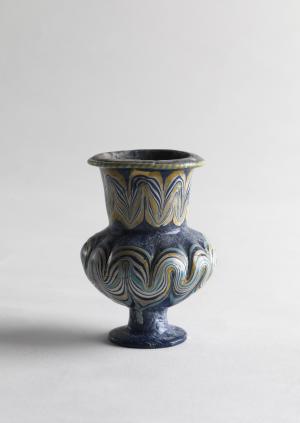
The Bible Lands Museum Jerusalem is hosting a special exhibition entitled By the Rivers of Babylon beginning next month. An international conference on Jerusalem in Babylonia will be held on February 2-3.

Now online: the Fall 2014 issue of DigSight, published by Southern Adventist University’s Institute of Archaeology.

See the Holy Land has published new articles on Kathisma and the Church of St Alexander Nevsky (the Russian excavations), and an updated article on Magdala.

Free video lecture online: Doctors, Diseases and Deities: Epidemic Crises and Medicine in Ancient Rome, by Sarah Yeomans of the Biblical Archaeology Society.

Matthew Karsten hiked portions of the Israel National Trail and has some spectacular photos to show for it.

Aren Maeir will be giving a lecture on the latest work at Gath at the Albright Institute on January 15.

Registration for MEMRA’s ancient language courses ends soon.

G. M. Grena shares some personal thoughts and more from his time at the ASOR 2014 conference.

The British Museum explains why it was so pleased to be involved in the latest Night at the Museum movie.

The new Exodus movie is “an unimaginative, mind-numbing bore,” according to Michael Heiser.

Egypt has banned the movie “Exodus: Gods and Kings” for being historically inaccurate.

ISIS is threatening to blow up the walls of ancient Nineveh.

Vassilios Tzaferis has died in Athens. Among Tzaferis’s excavations was the tomb of the crucified
man.

HT: Agade, Exploring Bible Lands

Michael Eisenberg tells the story of trying to discover the synagogue of Sussita (Hippos).

An Egyptian cemetery may contain more than a million mummies, say BYU archaeologists. No, it doesn’t, and you’re not working here again, says Egypt’s Ministry of Antiquities.

The colossi of Amenhotep III have been re-erected at the site of his funerary temple in Luxor.

The Harvard Semitic Museum is honoring its founder with a special exhibition.

A new discovery in Galilee suggests that olive use was already in use in the Early Chalcolithic period.

The Book and the Spade features Mike Molnar explaining the star of Bethlehem mystery.

Leen Ritmeyer: Where on the Temple Mount was Jesus during Hanukkah?

How close is the new movie Exodus to the Bible? Ellen White answers: “Their story was so different
that if they didn’t use the Biblical names and released the same movie with a different title, I might not have even recognized it.”

Don McNeeley reports on the 2014 NEAS Conference in San Diego.

Our Rabbi Jesus notes a couple of free books on Greek and Hebraic thought.

Heritage Daily lists its Top 10 Archaeological Discoveries of 2014.

This will be the final roundup of 2014. We’ll try to note major stories as they break. Thanks for joining us this year!

HT: Charles Savelle, Ted Weis

The largest stone block known from antiquity has been uncovered in Baalbek. Its weight is estimated at 1,650 tons.

AirCamz’s new video provides the best views of Tel Burna I’ve ever seen.

Lawrence Mykytiuk provides evidence for Jesus’ existence outside the Bible in a new Biblical 
Archaeology Review article now online in its entirety.

If you’re interested in the various kinds of nets used in fishing on the Sea of Galilee, Ferrell Jenkins shares many photos.

Scientists at Chicago’s Field Museum recently opened the lid of the coffin of a 14-year-old boy.

Osiris statues have been discovered in the temple of Karnak.

The Book and the Spade looks at Shishak’s scarab.

Most of Syria’s World Heritage sites have been damaged by bombing or looting.

Travelujah describes some of the different tastes of Bethlehem.

Lamb & Lion Ministries is offering its new 2015 Holy Land Calendar for $5. I contributed several of the photos.

HT: Ted Weis, Agade

A Roman game board from the first or second century AD has been discovered in southern Turkey.

Some extremely well-preserved mosaics have been discovered near the Syria-Turkey border.

France is returning 300 artifacts stolen from Egypt.

Why did the Egyptians use scarabs? Michael Wall’s recent lecture on the role of insects in religion explains.

“What can we learn about the time of Abraham from simple stone beads?” Geoffrey Ludvik explains on this week’s interview on The Book and the Spade.

The Pompeii Bibliography and Mapping Resource (PBMR) is “working to map the landscape of publications about Pompeii onto the space of the ancient city itself, creating a unified, bi-directional interface to both resources.”

A “small underwater Pompeii” has been discovered off the shore of the Greek island of Delos.

Climate change apparently did not cause the end of the Bronze Age.

James Cuno, the President and CEO of the J. Paul Getty Trust, makes the case against repatriating museum artifacts in the latest issue of Foreign Affairs.

The Biblical Archaeology Society is running a Thanksgiving sale through Thursday.

Sharon Zuckerman, co-director of the Tel Hazor Excavations and senior lecturer at the Institute of
Archaeology at the Hebrew University of Jerusalem, died on Friday. She was 49.

HT: Agade, Charles Savelle, Chris McKinny

I’m traveling this month, and this will be the last roundup before Thanksgiving. If you’re at SBL, come find us in the exhibition hall (booth #411).

Corinth’s Lechaion port has been discovered and it is impressively large.

The British Museum plans to allow you to print 3D artifacts at home.

Elad is appealing a ruling that prevents it from running the Jerusalem Archaeological Park along the southern end of the Temple Mount.

Brian M. Howell reviews Walking Where Jesus Walked: American Christians and Holy Land Pilgrimage for Christianity Today.

With the resident of the Amphipolis Tomb now being studied, the excavation has been concluded.

Robert Cargill critiques Simcha Jacobovici’s claim that he discovered the nails of Jesus’ crucifixion.

He concludes that it is “nothing but religious profiteering.” Another reviewer calls it a “sensationalist money-making scheme.”

Volume 2 of the Khirbet Qeiyafa Excavation Report is now available.

Leen Ritmeyer continues his series showing the Temple Mount through the ages, including during the times of Hezekiah and the Hasmoneans.

Ferrell Jenkins links to a video showing flash flooding in the Qumran area. He also notes some restoration work in the Protestant Cemetery on Mount Zion.

Mari is being looted while under ISIS control.

The Wall Street Journal has a video about plans to open Carchemish to tourists in the spring. The site
is only 60 feet away from the control of ISIS. (See here for the transcript.)

HT: Explorator, Ted Weis, Agade, Charles Savelle

A recent excavation at the Tower of David and Kishleh police station revealed a mikveh from Herod’s palace and an earlier wall from the time of Hezekiah. The site is to open to the public next week. (I don’t have any more information at this time.)

An Italian archaeologist wants to restore the Colosseum’s floor.

Wayne Stiles explains why hymn writers use the Jordan River as a metaphor for transitions in the spiritual life.

Part 3 of Mary Magdalene and Magdala is up at the Book and the Spade, with an interview of Father Eamon Kelly, assistant director of the Magdala Center.

Exploring Bible Lands reports on their recent visit to Magdala, a site now extensively open to tourists.

The spoils of Jerusalem on the Arch of Titus are the subject of a Khan Academy video narrated by Steven Fine and Beth Harris.

The first volume of the Gath excavation report is now on sale for an amazingly low price. This is the same work that won the 2013 BAS Award for Best Scholarly Book in Archaeology.

Ferrell Jenkins has great photos of the Cove of the Sower, from land, sea, and air.

William Hallo writes about the fragment of the Cyrus Cylinder that was found in Yale’s Babylonian Collection.

Abram K-J has just posted an extensive review of The Sacred Bridge, arguing that it is the best Bible atlas ever. (I would add that it may be the best ever, but not the best for you, your class, or your church. But you’ll figure out whether it’s for you very quickly from his excellent review of both the print and Accordance versions.)

HT: Paleojudaica