“A new geological and archaeological study has mapped dozens of ancient stone quarries hidden beneath today’s Jerusalem.” You can find the underlying article and map here.

Aren Maeir notes that more announcements are forthcoming related to the Pool of Siloam excavations.

An elaborate Byzantine mosaic discovered west of Beersheba has been conserved and relocated and is now on public display.

In part 3 of his series on the latest research on Jericho, Bryan Windle shows that the pottery discovered at the site indicates that Jericho was inhabited at the time of Joshua’s conquest.

“The ancient Jewish prutah of Hasmonean Judaea and the modern American penny share far more than their diminutive size and copper heritage; they reflect timeless tensions between intrinsic value, symbolic meaning, and practical utility.”

Hybrid lecture at the Museum of the Bible on Dec 7: “Explore the Sacred Symbolism of the Magdala Stone,” by Marcela Zapata-Meza ($15-40)

Hybrid lecture at the Albright on Dec 15: “Our Life in Light: Ancient Lamps, Faith, and Festivals of Illumination,” by Benyamin Storchan

Zoom lecture on Dec 10: “Building God’s House: Synagogues, Churches, and Intercommunal Relations in Late Antique Palestine,” by Zeev Weiss

“A new initiative using the National Library of Israel’s digital Hebrew manuscript database will enable automatic transcription of the entire Cairo Genizah, making the world’s largest trove of medieval Jewish texts searchable and accessible worldwide.”

“The Lord’s Prayer” feature film released this week. This new website has links to the trailer, the movie, the book, and how you can get involved. (I watched it last night, and it is one jaw-dropping scene after another.)

William Varner, a long-time colleague, and David Hegg, the senior pastor at the church where both Will and I serve, have just released Matthew’s Messiah: His Jewish Life and Ministry, an exposition of the Gospel with special focus on the Jewish backgrounds. This study has been a passion of Dr. Varner’s for many years, and the full-color volume is illustrated with many of my photographs. I haven’t seen it yet, but I’m told the book is beautiful. Here is a link to the book on Amazon, but the publisher has a lower price right now.

HT: Agade, Joseph Lauer, Andy Cook, Explorator

Share:

A Roman sarcophagus was discovered in Hungary, “untouched by looters and sealed for centuries … with its stone lid still fixed in place, secured by metal clamps and molten lead.”

Five theatrical mask reliefs have been discovered during excavations in the theater area of Kastabala, an ancient city in Osmaniye, southern Türkiye.”

Excavations at Ugarit have resumed after a 14-year hiatus.

Remember the Jordan Lead Codices? A new scientific analysis provides some answers about their dating. (James Davila gives some background.)

“A stunning replica of an ancient trireme will be displayed as the centerpiece of the new Greek Underwater Archaeology Museum” in Piraeus, opening next year.

The Dead Sea Scrolls exhibition opens at The Museum of the Bible this weekend. “The exhibition will feature biblical texts and scrolls from the community at Qumran, as well as hundreds of artifacts that reveal details about life and Judaism during the Second Temple period.”

“More than 40 precious artifacts from the Church of the Holy Sepulchre in Jerusalem are currently on display at the Frick in New York City.”

The Metropolitan Museum of Art just launched a virtual reality tour of the 1st-century BC Egyptian Temple of Dendur.

New release: Assur 2024: Continuing the Excavations in the New Town and Other Research across the Site, edited by Karen Radner and Andrea Squitieri. Exploring Assur 2. (PeWe-Verlag; 59 €; open-access)

New release: Excavating Ancient Egypt: Fifty Years of Archaeological Memories, by Jeffrey Spencer (Archaeopress; £16-£32)

In the latest episode on the Biblical World podcast, Mary Buck explains the importance of the Achaemenid Empire, including figures like Cyrus and Darius.

HT: Agade, Arne Halbakken, Alexander Schick, Gordon Franz, Ted Weis, Explorator

Share:

A new study of the Masada siege system reveals that the “circumvallation wall stood to a height of 2–2.5 m and served several functions – as an obstacle, a means of psychological warfare, and a platform from which to mount counterattacks.” It also was built quickly.

Artifacts stranded outside of Gaza since the Hamas coup in 2007 are on exhibit in Paris, and strong interest has led to extending the exhibition.

“Ancient textiles from the Judean Desert reveal that many Roman-era ‘purple’ garments were not dyed with costly murex but with a clever blend of madder and woad.”

The Biblical Museum of Natural History is hosting a “culinary expedition into the unexpected corners of kashrut” on December 24.

Israel’s authorities over the West Bank are expropriating 445 acres of land around the ancient Israelite capital of Samaria.

An agreement has been reached for a 2026 theatrical release of Legends of the Lost Ark, starring Chris McKinny.

Jerusalem Dateline has a 20-minute special on Bethsaida (el-Araj) that reports on the recent wildfire and its effects on the archaeological excavations.

Biblical Archaeology Society interviews archaeologist Achia Kohn-Tavor on location at Chorazin.

On Digging for Truth, Thomas Schmidt reports on his research into Flavius Josephus and his connections with the high priests who executed Jesus and James.

New release: Jews vs. Rome: Two Centuries of Rebellion against the World’s Mightiest Empire, by Barry Strauss (Simon & Schuster, $15-$25). This looks like a good one. (WSJ review here)

Andy Cook gives a year-end update about the work at BibleStock.

The latest issue of Biblical Archaeology Review includes articles on Bethlehem, Khrbet al-Rai, Megiddo, and putting the Bible back in biblical Archaeology.

Walking The Text has been working for the last six years on a high-quality documentary on the Lord’s Prayer. The movie releases on Angel on Tuesday, and the video footage of the biblical world is spectacular! A companion book also releases on Tuesday, and you can pre-order now to receive bonus content (after purchase, fill out this form).

HT: Agade, Arne Halbakken, Alexander Schick, Gordon Franz, Ted Weis, Explorator

Share:

“Archaeologists in Gölyazı, Turkey, have uncovered a Greek inscription carved into a seat in a Roman-era theater, revealing the name of a female priestess who lived nearly two thousand years ago.”

“Examination of an ancient alabaster vase in the Yale Peabody Museum’s Babylonian Collection has revealed traces of opiates, providing the clearest evidence to date of broad opium use in ancient Egyptian society.”

Six archaeological artifacts were stolen in a burglary of the Damascus National Museum.

“One hundred years after Tutankhamun’s body was first unwrapped, the Griffith Institute at the University of Oxford launches a new database bringing together every archaeological record from the tomb’s discovery.”

Itiner-e is a new digital atlas of Roman roads. “Itiner-e aims to host the most detailed open digital dataset of roads in the entire Roman Empire. The data creation is a collaborative ongoing project edited by a scholarly community. Itiner-e allows you to view, query and download roads.” The Times of Israel and Gizmodo have stories about this new resource.

New release: Scenes from a Provincial Life: Memoirs of a Biblical Scholar, by David J.A. Clines  (Sheffield Phoenix Press, $30)

New release: Contacts of Languages and Peoples in the Hittite and Post-Hittite World, Volume 2, The 1st Millennium and the Eastern Mediterranean Interface, edited by F. Giusfredi, A. Matessi, S. Merlin and V. Pisaniello ($109; free pdf)

New article: “The New Swedish Cyprus Expedition: The 2023 and 2024 excavations at the Late Bronze Age cemetery of Hala Sultan Tekke,” by Peter M. Fischer and many others (free pdf).

The latest DigSight, a newsletter from the Southern Adventist University Institute of Archaeology, reports on the museum’s 25th anniversary, a study tour to Cyprus and Greece, the temple model from Khirbet Qeiyafa, and more.

The AP has many nice photos of the Parthenon without scaffolding.

HT: Agade, Gordon Franz, Ted Weis

Share:

Israel has begun pumping desalinated water into the Sea of Galilee, making it the first such effort anywhere in the world. They expect the effort to raise the lake’s level by 0.2 inches per month. The lake is currently only 1 foot above the lower red line.

“A 4,300-year-old silver goblet featuring the earliest depiction of the Creation narrative from the Near East tradition echoes the struggle between chaos and order from the book of Genesis, a new study published on Thursday suggests.” The authors of the underlying journal article have written a short piece for ANE Today.

Ivory from sub-Saharan Africa was imported to the Land of Israel between 1600- 600 BCE, overcoming geopolitical changes in both arenas, a new study analyzing over 1,500 artifacts and fragments excavated at 46 sites in the region has shown.”

A recent study analyzed hundreds of Chalcolithic cornets from Teleilat Ghassul and concluded that they were lamps used for ceremonial fire processions.

Lawrence Schiffman has written a short article for Ami Magazine explaining the significance of recent research on Masada, including the overturning of some common views.

Winners have been announced for the BAS 2025 Publication Awards.

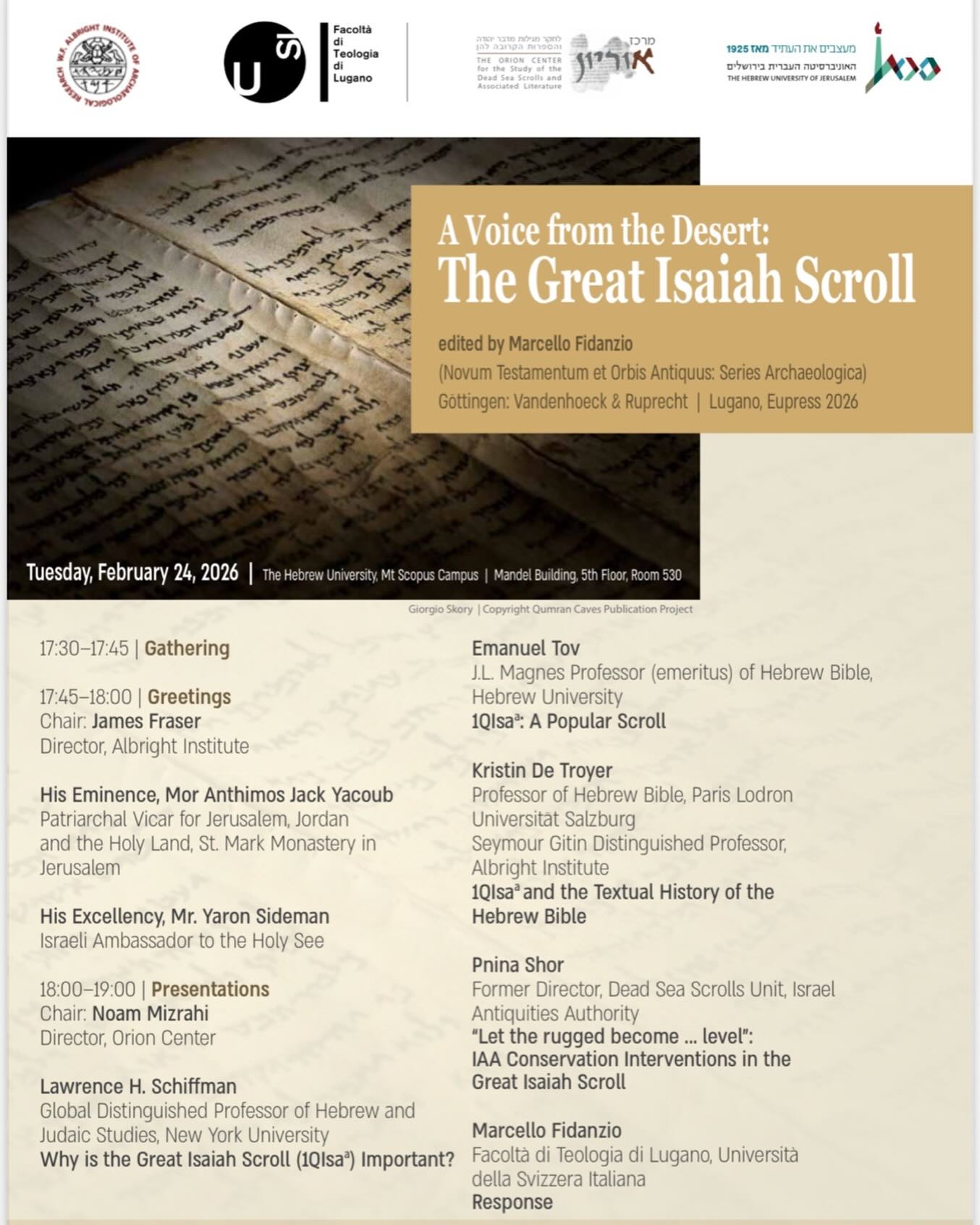
I’ve learned that the exhibition of the Great Isaiah Scroll has been postponed due to issues of climate control and will now open in February 2026. Perhaps they will extend the exhibit into the summer to compensate.

A bill introduced in the Israeli parliament would transfer control of the Cave of the Patriarchs in Hebron to Israeli authorities.

Jerusalem University College has announced its lineup of spring online courses, including:

  • Biblical Archaeology II, taught by Kyle Keimer
  • The Book of Revelation and the Seven Cities of the Apocalypse, taught by Chris Vlachos
  • Cultural Backgrounds of the Bible, taught by Oliver Hersey
  • The Parables of Jesus and the Rabbinic Meshalim, taught by Steven Notley

Israel’s Good Name reports on a summer excursion to the Sharon Beach Nature Reserve.

HT: Agade, Gordon Franz, Ted Weis, Charles Savelle, Paleojudaica

Share:

We lived within a mile of each other in the Judean hills for a decade, but we only “met” online years later. I was astonished that an Israeli rabbi had written a book about the archaeology of Esther (set in modern Iran). Somehow we connected by email, and when his book on the archaeology, geography, and history of Jeremiah came out, I was happy to recommend it.

I did not know at the time that Rabbi Yehudah Landy z”l was from an illustrious line of rabbis, a direct descendant of the Vilna Gaon. Nor did I know about his impressive rabbinical training, his founding of a yeshiva, or his deep knowledge of the Babylonian and Jerusalem Talmuds. (He completed these dozens of times in his life!)

I did know that he was a licensed Israeli tour guide, an expert author of books in both Hebrew and English, and a kind and humble man. Once, I needed a photo of a biblical site in the Judean hill country where I had previously lived—and where he still did. He provided that photo with permission to include it in the Photo Companion to the Bible.

A few years ago, he was traveling to the Los Angeles area, and he went to some extra effort to travel up to The Master’s University. Perhaps he was intrigued by this evangelical Christian school that thirty years ago established its own campus in Israel. We enjoyed a wonderful visit and tour of the TMU campus, with a few head turns at the unusual sight of a visiting rabbi. One topic of our discussion was the book he was finishing on the archaeological and geographical background of Joshua; I was glad to hear of his progress.

Within a few weeks of his return to Israel, Rabbi Landy responded to an email with a brief reply that he was “in need of serious medical treatment.” Since then I have prayed for his healing. I wrote to him a few times and always assumed the best when I didn’t hear back. But I learned last week that he died in the fall of 2023. He was only 64, and an online source said he had a brain tumor.

Much was lost with his passing. I can only imagine what he still planned to do with his encyclopedic knowledge of Scripture, the land, and Jewish writings. I can only imagine the personal impact he had on others, wide enough to reach this Gentile Christian living in California.

The reply that informed me of his passing also included the happy note that his book on Joshua has recently been published in English. This is indeed something for which to give thanks. The Lord sustained his life so that he could finish this work which he had spent years researching and writing. Of all the books in the Bible, none is as “land-focused” as Joshua, which makes this such a valuable work for someone with his areas of expertise.

Understanding Sefer Yehoshua (the Book of Joshua) is a beautiful book, attractively laid out with 1-3 photos on nearly every one of its 300 pages. The 32 chapters walk through the biblical text, beginning with an introduction on “The History of Torah Research on the Land of Israel.” Some chapter titles are:

  • The Borders of Eretz Yisrael
  • Crossing the Jordan
  • Conquest of Yericho
  • The Extent of Yehoshua’s Conquest
  • Apportioning the Land by Lottery
  • Shiloh and the Mishkan (Tabernacle)

About ten chapters are devoted to the individual tribal inheritances, and a couple others focus on the cities of refuge and the Levitical cities. A lengthy final chapter addresses “Archeological Findings.”

An obvious value of this book to most of my readers is Rabbi Landy’s knowledge of the works of Jewish sages. This is rarely considered in atlases or commentaries on Joshua. Another strength of this book is the precise topographic maps, utilizing satellite imagery and marked with cities and borders based on Rabbi Landy’s careful research.

In the book’s introduction, Rabbi Landy notes a few of the unique contributions that he makes in the pages that follow. These include:

  • A fresh understanding of Joshua’s battle with the northern kings at the waters of Meirom
  • An original proposal on where the tribes of Israel stood on Mounts Gerizim and Ebal
  • A novel interpretation of Joshua’s cryptic response to the tribes of Joseph in Joshua 17:14-18

Rabbi Landy has gifted us with a valuable resource that I believe will be treasured by many. Not only Bible students and teachers, but future writers of atlases, commentaries, and works of historical geography will benefit tremendously from his years of research and travel. By publishing his work both in Hebrew and in English, he has ensured that it will reach the broad audience it deserves. The book is available from the publisher and from Amazon.

Rabbi Landy will be greatly missed, but we can be thankful that he used his time and talents in ways that will help many to better understand the Bible. May his memory be for a blessing.

Share: