Glo has a gallery of several dozen Easter images available for free download (in high-resolution). 

These include photographs (including a few of ours), as well as ancient and modern works of art.  It’s probably too late to use for this year’s teaching, but they could be handy for future years.  Glo is available from Amazon for $57 and includes many thousands of images like these.

Share:

I sent out the latest issue of the BiblePlaces Newsletter this morning.  If you didn’t receive it, check your spam folder or subscribe here.  New subscribers won’t get the March issue by email, but you can view it online here.

The new CD this month is People of Palestine, and it includes a wide variety of fascinating photographs of individuals, couples, and groups from the early 1900s.  The American Colony photographers recorded the lives of Jews and Arabs, Christians and Muslims, as well as Samaritans, Druze, and foreigners.  Of the last category, none were quite as obvious as this guy, seen near the Damascus Gate of Jerusalem in January.

Foreigner near Damascus Gate, tb010910292 Foreigner in Jerusalem
Share:

Where are all the biblical texts between the Dead Sea Scrolls and the Aleppo Codex (10th century)? 

James Charlesworth has dubbed this “The Period of Great Silence.”  Recently, however, scholars identified that two fragments, located oceans apart, belong to a single text of Exodus 15 from the 6th-8th centuries.  The fascinating story is featured in this week’s Jerusalem Post Magazine.

The Economist has an article on polynomial texture mapping, which allows scientists to study ancient objects by a careful use of photography and lighting from different angles.  The result is that you can see features not otherwise observable.  I’ve seen it in action and it is phenomenal.

Leon Mauldin has started a new blog featuring photos from his recent Turkey and Greece trip.

Criticism of Jerusalem archaeologists is not new, but at least this Reuters article has interviewed both sides.

A rocket hit the archaeological site of Ur in Iraq this week.

There’s a half-price sale now for John Beck, The Land of Milk and Honey: An Introduction to the Geography of Israel, 2006 ($21 at Amazon, now $10 from the publisher). I haven’t read the book, but you can see a 6-page pdf sample at the website.

A couple of good Zondervan resources are now 50% off until April 15.  The Zondervan Illustrated Bible Backgrounds Commentary: Old Testament is available for $125 and the Zondervan 
Encyclopedia of the Bible is for sale for $140.  You must use source code 980683 for each.  Shipping is free.  (UPDATE: At the moment, Amazon’s price on the Encyclopedia is $138 with shipping.  My guess is that won’t last.  You can track Amazon’s price here.)

HT: Joe Lauer

Share:

The LandMinds show at Israel National Radio (Arutz-7) has two interviews this week that may interest readers.  Each interview is 48 minutes and may be downloaded in mp3 format.

James Monson describes his years living in Israel and the creation of maps for students of Bible. 

Monson was one of the creators of the long-lived Student Map Manual, and for the past decade he has been creating resources for Biblical Backgrounds, Inc.  His influence on students of historical geography can hardly be overstated. 

Gabriel Barkay discusses his work over the past decade sifting the material illegally removed from the Temple Mount.  He also answers questions on a variety of archaeological subjects.

I don’t have time to listen to these interviews in full before posting this notice, but I expect that both interviews are fascinating and worth the time.

Readers may be interested in following the LandMinds show regularly:

LandMinds broadcasts live on www.israelnationalradio.com every Wednesday evening from 5-7pm Israel time, 10-12 EST, 3-5pm in the UK, and rebroadcast during the week. You can also listen live with your iPhone!

HT: Yehuda Group

Share:

Here’s something that could easily be overlooked.  In 2004 Fortress published a photo CD by Helmut Koester entitled “Cities of Paul, Images and Interpretations: from the Harvard New Testament and Archaeology Project.”  It was and is very pricey ($250), and because of my teaching interests and my own collection, I purchased but never really used the collection.  But if this is of interest to you, you can now purchase it for less.  Kind of.koester

Logos has a pre-publication special on 20 Fortress volumes on Paul.  One of those “volumes” is this photo collection.  If you use Logos and find any of the other books in the set worthwhile, you can save a few dollars by purchasing now for $230 (retail $776).

If I don’t say, someone is bound to ask me my opinion.  I thought I had written something brief about it previously, but I can’t find it now.  In short, the photos are of high resolution, but most look like old slides that have been scanned.  Diagrams are included, which may be quite useful in teaching.  Note that there are only nine sites included: Athens, Olympia, Corinth, Isthmia, Pergamon, Delphi, Philippi, Ephesus, and Thessalonike.  The notes are extensive and valuable.  I think the $250 price tag is too high.  If you’re a Logos user, you’ll likely find many advantages in this new edition.

There are no reviews of the CD at Amazon.  The work is reviewed positively in the Review of Biblical Literature (pdf).

Share:

The story of the discovery of the Dead Sea Scrolls is a fascinating one, though it’s not always easy to separate fact from fiction.  For instance, the notion that a shepherd accidentally discovered the first cave of scrolls while chasing a stray sheep seems less likely given the history of the Bedouin in finding and selling ancient artifacts.fields_dead_sea_scrolls  The intrigues of the first decade is now clearer with the publication of the first volume of Weston Fields, The Dead Sea Scrolls: A Full History.  The book is being promoted by the publisher with a interesting review by Jerome Murphy-O’Connor. 
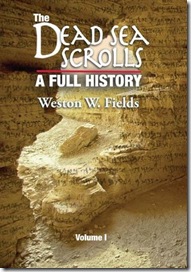
You can download the full review as a Word document here.  You can get a flavor from the first paragraphs:

Even though the Dead Sea Scrolls were discovered only 62 years ago, much of their early history has been shrouded in obscurity. Details of persons and places were compromised by focus on the scrolls themselves, and on occasion deliberate deception facilitated the continuation of illegal, but highly profitable, excavation. In 1998 Marcel Sigrist, OP, suggested to Weston Fields, Director of the Dead Sea Scrolls Foundation in Jerusalem, that the only way to acquire clarity would be to record critically the testimony of the original eye-witnesses. Some had already died, others were getting old, and this would be the last opportunity.
Fields took up the challenge, and the thoroughness of his oral history is illustrated by the fact that he even gives the number of sheep (about 55) in the care of Muhammed ed-Dib the day he threw the stone into what became Cave 1. The surviving actors were all happy to cooperate, and a number revealed that they had extensive private archives that had never been exploited. These amounted to tens of thousands of pages of precise written and photographic documentation, which was contemporary with the events. This greatly widened the extent of the project, and gave it a much more solid base. No longer did Fields have to rely on aging memories, and the unsupported word of one witness against another. He had documentary evidence that could be compared, contrasted, and critically evaluated. In the case of the ten actors who have died since the project began he just got there in time.
So much material became available that it quickly became clear that one volume would not be enough. The change in de facto ownership of the scrolls in the aftermath of the Israeli invasion of June 1967 might seem an obvious place to break. Fields, however, opts for 1960, both for practical reasons, and because that year caused an even greater upheaval in the publication of the scrolls. The Rockefeller funds supporting the full-time scholars working at the Palestine Archaeological Museum (PAM) dried up, and the team had to disperse to find jobs that ate into the time they could devote to the scrolls. Publication inevitably slowed.
From 1947 to 1960 Fields follows a strictly chronological order, often with subheadings of great precision, e.g. “19 July 1947, Saturday”; “Last week of July 1947” . He wisely refuses to treat the scrolls as a unified whole. The circumstances concerning the discovery, acquisition, and publication of Cave 1, for example, differed radically from those of Cave 4, and again from those of Murabba‘at, and still more from those of Cave 11. Thus separate topics are treated individually and chronologically. Fields is also right in quoting as much as possible from letters and interviews. As he points out, this is the only way “to taste the flavor, and to enjoy the nuances of entire letters or other documents from the earliest actors in the unfolding drama of the scrolls” (13 my emphasis). More importantly, it enables the attentive reader to formulate his or her own conclusions based on the evidence. Was the writer stating a bare fact or merely being ironic or sarcastic? Was the presentation tailored to the recipient?

Download the full review here.  You can also read it directly online at Amazon in what initially appears to be the author’s review of his own book. The publisher’s description of the 600-page, $99 book is here.  Fields also published a 128-page A Short History in 2006.

HT: Joe Lauer

Share: