A new book is out this week that I want to recommend highly.  Walking in the Footsteps of Jesus: A Journey Through the Lands and Lessons of Christ combines passion with humor in a unique “tour” through Jesus’ life.  Author Wayne Stiles has not written a “life of Christ” book, nor has he produced a work recounting the geographical background of Jesus’ ministry.  What he has done, through his deep knowledge of Jesus’ life and land, is to take the reader on a delightful and challenging journey to the physical and spiritual places where Jesus lived and taught.Walking in the Footsteps of Jesus Cover
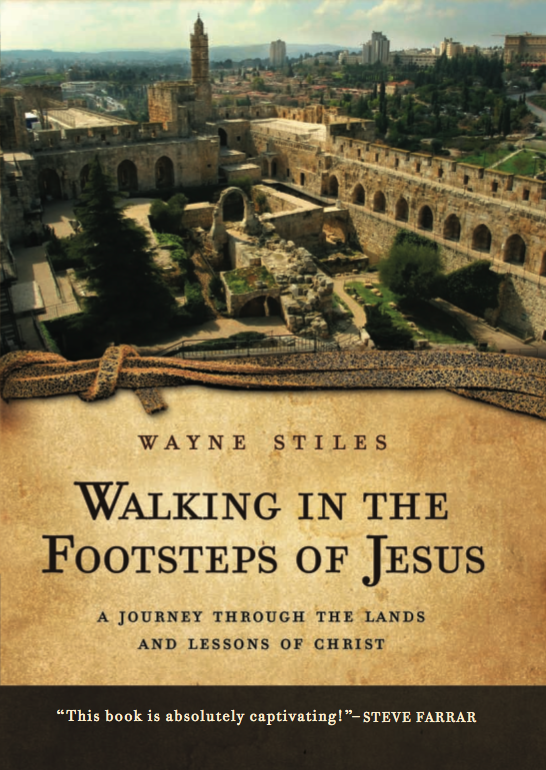
Stiles’ skill as a writer and “tour guide” makes the book engaging and rich with insights.  As a pastor for many years, Stiles is gifted in making lofty ideas of Scripture readily understandable to the average person, and he does so with many fun anecdotes and helpful analogies from his travels in Israel.

From Bethlehem, to Galilee and Jerusalem, and ending in Patmos, the book largely travels “in the footsteps of Jesus.”  Here is a snip related to the wilderness:

I have walked in the wilderness where Satan tempted Christ, just west of where He was baptized. Good grief, what a place. This is the wilderness of Judea where God shaped the character of the future King David in “the valley of the shadow of death” (Ps. 23:4). Here David prayed, “my flesh yearns for You, in a dry and weary land where there is no water” (Ps. 63:1). David wasn’t kidding. Endless piles of rocks, steep hills, no trees, modest vegetation, little water, slight shade, and lizards. As far as my eye could see, it was empty, dry, and depressing. I tried to imagine the silence, solitude, and struggle Jesus would have endured here for over a month. But I could not.
We can barely stand to fast for a day or two. Can you imagine fasting forty days? Jesus did so in preparation for temptation—and became desperately hungry and needy. And in His moment of need, the devil slipped in. He waits for moments like these.
“If You are the Son of God, tell this stone to become bread” (Luke 4:3).
The devil is no idiot—and also no gentleman. When he tempts, he plays dirty. No rules. No concessions. No mercy. He waited for a moment of vulnerability and then tempted Jesus to satisfy His legitimate need for food in an illegitimate way: “Turn this stone to bread—use your power to gratify your need.” What a cheap shot. Every stone would then become a temptation. And believe me, the Wilderness of Judea has plenty of stones! Jesus’ reply—although He was physically hungry—showed that He was spiritually full.
“It is written, ‘Man shall not live on bread alone.’”

If you haven’t yet been on a trip to the Holy Land, you’ll enjoy visiting it virtually through this book. 

If you have been, you’ll see it in ways that you haven’t before, even if you’ve visited countless times. 

This journey combines so many of my favorite things in one book: the places of the land of the Bible, the life of Christ, fascinating stories, excellent writing, and God-exalting, people-challenging truth. 

Pick this up for your next plane ride to Israel (or anywhere) and enjoy!
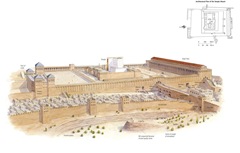
From earlier previews of the maps, illustrations, and study notes, I think that the ESV Study Bible will be a very useful resource for those interested in biblical geography and archaeology.  The Bible includes more than 200 full-color maps, and 40 stunning, up-to-date illustrations.  (For one example of “up-to-date,” look at the Pool of Siloam on the Jerusalem illustrations.) 

The Bible is due out on October 15, but the publisher wants everyone to know just how good this Bible will be before then.  To that end, they have just begun a blog.  I’d draw your attention to the post on the Gamla synagogue, with its outstanding reconstruction drawing (which you can download in high resolution).  Leen Ritmeyer gives his perspective on the illustration he helped to create here
If you want to know more about the Bible, there’s a 5-minute video overview that shows off some of the beautiful illustrations. 

One thing that I don’t think I’ll ever understand is how books like this can be so affordable ($31.50 online).

Justin Taylor at Between Two Worlds has posted a two-part interview with Leen Ritmeyer.  Ritmeyer served as the archaeological and architectural reconstruction editor for the forthcoming ESV Study Bible, of which Taylor is the managing editor. 

Part one of the interview focuses on what theGolgotha and Jerusalem, ESV Study Bible place of Jesus’ crucifixion looked like.  It includes a stunning, high-resolution reconstruction of the Temple Mount as it may have looked in the time of Jesus.

Part two of the interview concerns what the tomb of Jesus looked like.  It features a high-resolution image of what the “new tomb” may have looked like.

I have had the privilege of having an preview of dozens of graphics and hundreds of full-color maps that will be included in the ESV Study Bible and I concur with Ritmeyer’s assessment:

It is vital for Bible students to have a correct knowledge of the background of the Bible, and I am sure that the Study Bible will be of tremendous help for those who love to study the Word of God. With its many exquisitely rendered reconstruction drawings and accurate maps, a new standard has been set for biblical illustration, raising the bar for many years to come.

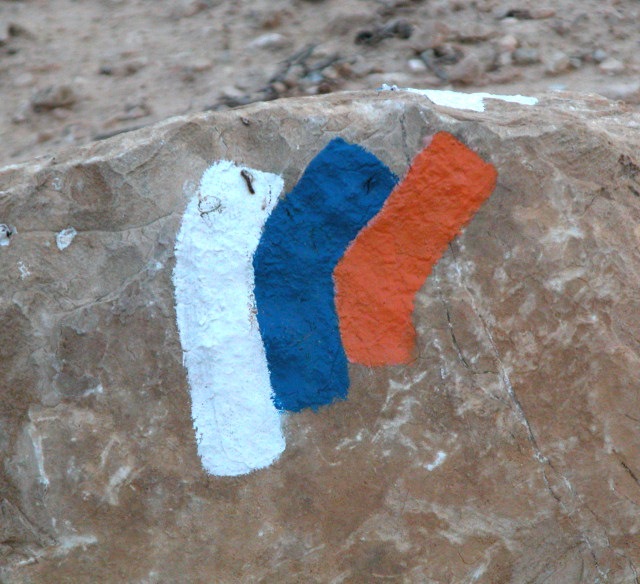
One of the simultaneously best and worst experiences of my life was hiking the Israel Trail.  I led a group of intrepid adventurers on a 120-mile hike, beginning in Dan and concluding in Caesarea Israel Trail marker at Machtesh Ramon, tb110702007(skipping a 30-mile section in the middle).  I’ve hiked many other portions of the trail over the years.  The trail covers some of most beautiful and remote scenery, and it is a way to understand the land of Israel that you’ll never get from jumping on and off a bus.  It also can be quite a painful experience for your feet. 

An Israeli couple recently hiked the entire trail from Eilat to Dan (580 miles) and the wife wrote a book about the 2-month trek.  The book, Walk the Land, was recently reviewed by Theresa Newell of CMJ USA (pdf, p. 21).  The review begins:

“What is needed by the reader or teacher of the Bible is some idea of the outlines of Palestine – its shape and disposition; its plains, passes and mountains; its rains, winds and temperatures; its colours, lights and shades. Students of the Bible desire to see a background and to feel an atmosphere; to discover from `the lie of the land’ why the history took certain lines and the prophecy and gospel were expressed in certain styles; to learn what geography has to contribute …” (From the 1894 Preface to the First Edition of The Historical Geography of the Holy Land, by George Adam Smith.)

Over a hundred years later, Judy Pex brings the reader through those very “plains, passes and mountains” about which Smith wrote. Step by step from Eilat to Mt. Hermon on The Israel Trail, Pex describes her country from the ground up.
Judy and John Pex have overseen The Shelter Hostel in Eilat for over 20 years. They lead an international congregation there which grew out of their work of serving soup dinners and giving backpackers a place for overnights. It is a 24/7 kind of job.
Their dream grew over the years: to walk the entire Israel National Trail (Shvil Israel) – a feat accomplished by only about 100 people per year. John decided it had to be done before his 60th birthday! And they did it – all winding 940 km (580 miles) from Eilat to Dan. The Trail meanders through the vast wadis and heights of the Negev, then cuts west to the Mediterranean near Tel Aviv along busy roads, up the coast and across the Carmel Range, ending on Mt. Hermon at the Syrian-Lebanese border. The map and 16 pages of Pex’s color photos augment her descriptive passages.

There is also an interview with the author here.

The book sounds like a profitable way to gain insights from the trip without having to wrap your feet in duct tape every morning.

HT: Yehuda Group

I have been alerted to a new resource which may be very helpful for researchers.  From their description:

The Graduate Junction is a brand new website designed to help early career researchers make contact with others with similar research interests, regardless of which department, institution or country they work in. Designed by two graduate researchers at the University of Durham, The Graduate Junction has proved very popular with research students and academics alike. Within the first two weeks after our launch in early May 2008 over 2000 researchers in the UK had registered and the news had spread across 40 countries. Currently research students have two main sources of information, published literature and academic conferences. Whilst published literature is essential, it can only ever reveal completed work. Relevant academic conferences provide a forum for students with similar research interest to interact but occur infrequently. It is very easy to become isolated, overly focused on the specifics of one’s own work and lose a sense of what other related work is being done. The Graduate Junction hopes to prevent that isolation and allow early career researchers to start forming the networks which can stay with them throughout their careers. The Graduate Junction aims to provide an atmosphere similar to that at academic events and through the use of the internet aims to establish an on-line worldwide graduate research community.

This could be a great way to connect with those working in your field.  Check it out here.

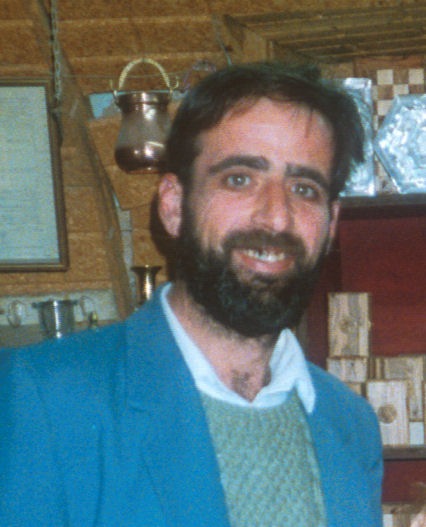
Some years ago Zondervan released a educational game on CD called “Get Lost in Jerusalem.”  The goal of the game was to navigate through the Old City of Jerusalem with the help of clues.  shabanMany American students were particularly delighted to find that “home base” in the game is the shop of the famous Shaban (photo at right).  The copyright on the game has now reverted to its creator, Ted Hildebrandt, and he is making it available for free download.  So if you’re hankering for a stroll down the historic narrow alleyways of Christian Quarter, minus the odors, you’re in luck.  You can check out Hildebrandt’s page with the download (and lots more), get more information at Amazon, or take a look at Biblical Studies and Technological Tools to get some helpful instructions before downloading and installing the 550 MB file.

lost