A representative of Logos Research Systems has contacted me with a note about their Pre-Publication offer for the Near East Archaeology Collection (3 volumes).  The retail price for the set is $430, but they are offering it now for $100.  The three volumes are:


Studies in the Archaeology of the Iron Age in Israel and Jordan, edited by Amihai Mazar (2001).


Urbanism in the Aegean Bronze Age, by Keith Branigan (2002).


Excavations by Kathleen M. Kenyon in Jerusalem 1961-1967, Volume III: 
The Settlement in the Bronze and Iron Ages, by Margreet Steiner (2001).

I was initially reluctant to mention it here because I feel that these are not foundational archaeological works, which most of this blog’s readers probably would be better suited for.  In fact, these books are all quite advanced and I would only recommend them for the scholar, graduate student, or a real nerdy armchair archaeologist.  For me personally, the first volume is the most valuable.  This alone is $150 new at Amazon.  Logos software, of course, offers significant advantages for an electronic edition.

As a Pre-Pub offer, customers get the lowest possible price, as the price goes up once enough orders are received.  If enough orders aren’t placed, the books are never produced.

I’d love to see Logos offer in the future some more foundational archaeological works, such as:

Mazar, Archaeology of the Land of the Bible

Stern, Archaeology of the Land of the Bible, vol 2

Ben-Tor, ed., Archaeology of Ancient Israel

Hoerth, Archaeology and the OT

McRay, Archaeology and the NT

And I would get real excited if they could get the archaeological encyclopedia sets:

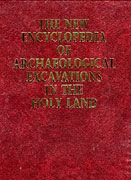
The New Encyclopedia of Archaeological Excavations in the Holy Land, 4 volumes

The Oxford Encyclopedia of Archaeology in the Near East, 5 volumes

I fear that most/all of these will never happen because publishers tend to be difficult to work with.  It
seems to me that publishing an electronic edition several years after the initial publication is a win-
win situation.

Share:

Many readers may be unfamiliar with the work of the Near Eastern Archaeological Society.  Founded in 1957, this group of evangelical scholars is committed to research in the lands of the Bible.  Membership in the organization includes the annual bulletin (a journal with 4-5 articles and book reviews) as well as 4 quarterly issues of Artifax, an excellent review of the latest news throughout the biblical world.  Full membership requires belief in the inerrancy and inspiration of the Bible.  Supporting associates pay the same dues ($30), but need not sign the statement of faith.  Student members pay half price ($15).  You can get more information as well as subscription information at the NEAS website.

Share:

The first is a brand new work, released a few months ago.  The second is the 4th edition and is due out in April.  I have not seen either and so can only judge them by their covers (and both fail on that count).  There must be a good market for Bible atlases with so many out there; in addition to these, I am aware of two revisions underway and two new ones being written.


The IVP Atlas of Bible History, by Paul Lawrence

* Includes nearly 100 superb relief maps.
* Features over 140 colour photographs.
* Includes over 20 site plans and panoramic reconstructions.
* Draws on the latest finds of historians and archaeologists.
* Includes special features on topics such as the peoples and languages of the Bible throughout the text.
* Also includes a Scripture index.
This atlas is currently available for $28 from either Eisenbrauns or Amazon.


Oxford Bible Atlas, 4th ed., by Adrian Curtis

This new edition of the Oxford Bible Atlas, now with full-colour maps and illustrations, has been thoroughly revised to bring it up to date with regard both to biblical scholarship and to archaeology and topography. The Atlas will help readers of the Bible understand the contexts in which its stories are set and to appreciate the world from which it emerged and which formed its background. Maps show the geographical setting of the Bible’s stories and reflect the successive stages of the Bible’s accounts, while specially chosen full-colour illustrations bring the countries and their peoples to life. The accompanying text describes the land of Palestine, and its wider ancient Near Eastern and east Mediterranean settin  gs. It outlines clearly the successive historical periods, and describes the major civilizations with which Israelites, Jews, and early Christians came into contact. There is also an illustrated survey of the relevance of archaeology for the study of the Bible. The Atlas provides a superb guide to the geography of the Holy Land throughout biblical history, from the Exodus period through to New Testament times.

This edition will be available in April and is currently priced at $28 at Eisenbrauns and $23 at Amazon.

Share:

There’s a new interactive satellite map available for download.  B. G. Galbraith created this using a high-resolution satellite photo of Israel and then identifying major biblical sites.  Each site is hyper-linked to a page with photos, descriptions, and relevant Scriptures about it.   The program is free and may be downloaded here.  This is another great tool to learn about the land and the Bible.

Share:

The problem with studying the geography of Israel is that it can quickly become divorced from the life-changing truths of Scripture. After all, how do hills and valleys help you grow closer to God?

Wayne Stiles has the answer to that in his new book, Going Places With God: A Devotional Journey Through the Lands of the Bible. I am often asked what is the perfect follow-up to a trip to Israel. My typical answer (“read a Bible atlas”) just got better: read and meditate on the truths of this devotional guide. What makes this book so good is that it takes “boring” details of Scripture and shows how they are profitable for life and godliness.

Here’s an example: Stiles shows how the geography of Joseph’s brothers tending their sheep brought Joseph to slavery in Egypt and ultimately Israel’s deliverance from famine. Unless you understand the geography, you won’t fully appreciate God’s sovereignty. The author draws from that just how we should relate to our sometimes bewildering circumstances. In another story, Israel has to travel all the way around Edom, and Stiles explains that in God’s plan, sometimes the long way is the best way.

I love too the way that Stiles draws beautiful word pictures. With him as guide, I picture myself one day walking along the shores of the Sea of Galilee and another day watching the sunrise from the Mount of Olives. A pastor for fourteen years, Stiles is a truly gifted communicator with a knowledge of where people are hurting today. One devotional will encourage you to increase your
trust in the all-powerful God, and another devotional will challenge you to take heed lest you fall.

Familiar lessons some, but brought to life from places in the Bible that you would never otherwise look.

I love the geographical nuggets contained in this book, but the reason that I am recommending it is this: Going Places With God will challenge you to live a radical, Christ-centered life. The book came
out a week ago: I encourage you to buy it, read it, and buy a couple for friends.

You can see more about the book and its author at this website. The book lists for $15, but Amazon has it for $10.

[Update: The free copies have all been claimed.]

Share:

Too often new discoveries are sensationalized, and after things are sorted out and more rational conclusions are made, the story doesn’t make the news again.  For this reason, anyone interested in the “Megiddo church” would do well to read the book, or at least James Tabor’s helpful comments about it.

In November, 2005 the news spread quickly around the world: Oldest “church” ever found has been discovered near the biblical site of Armageddon! The site was uncovered on the grounds of a modern Israeli prison near Megiddo. It gives us a precious glimpse into early Christian worship and devotion before the time of Constantine (325 AD), for it is only after Constantine that structures we can definitely identify as “Churches” began to spread throughout the Mediterranean world. Yet this site can not properly be called a church. So what is it? Scholars are just beginning to try and access the impact of this precious discovery. What we appear to have here is what the authors have called a “Christian prayer hall.” It is a room, complete with mosaics containing art work and inscriptions, dedicated to “the god Jesus Christ,” with obvious ritual functions and symbols, but quite different from later Christian churches of the Byzantine period. The structure appears to date to the early 3rd century, making it by far the most important early Christian archaeological site of its kind ever discovered in the Holy Land. In their book, excavation director Yotam Tepper, and epigraphic expert Leah Di Segni, throughly explore the textual evidence for “sacred meals” from sources such as the Didache, the fascinating early Christian document discovered in 1873 that I discuss in The Jesus Dynasty. Our evidence for pre-Constantinian “Christianity” is almost wholly textual. It is rare to find any kind of material evidence that might shed light on the practices of early followers of Jesus, particularly in the Holy Land. To have found at Megiddo this evidence for liturgical activities that seem to link to rites and practices we read about in ancient texts is something of which we normally can only dream. But there is more. One of the three inscriptions mentions four women, singled out as having special importance to the community. This is clear evidence, echoing what we find in our earliest gospel sources, of the vital importance of woman as leaders and even patrons in the earliest days of the movement. Now that the dust has cleared a bit, literally, the story of this most extraordinary archaeological find has just become available in an attractive, lavishly illustrated, full-color booklet published by the Israel Antiquities Authority titled, A Christian Prayer Hall of the 3rd Century. The authors, have provided us with a fascinating but authoritative, account of the excavation and its significance narrated in an accessible style for the non-specialist. I recently heard both Tepper and Segni lecture on the discovery at the annual meeting in D.C. of the American Schools of Oriential Research, the preeminent gathering of archaeologists working in areas related to the Bible and the Ancient Near East. Their presentations were riveting and thought provoking and the substance of those lectures, plus much more, is provided in this richly illustrated volume. This little book is a model for publications in the field of archaeology. It is beautifully done, reasonably priced, and as readable as it is informative. It is a must for anyone interested in the earliest archaeological records of the spread of Christianity in the Holy Land. The IAA has printed a limited but reasonable number of copies. It can be conveniently ordered in the U.S.A. from the Web bookstore: Centuryone.com. I urge anyone interested in the material evidence related to earliest Christianity to get a copy of this book while they are still available. Dr. James D. Tabor
Chair, Dept. of Religious Studies
UNC Charlotte
Charlotte, NC 28223

For earlier BiblePlaces posts about this place, see here and here.

Share: