A woman hiking on an unnamed archaeological site in eastern Galilee picked up a gold coin with the image of Emperor Augustus. High-res images are available here.

Luke Chandler reports on a new excavation at Khirbet Arai, not far from Tel Lachish. The first week has already revealed two massive structures as well as Philistine pottery.

Douglas Petrovich has done some interesting work related to the Israelite presence in Egypt. He has started a Kickstarter project to raise funds to publish a book on it.

The lyre depicted on Israel’s half-shekel is based on a seal now known to be forged. A larger drawing of the forged seal is online here.

A 19-year-old American spent the night in Solomon’s Quarries to dig for treasure.

The publication of Yadin’s final report from his Megiddo excavations will be celebrated at an event at Hebrew U on April 5.

In Photos: Members of an Israeli historical group dressed up in costume for a three-day hike from Jericho to Jerusalem.

The plan to enlarge the mixed prayer area in the Jerusalem Archaeological Park next to the Western Wall prayer plaza is apparently dead.

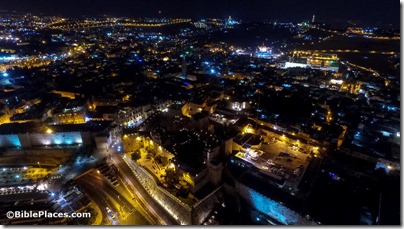
Archaeologists are opposing plans to build a hotel and apartment buildings in the Jerusalem neighborhood of Abu Tor, the traditional “Hill of Evil Counsel.”

Ferrell Jenkins shares a photo of one of the best preserved stretches of Roman roads in Israel.

Ashkelon excavation veterans are invited to a closing celebration as the thirty-year project ends.

HT: Charles Savelle, Joseph Lauer, Agade, Ted Weis, Daniel Wright

I want to recommend to you today a work that’s a little broader than the typical “Bible places” category, but one that I have found of great use for several years now. Dr. Anderson’s Interpretive Guide to the Bible is very valuable tool for understanding the Bible. This unique resource walks you through the biblical text with the aim of seeing the parts in light of the whole. For each of the 66 books, you get relevant background material, a synthetic overview of the text, and an outstanding annotated review of the major commentaries. You can read more about what makes this resource unique here.

When Steven Anderson finished his 8-volume guide, it was an easy decision for me to purchase it.

Since that time, I have consulted it many times to great profit. His approach is conservative, and his precision is all too rare today.

Steven has now made the pdf editions of his guide available for free. This is a real gift to Bible readers and teachers everywhere. Amazon continues to sell the printed volumes, and he is also accepting donations for those grateful for his work.

I encourage you to download these and recommend them to others. You would do well to consider purchasing a print copy or recommending it to church and local libraries that you frequent.

One other happy note: Steven has been on the BiblePlaces team for more than a year now, working with us on our next (awesome!) photo project. We look forward to releasing the firstfruits of these labors in the near future. But for now, check out his excellent Interpretive Guide!

Some scholars have weighed in on the seal of the woman discovered in Jerusalem. Christopher Rollston has a lengthy analysis, concluding in part that the seal dates to approximately 700 BC.

Robert Deutsch writes that the archaeologists made several mistakes, including misreading the name on one of the seals. The Daily Mail has a number of photographs. For some political irony, see The Blaze.

The first phase of the Terra Sancta Museum in Jerusalem (at the Monastery of the Flagellation) opens on March 17.

The latest issue of Near Eastern Archaeology features articles on Jericho, Adam (Tell Damiyah), Gustaf Dalman, and more.

A schedule of forthcoming lectures for the Anglo-Israel Archaeological Society are online here.

New Excavation Report: Beer-Sheba III: The Early Iron IIA Enclosed Settlement and the Late Iron IIA-Iron IIB Cities, by Ze’ev Herzog and Lily Singer-Avitz. Sold as a 3-volume set by Eisenbrauns.

The latest exhibit at the Israel Museum, “Pharaoh in Canaan: The Untold Story,” looks at Egyptian presence in Israel during the Middle and Late Bronze periods. A one-minute video provides a preview.

“Pharaoh: King of Ancient Egypt” opens at the Cleveland Museum of Art on March 13, featuring many pieces from the British Museum.

Many documents from the 18th and 19th centuries have been discovered in a storeroom in Egypt, including letters from Flinders Petrie and Howard Carter.

Luxor is sending 778 artifacts to be displayed in the Grand Egyptian Museum in Cairo.

National Geographic runs a well-illustrated story on King Tut’s grandparents, Yuya and Tuyu.

The Karnak Temple did not catch on fire.

A New York Times reporter describes some of the challenges of being a tourist in Saudi Arabia.

The BBC reports on the impact of the Syrian civil war on the archaeology of Tell Qarqur (Qarqar).

Clyde Billington is on The Book and the Spade this week discussing the harbor of Corinth and the fortress of Macherus.

Now on pre-pub pricing for Logos: Archaeology in Action: Biblical Archaeology in the Field ($50).

Many of the early volumes of the Palestine Exploration Fund Quarterly Statement are now online.

Recommended book, on sale for Kindle: Israel: Ancient Kingdom or Late Invention?, edited by Daniel I. Block ($2.99)

Zecharia Kallai, professor emeritus of Historical Geography of Palestine at Hebrew University, died last month.

HT: Charles Savelle, Agade, Pat McCarthy, Joseph Lauer

Jaffa, rough sea, mat00699
Our most liked photo this week on Facebook was this one of the harbor at Jaffa (biblical Joppa), from the American Colony and Eric Matson Collection.

IAA excavations in the Schneller Compound in Jerusalem have revealed a Roman bathhouse and a Roman- or Byzantine-era winerpress. High-res photos and a video may be downloaded here.

Archaeologists have unearthed a cemetery in use from the Middle Bronze to the Iron Ages south of Bethlehem. Two journal articles on which the report was based can be read here and here.

A hidden camera reveals for the first time the condition of Palmyra after ISIS terrorists destroyed temples, arches, and tower tombs.

A missing letter in an inscription brings into question whether the Amphipolis tomb really belonged to Hephaestion, Alexander the Great’s beloved friend and general, and may instead belong to Alexander’s mother, Olympias.

The Bethsaida Excavation Project has posted their 2015 season report (73 pages with lots of photos).

Three looted Mesopotamian sculptures were found in a Slovenian refugee camp.

Haaretz runs a story on the mysterious 90-mile long wall in Jordan.

Two UCSD professors are working with the Israel Antiquities Authority to update the Digital Archaeological Atlas of the Holy Land.

An online Neo-Assyrian Bibliography compiled by Heather D. Baker and Melanie Groß is available.

Egypt is seeking to add four archaeological sites in Alexandria and Sinai to UNESCO’s World Heritage List.

Jacob sheep being raised in Canada will be brought back to Israel.

The death of the Dead Sea has probably never been better illustrated than in this multi-media rich “article” at Haaretz. It includes the prediction that within 20 years there may be no access to the shoreline of the Dead Sea.

Clyde Billington and Gordon Govier discuss the latest discoveries on this week’s edition of The Book and the Spade.

Shmuel Browns visits the site of Lifta (biblical Nephtoah) on the edge of Jerusalem.

Minna Silver takes readers on a visit to biblical Haran, once home to the patriarch Abraham.

Eisenbrauns’s Deal of the Weekend: The Horsemen of Israel
Horses and Chariotry in Monarchic Israel, by Deborah Cantrell ($20).

Barry Britnell introduces a new video project entitled “Following the Messiah” and encourages everyone to support the project through their Kickstarter Campaign.

HT: Ted Weis, Gale, Joseph Lauer, Agade, Ferrell Jenkins

A seven-year-old boy found a 3,400-year-old figurine at Tel Rehov.

Archaeologists working at Timna in southern Israel found some remarkably well-preserved fabrics from the time of David. You may recall that for a long time scholars denied there was any activity at the site during the time of the United Monarchy.

A €1.6 million Israeli-German project will use digital tools to put the fragments of the Dead Sea Scrolls back together again.

A major renovation of the Church of the Nativity in Bethlehem is underway.

Two artists covertly scanned the bust of Nefertiti and have now released a 3-D dataset.

Two guards at Dayr al-Barsha in Middle Egypt were killed by looters.

Adam Prins recently presented a seminar at the Albright Institute on “3D Models in Archaeological Excavation Recording: The JVRP Method.”

An exhibition of two recent treasure hoard discoveries provides insight into Roman life in England.

A series of lectures will be given at Tel Aviv University for the annual celebration of “Aharoni Day” this coming Thursday.

Project Mosul is a new website that “solicits photographs of antiquities and uses 3-D modeling software to create a virtual record of what was lost in the attack.”

Now online: Bryant Wood’s critique of Steven Collins’ northern location of Sodom.

Wayne Stiles explains five ways the Lord taught his people to walk by faith in the land of Israel.

The Zondervan Illustrated Bible Backgrounds Commentary, Old Testament e-book volumes are on sale for $4.99, ending today.

HT: Ted Weis, Joseph Lauer, Agade

On Jan 6, 2016, the New York Public Library released more than 187,000 items in their digital collection into the public domain. Mark Hoffman sent along some of the treasures he found and that motivated me to dig deeper. The list below reflects highlights of what we discovered.

You might begin by checking out the interesting visualization of the project. When you’re sufficiently overwhelmed, you can follow the direct links below, beginning with collections including the land of Israel and concluding with Egypt, Mesopotamia, and biblical manuscripts.

The Holy Land, Syria, Idumea, Arabia, Egypt and Nubia. From drawings made on the spot by David Roberts . . . With historical descriptions by the Revd. George Croly . . . Lithographed by Louis Haghe, 1842-49. 252 images.

Egypte, Nubie, Palestine et Syrie : dessins photographiques recueillis pendant les années 1849, 1850 et 1851 [Egypt, Nubia, Palestine and Syria: Photographic Drawings Collected during the Years 1849, 1850 and 1851], by Maxime Du Camp, 1852. 127 images.

Jérusalem: étude et reproduction photographique des monuments de la Ville Sainte, depuis l’époque judaïque jusqu’à nos jours [Jerusalem: study and photographic reproduction of the monuments of the Holy City from the Jewish era to the present], by Auguste Salzmann, 1856. These 42 images are the earliest known photographs of Jerusalem.

Palestine, by Robertson and Beato, 1857. 19 images.

Egypt and Palestine, by Francis Frith, 1858-59. 78 images.

Sinai and Palestine, by Francis Frith, 1862(?). 40 images.

Plates from the Queen’s Bible of 1862. 71 images.

Jerusalem Explored, being a description of the ancient and modern city, with numerous illustrations consisting of views ground plans, and sections, by Ermete Pierotti. Translated by Thomas George Bonney, 1864. 64 images.

Ordnance Survey of Jerusalem, by Charles W. Wilson, 1865. 46 images, but it does not include the survey map.

Views of Egypt, Palestine and Syria, by Félix Bonfils, 1867-71. 32 images.

Palestine and Syria, by Bonfils, Zangaki, and Arnoux, 1870s. 19 images.

Voyage d’exploration a la mer Morte, a Petra, et sur la rive gauche du Jourdain [Exploration of the Dead Sea, Petra, and the Left Side of the Jordan River], by Melchior Vogüe, 1874. 84 images.

Picturesque Palestine, Sinai and Egypt, by Charles W. Wilson, 1881-84. We like our version better, but this one is free.

Maps of Asia, 1890. 64 images.

Palestine and Egypt, March 1894, by Bonfils, Zangaki, and Arnoux, 1894. 65 images.

Assortment of photographs of Palestine and Jerusalem, 1870-1900. 36 images. Includes some of the American Colony photographs.

Views of Interesting Places in the Holy Land. Published by the American Sunday School Union. 8 sketches that are not high quality.

From Egypt . . .

Description de l’Égypte: ou, Recueil des observations et des recherches qui ont été faites en Égypte pendant l’expédition de l’armée française [Description of Egypt: and Reports of observations and research that have been made in Egypt during the expedition of the French army], 1809-28. 903 images. The extraordinary work of Napoleon’s expedition.

Pantheon Egyptien: Collection des personnages mythologiques de l’ancienne Egypte [Egyptian Pantheon: Collection of Mythological Figures of Ancient Egypt], by L. J. J. Dubois and J. F. Champollion, 1823-1825(?). 90 color illustrations.

Manners and Customs of the Ancient Egyptians, by J. G. Wilkinson, 1837. 100 images.

Pyramids of Gizeh, from Actual Survey and Admeasurement, by J. S. Perring, 1839-42. 62 illustrations.

Monuments Égyptiens, bas-reliefs, peintures, inscriptions, etc., by E. Prisse d’Avennes, 1847. 54 images.

Collection of Views of Egypt, including Cairo and the Pyramids, by G. Lékégian and Pierre Marchandon de La Faye, 1880s or 1890s. 58 images.

From Mesopotamia . . .

Monuments of Nineveh, from Drawings Made on the Spot, by A. H. Layard, 1849. 100 plates.

Monument de Ninive, découvert et décrit, by Paul Emile Botta, 1849-50. 398 images.

Voyage en Perse [Travels in Persia], by Eugène Flandin and Pascal Coste, 1851-54. 346 images.

A second series of the Monuments of Nineveh; including bas-reliefs from the palace of Sennacherib and bronzes from the ruins of Nimroud, by A. H. Layard, 1853. 73 images.

Ninive et l’Assyrie [Nineveh and Assyria], by Victor Place, 1867-70. 90 images.

The Bronze Ornaments of the Palace Gates of Balawat (Shalmaneser II, B.C. 859-825); edited, with an introduction by Samuel Birch; with descriptions and translations by Theophilus G. Pinches, 1880-[1902]. 94 images from the palace of the king we now call Shalmaneser III.

Biblical Manuscripts . . .

Samaritan Pentateuch, 1232. These 277 images are currently only available in low resolution.

The Xanten Bible, from Xanten, Lower Rhineland, 1294. Includes the Torah and Writings. There’s more information about this manuscript here. 518 images in low resolution.

We welcome suggestions of other collections that we missed. Add a note in the comments or send us an email (see address in sidebar) and we will update this list.