A large bronze mask depicting the god Pan was excavated at Hippos (Sussita). A video shows the discovery with the use of a metal detector. A press release from the University of Haifa has more details.

Members of the Israeli Caving Club discovered a cache of rare coins and other artifacts from the
Hellenistic period in northern Israel. That find is one of seven exciting discoveries made around the world this month.

An orange gem depicting the goddess Artemis has been discovered at the Herodium.

Luke Chandler reports that inscriptions from Khirbet Qeiyafa and Tel Lachish will be published soon.

A man walking on the beach at Ashkelon found some archaeological pieces.

Leen and Kathleen Ritmeyer’s guide to the Temple Mount has been published. Copies may be purchased from their website.

Clint Gilbert has recorded a Bible Lands Song which can help you or your students learn basic Bible geography.

Studies suggest that ancient people didn’t perceive the color blue because they didn’t have a word for it.

AWOL’s List of Open Access Journals in Ancient Studies now includes 1481 titles.

Sad news: Harry A. Hoffner passed away suddenly on Tuesday, March 10. Hoffner was a long-time professor of Hittitology at the University of Chicago’s Oriental Institute. I am told that his two-volume commentary on 1-2 Samuel for the Evangelical Exegetical Commentary was recently submitted to the editor.

More sad news: “Hans G. Goedicke, a renowned Egyptologist who had been chairman of the Johns
Hopkins University’s department of Near Eastern studies, died of cancer Feb. 24.”

We’ll have more links tomorrow.

HT: Agade, Charles Savelle, Bill Schlegel, Joseph Lauer

Share:
(by Chris McKinny)


In past years, this blog has
discussed extensively
the identification of Khirbet Qeiyafa, which has been
identified with Shaaraim by the excavators. I agree that Khirbet Qeiyafa should
not be identified with Shaaraim (see also below), but if Khirbet Qeiyafa is not
Shaaraim then where should we locate the biblical town?
  
Shaaraim is mentioned twice in the
biblical narrative, once in the Eshtaol district (Josh. 15:36, cf. Onom. 87.1) where
it is found between and again in association with the Philistine retreat
following the death of Goliath (1 Sam. 17:52). The text states that they fled
“as far as Gath and up to the gates of Ekron…on the way of Shaaraim, as far as
Gath and Ekron.” This latter context clearly puts the site in the vicinity of
the battle, which occurred in the Elah Valley between “Socoh and Azekah at
Ephes Dammim” (1 Sam. 17:1). Also, it should be noted that this reference does
not actually refer to the town of Shaaraim, but to the road that led to Gath
(Tell es-Safi) and Ekron (Khirbet el-Muqqana). Therefore, the text seems to
indicate that Shaaraim should be located west and perhaps north of the battle
with the toponym likely deriving from the routes that went through the Elah and
Sorek Valleys to Philistine Gath and Ekron (Na’aman
2008b:2–3).


Click on sites to see archaeological details and pictures


Garfinkel and Sanor, the excavators
of the recently concluded excavations at Khirbet Qeiyafa (2012), have revealed
one of the more intriguing ancient sites from the Early Iron Age IIA (i.e. 10th
century BCE). They have identified
Khirbet Qeiyafa with Shaaraim. This argument is based on three main criteria:
1) Shaaraim occurs after Socoh and Azekah in Joshua 15:35-36, 2) the site is
located directly above the presumed location of the biblical battle between
David and Goliath, and 3) the site produced two Iron IIA four-chambered gates
inside of a massive casemate fortification, which gave the name to the site
(Shaaraim = two gates) (Garfinkel and Ganor
2008; Adams 2009:47–66).
This identification has received a good deal of criticism from various scholars
who have offered different identifications for Khirbet Qeiyafa (Na’aman 2008a
  Gob, before changing his mind in,
2012:88; see also Finkelstein and Fantalkin 2012:48; Galil 2009 – Netaim; Levin
2012b –  Ma’agal – interpreted as a
circular military fortress mentioned in 1 Sam. 17:20; Bolen 2012 –  Ephes Dammim, but it is possible that this is a
regional term).
Simply stated, Khirbet Qeiyafa should not be identified with Shaaraim. This is
due to the fact that the dual ending most likely does not mean “two gates” and
the site should be located further to the west/northwest (Na’aman
2008b:3–4; see also Elitzur 2004:282–290). This latter point means that
Rainey’s earlier identification with Khirbet es-Saireh can probably be ruled out on
geographical grounds (see discussion in 1975:69*; but see his later opinion that left Shaaraim unidentified 2006:147). On the other hand, Dagan’s suggestion of Khirbet
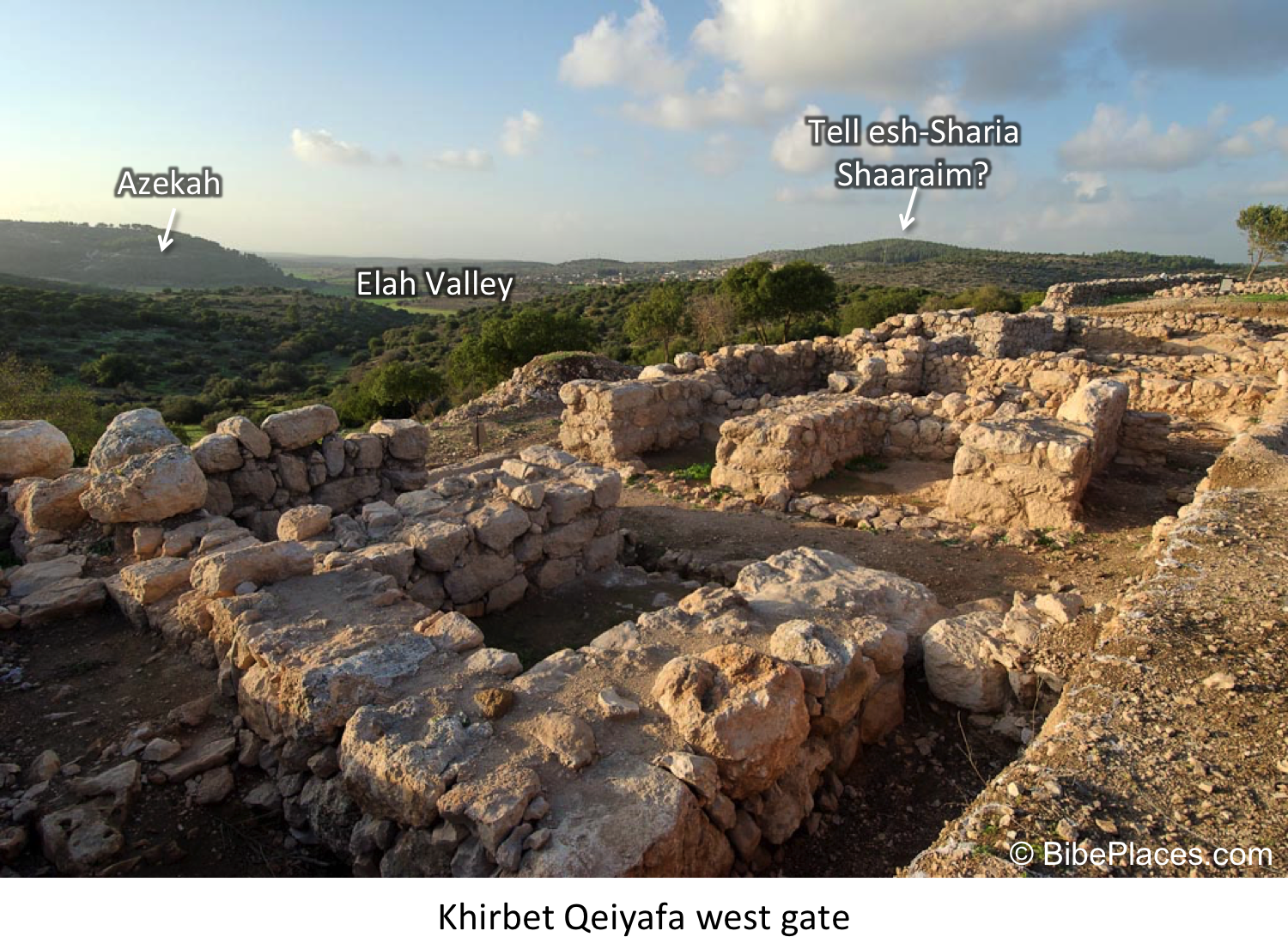
esh-Sharia, which is situated between Azekah and Khirbet el-Kheisum
(Adithaim?), would seem to fit this geographical requirement (1996a:139). Additionally, Khirbet
esh-Sharia would seem to present a compelling toponymic connection with
Shaaraim. The archaeological remains at the site are also in line with this
identification, as the site has remains from the Iron IIA (30 dunams**), Iron
IIB-C (40 dunams), and
Roman-Byzantine periods (Zissu
2000:77*–78*; Dagan 2000:site 55).
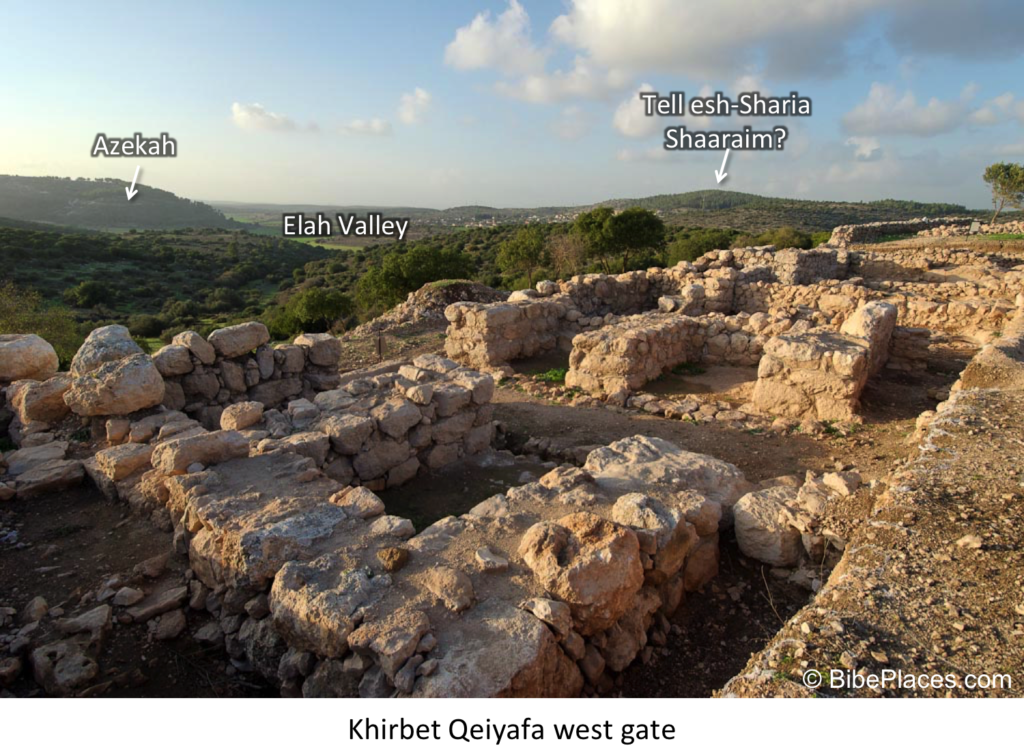

I disagree with Na’aman’s
conclusion that Khirbet esh-Sharia is not far enough to the west to match the
retreat of the Philistines (1 Sam. 17:52) (2008b:4–5). There are no known Judahite
sites to the west of Azekah (i.e. between Azekah and Philistine Gath) and it
seems that the Azekah-Tell Judeidah ridge formed a clear topographical border
between Philistine Gath and Judah (1983:10–11). Khirbet esh-Sharia sits very
near both the Elah Valley route to Gath and Ekron (Dorsey 1991:J6) and the “Diagonal Route” that
connects the Elah and Sorek Valley systems (Dorsey 1991:Sh2). In light of Na’aman’s
contention that Shaaraim was the “gateway to Judah” (2008b:4–5), it is difficult to
understand his hesitation to identify a site that perfectly suits his
definition.

** 1 Dunam = 1000 square meters

Update: Rainey references updated. 


Bibliography (note links to available online PDFs)

Adams, D.L.
            2009  Between Socoh and Azekah: the Role of the
Elah Valley in Biblical History and the Identification of Khirbet Qeiyafa. In Khirbet
Qeiyafa Vol. 1, Excavation Report 2007–2008
, edited by Y. Garfinkel and S.
Ganor, pp. 47–66. Israel Exploration Socity, Jerusalem.

Bolen, T.
            2012  Pictorial Library of Bible Lands.
BiblePlaces.

Dagan, Y.
            1996  Cities of the Judean Shephelah and Their
Division into Districts Based on Joshua 16. Eretz Israel 25: 136–46,
92*.
            2000  The Settlement in the Judean Shephelah in the
Second and First Millennium BC: A Test Case of Settlement Processes in a
Geographical Region. Unpublished Ph.D. Dissertation, Tel Aviv University, Tel
Aviv.

Dorsey, D.A.
            1991  The Roads and Highways of Ancient Israel.
The Johns Hopkins University, Baltimore and London.

Elitzur, Y.
            2004  Ancient Place Names in the Holy Land:
Preservation and History
. Hebrew University and Magnes Press and
Eisenbrauns, Jerusalem and Winona Lake.

Finkelstein, I., and A. Fantalkin
            2012  Khirbet Qeiyafa: An UnsensationalArchaeological and Historical Interpretation. Tel Aviv 39(1): 38–63.

Galil, G.
            2009  The Hebrew Inscription from Khirbet
Qeiyafa/Neta’im: script, language, literature and history. Ugarit-Forschungen(41):
193–242.

Garfinkel, Y., and S. Ganor
            2008  Khirbet Qeiyafa: Sha`arayimn. Journal of
Hebrew Scriptures
8(0).

Levin, Y.
            2012  The Identification of Khirbet Qeiyafa: A NewSuggestion. Bulletin of the American Schools of Oriental Research(367):
73–86.

Na’aman, N.
            2008a  In Search of the Ancient Name of KhirbetQeiyafa. Journal of Hebrew Scriptures 8(21): 2–8.
            2008b  Shaaraim – The Gateway To The Kingdom OfJudah. Journal of Hebrew Scriptures 8: 2–5.
            2012  Khirbet Qeiyafa and the Philistine- Canaanite
Struggle in South Canaan in the Early Iron Age. Cathedra 143: 65–92.
Rainey, A.F.
           1975  The Identification of Philistine Gath. A Problem in Source Analysis for Historical Geography. Eretz Israel 12: 63*–76*.           
           1983  The Biblical Shephelah of Judah. Bulletin
of the American Schools of Oriental Research
(251): 1–22.

Zissu, B.
            2000  Khirbet esh-Shari’a. Hadashot
Arkheologiyot: Excavations and Surveys in Israel
111: 77*–78*.
Share:

Chris Jones has a careful assessment of the damage at the Mosul Museum. Some of the items destroyed were replicas but many were originals.

The Iraqi Prime Minister has condemned the destruction of antiquities from Nimrud and Nineveh by IS. The United Nations Security Council has condemned the latest “barbaric terrorist acts.” Some experts see the video primarily as propaganda. Ferrell Jenkins provides some background and photos he took in 1970.

Militants have also taken control of Ezra’s tomb in Iraq.

Syria is blaming Turkey for the flow of artifacts out of the country.

What are Judean Pillar Figurines? Erin Darby explains our interest, their importance, and their use for protection and healing.

One of the divers gives his account of the discovery of the treasure of golden coins in the Caesarea harbor.

The downside of such discoveries is increased looting by everyone who thinks that they’ll be the next to find buried gold.

D. Scott Stripling: 2014 Excavations at Kh. el-Maqatir: A Proposed New Location for the Ai of Joshua 7–8 and Ephraim of John 11:53-54

The Jezreel Expedition used airborne LiDAR to prepare for an old-fashioned foot survey that showed that Jezreel is much larger than previously thought.

Dothan appears only twice in the Bible, and Wayne Stiles explains the lesson we can learn from Joseph and Elisha.

The Biblical Museum of Natural History recently opened in Beit Shemesh and it includes a skull of what they identify as behemoth.


Popular Archaeology has a profile of the recent excavations of Tel ‘Eton (biblical Eglon?).


Haaretz: What does it mean when a biblical figure “sat in the gate”?

Shmuel Ahituv has been awarded the 2015 Israel Prize for Bible Studies.

Israeli and Jordan authorities have signed a historic agreement on water sharing that includes sharing water from a desalination plant to be built in Aqaba.

The city of Jerusalem plans to build seven public swimming pools.

Newly released: I. M. Swinnen and E. Gubel, eds., From Gilead to Edom. Studies in the Archaeology and History of Jordan, in Honor of Denyse Homès-Fredericq on the Occasion of Her Eightieth Birthday. Akkadica Supplementum XII. Wetteren: Cultura, 2014.

I’ll be traveling the next couple of weekends and unable to collect stories or write round-ups. If you see anything of interest, send me an email and I’ll include it at the next opportunity.

HT: Ferrell Jenkins, Charles Savelle, Agade, Joseph Lauer

Share:

Leen Ritmeyer continues his Temple Mount series with a look at the Early Muslim period. He has many illustrations, but the one I’ve always found most helpful in teaching is the comparison of the
Temple with the Dome of the Rock.

Two Egyptian mummies were found in a sewer near Minya.

Morgan Freeman will star in a remake of Ben-Hur.

The IAA arrested three men for antiquities theft at Ashkelon.

The International Business Times has a short profile of Tel Burna (Libnah?) with many graphics.

For the 40th anniversary of Biblical Archaeology Review, Hershel Shanks recounts the story of how the magazine began.


Pontius Pilate, by Paul L. Maier, is on sale for Kindle for $0.99. I recommend it.

Here’s a unique subject for a blogpost: Salem—What We Can Learn from Abraham’s Visit to Jerusalem, by Wayne Stiles.

Wayne is also offering signed copies of two of his excellent books. This is a great gift idea for yourself or someone else who has recently traveled to the Holy Land or who wishes that they could.

Eisenbrauns has reprinted all 11 volumes of the State Archives of Assyria (SAA) and State Archives of Assyria Studies (SAAS) and they are on sale this month.

The exhibition catalog for the new Bible Lands Museum Jerusalem exhibit is now available: By the Rivers of Babylon, The Story of the Babylonian Exile Jerusalem, by Filip Vukosavovic.

The Al-Arish National Museum in the North Sinai has been damaged in an attack by the militant group State of Sinai.

Ancient Romans ate meals that most Americans would recognize.

On Monday we’re beginning a series on Twitter of our 15 favorite places in Jerusalem. Follow us @BiblePlaces or on Facebook.

HT: Agade, Jay Baggett

Share:

The Israel Exploration Journal is published twice annually. Several of the articles from the latest issue (64/2) may be of interest to readers here. Access to the full articles requires a subscription (print or electronic, via JStor).

EILAT MAZAR, YUVAL GOREN, WAYNE HOROWITZ and TAKAYOSHI

OSHIMA: Jerusalem 2: A Fragment of a Cuneiform Tablet from the Ophel Excavations
Abstract: A tiny fragment of a cuneiform tablet was recovered in the Ophel excavations in Jerusalem in 2013. Even smaller than the fragment recovered in the 2009–2010 excavations (published in IEJ 60 in 2010), the fragment preserves only parts of five signs. Nevertheless, on the basis of the provenance study and an analysis of the physical tablet and sign forms, we are able to suggest a Ramesside date for the tablet and propose that this fragment, like the earlier tablet, comes from a royal letter.

MICHAEL D. PRESS: The Chronology of Philistine Figurines

ITZHAQ SHAI and JOE UZIEL: Addressing Survey Methodology in the Southern Levant: Applying Different Methods for the Survey of Tel Burna, Israel


Abstract: Surveying in the southern Levant has until recently been limited to basic methods of surface artefact collection. While recent regional studies have begun to integrate other methods, surveys conducted on individual sites—particularly multiperiod settlements (tels)—remain outdated.

The following study presents the results of two different survey methods applied at the site of Tel Burna, Israel—surface artefact collection and test-pit surveying—and conducts a three-way comparison between the two survey methods and the excavation results, in an effort to promote survey methodology in the region and to determine the best way for surveying such sites. This will help to reduce the expense and damage caused by excavation, while providing further information on the sites, not obtainable through excavation.

ERIC MITCHELL, R. ADAM DODD and S. CAMERON COYLE: More ‘Boundary of Gezer’ 


Inscriptions: One New and Another Rediscovered


Abstract: The article discusses two Boundary of Gezer inscriptions found in 2012. One inscription,
classified as no. 4, had previously been discovered by Clermont-Ganneau but was never fully published, and had not been seen in the field since his time. The other is a newly discovered thirteenth Gezer boundary inscription; the tenth one with both גזר תחמ and ΑΛΚΙΟΥ. In an appendix, the authors also attempt to sort out the disjointed nature of the discovery, publication and attribution of the Boundary of Gezer inscriptions over time.

MORDECHAI AVIAM and DINA SHALEM: A Decorated Fragment of a Tyrian Lead Coffin from a Cemetery at Akhziv

MOSHE FISCHER and ITAMAR TAXEL: Yavneh-Yam in the Byzantine—Early Islamic Transition: The Archaeological Remains and Their Socio-Political Implications

The full table of contents with abstracts is available on the website of the Israel Exploration Society.

For previous issues, see here.

Share:

The largest stone block known from antiquity has been uncovered in Baalbek. Its weight is estimated at 1,650 tons.

AirCamz’s new video provides the best views of Tel Burna I’ve ever seen.

Lawrence Mykytiuk provides evidence for Jesus’ existence outside the Bible in a new Biblical 
Archaeology Review article now online in its entirety.

If you’re interested in the various kinds of nets used in fishing on the Sea of Galilee, Ferrell Jenkins shares many photos.

Scientists at Chicago’s Field Museum recently opened the lid of the coffin of a 14-year-old boy.

Osiris statues have been discovered in the temple of Karnak.

The Book and the Spade looks at Shishak’s scarab.

Most of Syria’s World Heritage sites have been damaged by bombing or looting.

Travelujah describes some of the different tastes of Bethlehem.

Lamb & Lion Ministries is offering its new 2015 Holy Land Calendar for $5. I contributed several of the photos.

HT: Ted Weis, Agade

Share: