Zachi Zweig recently produced photographs of a Byzantine mosaic floor discovered under Al Aqsa Mosque between 1938 and 1942. Zweig is certain that this was part of a Byzantine church on the Temple Mount. To this point, it has generally been held that the Byzantines left the Temple Mount in ruins. The 6th century Medeba Map does not show any buildings in this area. Underneath the mosaic floor was a Jewish ritual bath (mikveh). The story is in the Jerusalem Post, and Leen Ritmeyer comments at his blog.

Google Earth has added a layer for Ancient Rome as it stood in A.D. 320. Judging from a 2-minute video preview, this is an extraordinary resource. As with the rest of Google Earth, it is free. It probably would not be difficult to remove a few buildings and create a layer for Rome in the 1st century. Perhaps someone will be so motivated.

Leen Ritmeyer has created a less detailed Jerusalem layer that shows the city in the 1st century.

(UPDATE 11/20: This layer is no longer available.)

This story has been around before, but perhaps its re-circulation indicates that progress is being made.
The JPost reports that plans are underway for the world’s first underwater archaeology museum in Alexandria.

“The whole Bay of Alexandria actually still houses the remains of very important archeological sites. You have the place of the Pharaohs – the ancient lighthouse of Alexandria – which is one of the seven ancient wonders of the world. You have the Polonike Palace, which was the palace of Cleopatra, and there might also be the grave of Alexander the Great,” she said.

Share:

The Jehoash Inscription is a total fraud and everyone knows that, according to some people. 

Apparently these five scholars didn’t get the memo, as they conclude that the inscription is authentic. 

The Bible and Interpretation has the article.  Here is the abstract:

A gray, fine-grained arkosic sandstone tablet bearing an inscription in ancient Hebrew from the First Temple Period contains a rich assemblage of particles accumulated in the covering patina. Two types of patina cover the tablet: a thin layer of black to orange iron-oxide-rich layer, a product of micro-biogenic processes, and a light beige patina that contains feldspars, carbonate, iron oxide, subangular quartz grains, carbon ash particles and gold globules (1 to 4 micrometers [1 micrometer = 0.001 millimeter] in diameter). The patina covers the rock surface as well as the engraved lettering grooves and blankets and thus post-dates the incised inscription as well as a crack that runs across the stone and several of the engraved letters. Radiocarbon analyses of the carbon particles in the patina yield a calibrated radiocarbon age of 2340 to 2150 Cal BP. The presence of microcolonial fungi and associated pitting in the patina indicates slow growth over many years. The occurrence of pure gold globules is evidence of a thermal event in close proximity to the tablet (above 1000 degrees Celsius). This study supports the antiquity of the patina, which in turn, strengthens the contention that the inscription is authentic. 

This isn’t the last word, but that’s the point.  Scholars must be allowed to study this inscription without desperate-sounding people trying to silence those they disagree with.

The best indication of the inscription’s authenticity that I know and understand (which doesn’t include archaeometric evidence) concerns the “obvious” linguistic error in the inscription.  It doesn’t make sense that someone brilliant enough to do so many things right on this inscription would make such an obvious mistake.  Maybe, just maybe, we don’t know everything about how Hebrew was used in the 8th century.

The Bible and Interpretation has published much more on this inscription in previous years.

UPDATE (11/17): The more scientific version of this article was mentioned previously here.

Share:

The Jerusalem Post has a long, but very good, article on the preparations being made for the construction of the Third Temple by the Temple Institute.  If I had an extra couple of hours, I’d enjoy commenting on various statements made.  Since I don’t, I’ll simply refer you to the article, which begins:

For centuries Jews have remembered and mourned the destruction of the Temple through traditions such as crushing a glass at weddings or leaving unpainted a patch of wall opposite the entrance to one’s home – each stressing that nothing can be perfect or complete without the Temple.
Built by Solomon in about 950 BCE and destroyed by the Babylonians in 586 BCE, the Temple was rebuilt about 70 years later but finally razed by the Romans in 70 CE.
Talmud scholar Rabbi Yohanan wrote: “During these times that the Temple is demolished, a person is not allowed to fill his mouth with laughter. This is because the verse [Psalms 126] says, ‘Then our mouths will be filled with laughter,’ and does not say ‘Now our mouths will be filled with laughter.’ And when is ‘then’? ‘Then’ will be when the Third Temple is rebuilt.”
In other words, “Jewish life without the Temple is like fish out of water,” says Rabbi Chaim Richman, head of the international department of the Temple Institute.
An author of 10 books on the Temple, Richman adds: “Do you realize that 202 commandments out of 613 must have the Temple to be fulfilled? Without the Temple, Judaism is a skeleton of what it’s supposed to be.”
To this end, the Temple Institute was founded in 1987 with the explicit goal of rebuilding the Temple. Located in the Jewish Quarter, some 100,000 visitors, about half of them Christian, visit the institute each year to learn about the First and Second Temples and preparations for the Third Temple.
The institute is presently involved in education, research and constructing vessels for use in the longed-for Temple.

You can read the full article here.

HT: Joe Lauer

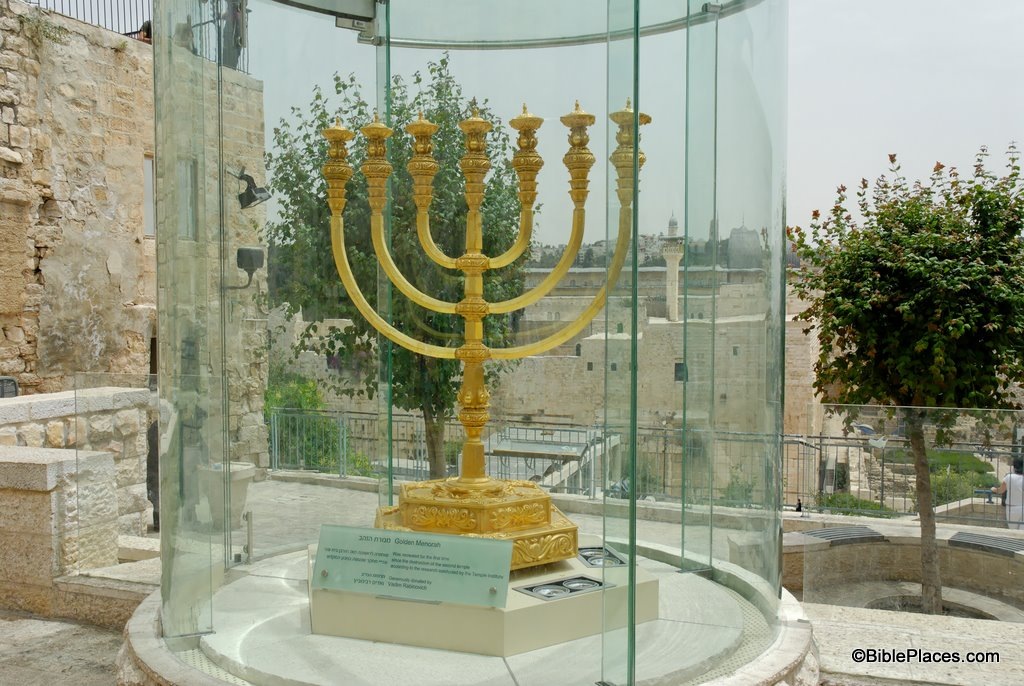
Golden menorah for third temple, tb051408996dxo Golden menorah, prepared for Third Temple.  Estimated value: $3 million
Share:

Haaretz:

Israel’s leading ultra-Orthodox rabbis are waging a new offensive against Jews visiting Jerusalem’s Temple Mount.
Rabbis Shalom Elyashiv, Chaim Kanievsky and Ovadia Yosef sent a letter recently to Rabbi Shmuel Rabinovich, the overseer of holy places in the Western Wall complex, urging him to reiterate the religious decree signed 40 years ago by most rabbis in Israel forbidding Jews from entering the Mount.
The rabbis’ efforts follow the publication in Haaretz last month of the visit of Rabbi Moshe Tendler, the son-in-law of prominent U.S. rabbi Moshe Epstein, to the Temple Mount.
Rabbi Tendler was photographed visiting the plaza atop the Mount, where the Dome of the Rock Islamic shrine now sits, igniting a firestorm of controversy in the ultra-Orthodox community. Several other prominent ultra-Orthodox rabbis have ascended the Mount in recent years, including Rabbi Dov Kook of Tiberias, the husband of Elyashiv’s granddaughter.
The rabbis’ statement calls for a complete ban on entering any part of the Temple Mount complex for fear of compromising the “purity” of the area.
The declaration stated that “as time passed, we have lost knowledge of the precise location of the Temple, and anyone entering the Temple Mount is liable to unwittingly enter the area of the Temple and the Holy of Holies,” referring to the inner sanctuary of the Temple tabernacle.

Temple Mount entrance forbidden by rabbis sign, tb122604453

The story continues here.

HT: Joe Lauer

Share:

Lela Gilbert has an article in the Jerusalem Post on the recent trend of denying that a Jewish temple existed in Jerusalem.  It includes a lengthy interview with archaeologist Gabriel Barkay, and concludes:

IN SPITE of these discoveries, Temple denial remains a growing phenomenon in Europe and America, particularly in leftist intellectual circles. It is supported by the reality that there are no visible remains of the temples of Jerusalem on the Temple Mount. Barkay contends that there were remains still visible in the 1960s and 1970s, which have either been removed or covered up by gardens.
“The Islamic Wakf says, ‘We are not going to let you dig, but show us any remains of the Temple.’ You cannot have it both ways. If you don’t allow people to dig, then don’t use this absence of remains as an argument.
“Temple denial is a very tragic harnessing of politics to change history. It is not a different interpretation of historical events or archeological evidence. This is something major. I think that Temple denial is more serious and more dangerous than Holocaust denial. Why? Because for the Holocaust there are still living witnesses. There are photographs; there are archives; there are the soldiers who released the prisoners; there are testimonies from the Nazis themselves. There were trials, a whole series of them, starting with Nuremberg. There are people who survived the Holocaust still among us. Concerning the Temple, there are no people among us who remember.
“Still, [to deny the Temples], you have to dismiss the evidence of Flavius Josephus; you have to dismiss the evidence of the Mishna and of the Talmud; and you have to dismiss the writings of Roman and Greek historians who mention the Temple of Jerusalem. And you have to dismiss The Bible. That is, I think, way too much.”

Previous related post: Muslims Recognize Temple’s Existence

HT: Joe Lauer

Share:

Leen Ritmeyer has a posted (with a follow-up) on his identification of several stones in the eastern wall of the Temple Mount that are clearly pre-Herodian.  Ritmeyer dates them to the time of King Hezekiah, suggesting that he was the one to build the 500-cubit square Temple Mount that Ritmeyer has previously identified.  He includes some helpful illustrations and photos.

A review of current excavations in Turkey is given at Today’s Zaman.  New Testament sites being excavated include Alexandria Troas, Miletus, Hierapolis, Sardis, Smyrna, and Laodicea.  There are many other sites as well.  Many of these cities have very impressive remains, unlike many sites in Israel.  Today’s Zaman also has an article on recent discoveries at Sardis.

NASA has a photo of a street of Ephesus at night, with (the planet) Jupiter illuminating the way.
Across the way in Greece, the ancient hippodrome of Olympia has been discovered.  This is a good story that counters the myth that everything to be found has already been found.

A couple fragments of the Dead Sea Scrolls have now been published by James H. Charlesworth. 

One of the fragments may be from the Samaritan Pentateuch, and the other appears to be from Nehemiah, making it the first portion of that book to be found among the DSS.  Paleojudaica gives more info and links.

If you’re a tourist in Israel and have a question, you can now call the 24-hour tourist hotline.  It’s easy (dial *3888), but it’s not a toll-free number.

Share: