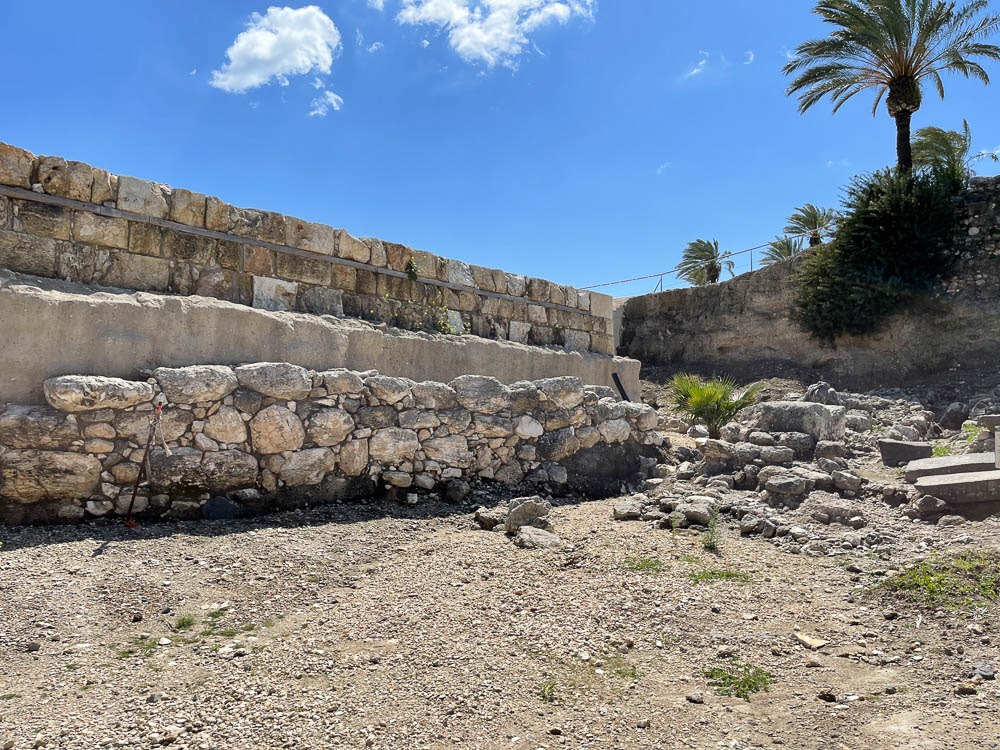
“The Tel Ashkelon National Park in southern Israel is undergoing a large-scale renovation project that will open up previously unseen parts of the heritage site, including a recently excavated 2,000-year-old Roman basilica.” More than a mile of accessible pathways will also be added to the park.

The director of the salvage excavations of Tel Beth Shemesh reports on the discoveries. One conclusion: the site was not abandoned after Sennacherib’s attack.

A study of more than 3,500 plant finds from Gath reveals that the Canaanites living there in the Early Bronze Age ate figs, olives, wheat, barley, grapes, and more. The underlying journal article is available for purchase.

The bridge that provides the only access to the Temple Mount for non-Muslims is in immediate danger of collapsing.

Drew Longacre’s analysis of the Dead Sea Scrolls suggests that some were written for community reading and others for personal use. Longacre’s recent lecture on a related subject is on YouTube.

A new episode on This Week in the Ancient Near East: “A Resurrected Date by Any Other Name Would Still Taste As Sweet, or, Jurassic Park in the Judean Desert”

Glenn J. Corbett, the new editor of Biblical Archaeology Review, answers five questions about his background that prepared him for his new position.

This week on The Book and the Spade: “Remembering Professor Eilat Mazar.”

Archaeology of the Passion Week is the subject of this week’s podcast on the Biblical World, with Chris McKinny and Kyle Keimer.

Israel’s Good Name reports on his February trip to the Golan Heights after a snowfall.

The T-shirt designs have been posted for this year’s excavations at Tell es-Safi/Gath and Tel Burna.

HT: Agade, Joseph Lauer, Arne Halbakken, Andy Cook

Share:

“One Place, Many Stories: Madaba” combines 3D models of the archaeological parks, audio and video tours, along with storytelling from local community members.

Győző Vörös has received an award from the Vatican for his archaeological work at Machaerus.

Cyprus is planning to build a marine archaeological park at the ancient port of Amathus.

Jiří Janák provides “new insight into Akhenaten’s motivations by analysing theological, cultic and iconographic changes within his religious-political reform.

Archaeologists at Northern Arizona University are using computers to quickly sort pottery sherds by type.

The British Epigraphic Society is hosting a series of digital “Epigraphic Conversations.” Next up: “Why were inscriptions reused or inscribed,” on May 28, with hosts Muriel Moser-Gerber and Aaron Schmitt.

Zoom lecture on May 28: The Sixteenth Annual Roger Moorey Lecture at the Ashmolean: “Round objects at Persepolis: Common and Uncommon Threads,” by Michael Roaf.

Zoom lecture on June 8: “Pasargadae and Persepolis Revisited: The Extended Achaemenid Cities beyond the Royal Palaces,” by Rémy Boucharlat.

This September Wayne Stiles is leading a tour of Greece, Patmos, Ephesus, and Crete with a post-tour visit to Rome and Pompeii.

HT: Agade, Arne Halbakken, Charles Savelle

Share:

“Archaeologists have uncovered a marble head of the Roman emperor Augustus in the Italian town of Isernia.”

Researchers “have successfully sequenced the genome of previously extinct date palm varieties that lived more than 2,000 years ago.”

The Roman Colosseum will have its event floor rebuilt in a $18 million remodeling project.

Many academics are criticizing planned renovations to the Athens acropolis.

The Mosul Museum is being rebuilt after its destruction by ISIS.

The ancient site of Assos will be closed for more than a year while work is done to stabilize the slope.

“Turkish Archaeological News collects the most important, interesting and inspiring news from Turkish excavation sites. Here’s the review for April 2021.”

Zoom lecture on May 4: “Clues in Cuneiform: Lives Revealed in Ancient Records of Mesopotamia,” by Amanda Podany

Thousands of monumental structures built from walls of rock in Saudi Arabia are older than Egypt’s pyramids and the ancient stone circles of Britain, researchers say – making them perhaps the earliest ritual landscape ever identified.”

Andrew Shortland investigates the earliest use and production of glass in the ancient Near East.

The French thought it was a toe, but Rome’s Capitoline Museums has recognized the bronze piece is a 15-inch-long index finger, now reattached to a colossal statue of Constantine.

The British Museum blog takes a look at the gods and goddesses of the Greek and Roman pantheon.

HT: Agade, Ted Weis, Joseph Lauer, Arne Halbakken, Explorator

Share:

A new project aims to restore five ancient theaters in central Greece, including Nicopolis and Dodona, in order to increase tourism to the sites.

An article in Daily Sabah discusses the contribution of Çatalhöyük, Alacahöyük, and Kültepe to Anatolian and Mesopotamian history.

Live Science has more about the amphitheater recently discovered in western Turkey.

Carl Rasmussen shares photos of the theater at Miletus and its inscription mentioning “the place for the Jews and the God-worshipers.”

Gardens of the Roman Empire “is the first complete and authoritative online scholarly corpus of all the gardens attested in the Roman Empire.”

On the British Museum blog, Francesca Bologna considers what we really know about the life and reign of Nero.

Some Syrian refugees are finding shelter in archaeological ruins.

The961 highlights 21 interesting Phoenician artifacts on display at the British Museum.

Ariane Thomas discusses the life of a curator at the Louvre on the Thin End of the Wed podcast.

Zoom lecture on April 27: “What Makes a Great Invention? The Invention of the Alphabet in the Sinai Desert C. 1840 BCE,” by Orly Goldwasser.

Zoom lectures on April 29: “Food in the Ancient Near East,” with Cynthia Shafer-Elliott and Rosaura Cauchi.

HT: Agade, Joseph Lauer, Arne Halbakken, Explorator

Share:

Tutku Educational Travel has a number of terrific tours planned in the latter half of 2021 and on through 2022. I’ve traveled with Tutku several times in the past, and my university is a regular partner with them for our student tours, and so I like to recommend them to others looking for great tours with the best instructors. You can get the full run-down of upcoming trips on the Tutku website, but I wanted to recommend and highlight six in particular:

Open to all:

For faculty and pastors (with discount):

You can see the full list of biblical tours here.

Share:

Archaeologists have discovered dramatic evidence of the conflagration that destroyed Azekah circa 1130 BC, leading them to dub the site as a “small Pompeii.”

According to news reports, a rare Tyrian shekel was discovered during a renovation project at the Tower of David Museum. This is true, except that the coin is not a shekel and not rare. It is a silver tetradrachm of Demetrios II Nikator from Tyre with a date of SE 184 = 129/8 BC.

While undergoing conservation work, a large structural crack was discovered in Herod’s tower in the Citadel of David.

Justin Kelley’s BAR article on “The Holy Sepulchre in History, Archaeology, and Tradition” is summarized in Bible History Daily, where a detailed plan of the Church of the Holy Sepulcher is also provided.

Scholars are using high-tech imaging to understand thousands of hand-engraved crosses on the Church of the Holy Sepulcher.

A new “Emmaus Trail” allows walkers to travel the 11 miles (18 km) from Abu Ghosh to Nicopolis/Latrun. Leen Ritmeyer takes the occasion to propose that Emmaus should be identified with Bethel in the Old Testament.

David Moster has posted a new video that explains how to “make sense of the new Dead Sea Scrolls,” including a discussion of how important these discoveries are to biblical studies.

Randall Price is on The Book and the Spade discussing the new Dead Sea Scrolls discoveries.

The latest teaching video from John DeLancey is “The Life of Jesus – His Redemptive Purpose.”

New book: Jesus of Nazareth: Archaeologists Retracing the Footsteps of Christ, by Michael Hesemann. The author’s background and motivations are reported here.

Bryan Windle lists the top 10 discoveries related to Jesus.

Robert E. Cooley died on Thursday. During his career, he excavated Tel Dothan and helped to found the Near East Archaeological Society.

HT: Agade, Charles Savelle, Ted Weis, Arne Halbakken

Share: