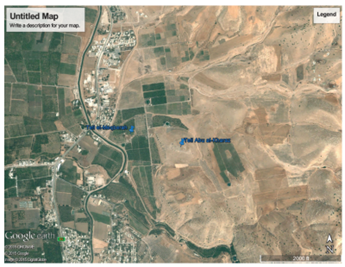
Just posted: Preliminary Report of the 2015 Jezreel Expedition Field Season

A full schedule of speakers and topics for the Annual Bible and Archaeology Fest is now online. Eric Cline is the plenary speaker.

After the heat wave and brutal sandstorm, Israel this past week experienced lightning, hail, and flash floods. This is not typical September weather.


Near Eastern Archaeology‘s latest issue is devoted to “The Cultural Heritage Crisis in the Middle East.” It is available online for free to all.

Eisenbrauns has just released its fall catalog.

A new book: Distant Views of the Holy Land, by Felicity Cobbing and David Jacobson. 330 pages, 350 illustrations, $200. A free sample is available here.

Here’s more about Penn Museum’s new exhibit, “Sacred Writings: Extraordinary Texts of the Biblical World.”

This Wednesday, Sept 23, Brent Strawn of Emory University will give a lecture at Trinity Evangelical
Divinity School entitled “The Historical Psalms, Iconographically Considered.” The event will take place at 7:00 pm on Trinity’s campus, Hinkson Hall in Rodine Building. The lecture is free and open to the public.

Clashes on the Temple Mount have caused damage to Al Aqsa Mosque.

Aren Maeir is on the Book and the Spade talking about his excavations of Gath and the discovery of a large gate this season (part 1, part 2).

Egyptian security officials have ordered the shutdown of St. Catherine’s Monastery.

From ASOR: Can you pass this Sea of Galilee quiz?

The latest issue of Popular Archaeology includes articles on Gath and Magdala.

Ferrell Jenkins explains the significance of Mahanaim (mentioned 13x in the OT) and shares some photos.

HT: Agade, Charles Savelle, A.D. Riddle, Paleojudaica

This week’s sandstorm in Israel is the worst it has experienced since the nation was founded in 1948.

Air pollution in Jerusalem was 173 times higher than average. Carl Rasmussen shares a video showing how bad it was on the Mount of Olives.

What exactly is a 100-foot-deep shaft doing next to the Rockefeller Archaeological Museum in Jerusalem?

Andrew Bernhard posts on the End of the Gospel of Jesus’ Wife Forgery Debate.

Thieves in Galilee were caught removing a sixth century mosaic church floor in Gush Tefen.

The cisterns at Arad are now open to visitors.

Muslim “sentinels” protecting the Temple Mount from “sacrilege” have now been outlawed by Israeli police.

If your interest is in exotic shofars and what Jewish halakah has to say about it, Zoo Torah has a free pdf on the subject.

The BBC reports on six “lesser-known wonders of the ancient world,” including the site of Baalbek in Lebanon.

The Jerusalem Post Magazine reports on sinkholes around the Dead Sea. (At the moment of posting this, the link is not working. Perhaps it will return.)

ISIS is destroying ancient buildings in order to conceal evidence that they are looting for profit.

The Institute for Digital Archaeology plans to distribute 10,000 3-D cameras in the coming year in
order to document archaeological sites and objects in West Asia before they are destroyed.

A luncheon will honor James F. Strange at this ASOR meeting in Atlanta.

Ferrell Jenkins illustrates what David meant when he wrote about “a dry and weary land where there is no water.”

Did you know that the Upper Room is located directly above David’s Tomb?

The Dead Sea Scrolls scam at the California Science Center closed this week.

“The Manar al-Athar open-access photo-archive (based at the University of Oxford) aims to provide high resolution, searchable images, freely-downloadable for teaching, research, heritage projects, and publication. It covers buildings and art in the areas of the former Roman empire which later came under Islamic rule (e.g. Syro-Palestine/the Levant, Arabia, Egypt, and North Africa), from ca. 300 BC to the present, but especially Roman, late antique, and early Islamic art, architecture, and sacred sites.”

HT: Charles Savelle, Ted Weis, Agade, Joseph Lauer, Jared Clark

Our Facebook photo with the most clicks in the past week was the final one in our “holy rocks” series.

Gezer standing stones, bowing down, tb091405098
Standing stones at Gezer

The excavation season at Magdala has concluded, and the wrap-up describes the major findings, including a fourth mikveh that was fed by spring water.

The Temple Mount Sifting Project has just released a video about their work, its importance, and the need to keep it going.

Leen Ritmeyer offers his thoughts and diagrams on the recent discovery of the stepped podium in the City of David.

The cross-border environmental organization EcoPeace has opened two hiking tours, a bike route, and a walking path in Israel, the West Bank, and Jordan. The two hiking tours each take eight days.

Arutz-7 reports briefly on the Studies of Ancient Jerusalem’s 16th Annual Conference in the City of David.

A study of 15 Roman-era Egyptian mummy portraits and panel paintings reveals that the artists used Egyptian blue, contrary to what has been long believed.

British conservation specialists have restored some Hellenistic-era paintings from Petra.
‘Atiqot 82 is now online.

Attempts by ISIS to blow up the Temple of Bel at Palmyra have apparently failed.

The Codex Sinaiticus will leave the walls of the British Library for only the second time since 1933, this time headed down the street for display in an Egyptian exhibit at the British Museum.

The Philistines introduced new plants to the coastal plain when they migrated from the Aegean.

HT: Ted Weis, Joseph Lauer, Agade

Visitors to Samaria are few since the Israel’s Nature and Parks Authority closed down daily operations. It is truly sad that most Israelis and foreign tourists can’t (or won’t) visit the ancient capital of the northern kingdom, home to Jehu and Jeroboam, Ahab and Jezebel. The history is of great significance and the views are terrific.

From The Times of Israel, by Ilan Ben Zion:

The manager of the Palestinian Authority’s Interpretation Center at the Sebastia archaeological site handed over a brochure; his colleague, roused from slumber, hastily pulled his pants on. Pointing to a small screening room where visitors would see a movie about the site, he contradicted himself with absolute confidence: “There’s a film — but there’s no film.”
The PA built the facility two years ago to inform visitors about the ancient city of Sebastia after Israel’s Nature and Parks Authority closed down its day-to-day operations at the site. But besides a pamphlet and some hard candies, the Interpretation Center has little to offer. The brand-new plush chairs in the 40-seat theater meant to show were still in their plastic covers. (The PA didn’t respond to inquiries about the cost of the center; the United Nations Millennium Development Fund, a co-funder, donated $132,000.)
“You can learn the history of the whole region (by) staying here because all the powers that crossed the region since the time of the Egyptians were passing through,” Carla Benelli, an art historian working in Sebastia, told AP a few years ago. Sebastia’s tel features remains from 10 different periods, from the Iron Age to modern times. “From this point of view, it’s really very important,”
The entire saga of preserving and showcasing ancient Sebastia unfolds like a comedy of errors which could only occur in the Wild West Bank. Israel controls the park containing the ancient finds, which is in Area C, but does nothing with it. The Palestinians say they want to control it, but lack the resources to develop it. And while both sides lay claim to the site as their exclusive cultural heritage, it lies neglected, underdeveloped, unexcavated.

The full story is here. We have more photos and descriptions here.

Samaria from west, tb050106488
Samaria from the west
Photo from Samaria and the Center

A feature story in the Worcester Magazine describes the discovery of the Dead Sea Scrolls.

The latest issue of Biblical Archaeology Review is out and it includes a story on Kadesh Barnea.

A new exhibit at the Ismailia Museum in Egypt features discoveries made during recent expansion work on the Suez Canal. One of the artifacts on display is a gift from Ramses II to his father Seti I.

Cary Summers, President of the Museum of the Bible, gives a lecture on foods of the Bible.

Paleojudaica notes two top-ten lists of archaeological sites to see in Israel.

Marlena Whiting writes at the ASOR Blog on milestones in ancient Palestine and Arabia.

BibleX notes three dangers associated with studying Bible backgrounds.

Wayne Stiles provides 10 reasons a tour to Israel belongs on your bucket list. But let me add: the longer you wait, the less the trip will benefit you. Go now, or pay for your kid or grandkid to go.

(BTW, I know the best school in the world for college students to attend in Israel.)

HT: Joseph Lauer, Agade, G. M. Grena

A mikveh from the first century has been discovered in a southern Jerusalem neighborhood. This one was unusual because of the numerous wall paintings. Leen Ritmeyer comments here. You can access high-res photos here.

Excavations at Horvat Kur near the Sea of Galilee have exposed the mosaic floor of a Byzantine-era synagogue. For background and a map, see our previous post.

Nicholas Reeves believes that he has identified two unrecognized doorways in King Tut’s tomb, one of which leads to the undisturbed tomb of Nefertiti. The Economist gives a summary; Reeves’s published article may be read at academia.edu.

An exhibition with hundreds of Egyptian artifacts discovered underwater opens next month in Paris.

Lebanese authorities are working to halt the antiquities trade that passes through their country.

Babylon 3D has many beautiful reconstruction images of the ancient city.

The Museum of the Ara Pacis in Rome is hosting an exhibition on how the Roman Empire and its people ate.

Two suspects have been indicted on charges of setting fire to the Church of the Multiplication of
Loaves and Fish at Tabgha.

International Bible Study Week provided participants in Jerusalem with three days of lectures and one day of touring.

Thomas Levy announces the publication of papers from a 2013 symposium on the exodus. (ASOR Blog requires subscription.)

Karaites follow the Mosaic Law but not the rabbinic law expounded in the Mishnah and Torah. There are about 25,000 of them living in Israel today.

The threat of ISIS is pushing Iraq to digitize the Baghdad National Library.

The Megalithic Portal provides many articles on sites in Israel.

Where is the Land of Uz? Wayne Stiles considers the evidence and suggests some application.

HT: Joseph Lauer, Agade, Ted Weis, Ryan Jaroncyk, Mark Vitalis Hoffman