This week’s edition of the Caspari Center Media Review has several stories of interest.

Of tourist sites in Nazareth:

In anticipation of the Christmas season, Zvika Boreg compiles a list of places to visit in Nazareth, including Mount Precipice, “where the people of Nazareth tried to throw Jesus to his death but he escaped, and – according to the legend – jumped from there to Mount Tabor,” and the Catholic and Greek Orthodox Churches of the Annunciation.

Of trash on the “Jesus Trail”:

Christian pilgrims walking the Jesus Trail are sure to encounter mounds of trash at various points along the way, writes Yair Kraus. The 65-kilometer trail runs from Nazareth to Capernaum and passes through sites that are associated with the life of Jesus. But the lack of supervision has made it possible for people to use the trail as an illegal dumping ground. Says one tour guide: “Christians think we are a third world country.” The Minister for the Protection of the Environment has asked the local municipalities to form a joint council to deal with the issue.

Of the St. John in the Wilderness Monastery that is not in the wilderness:

Dr. Adam Ackerman writes about the St. John in the Wilderness Monastery, located in the village of Ein Kerem on the outskirts of Jerusalem. According to Christian tradition, John the Baptist lived in a cave that is now hidden within the monastery, where he “fed on honey, locusts, and plant roots, and drank from the waters of the spring….” The monastery is located within a pastoral setting, which raises the question of why it is called St. John of the Desert. The monks explain that the name is “spiritual and not geographical, a ‘desert’ in the sense of a place of solitude and detachment for spiritual elevation.” Ackerman goes on to describe how John the Baptist left this place when he was twenty years old and went to the Judean desert where he “joined the cult of the Essenes … and baptized Jesus.”

The full report is here.

Monastery of St John in Wilderness, tb020305195
Monastery of St. John in the Wilderness
Photo from Judah and the Dead Sea

We announced this in the latest BiblePlaces Newsletter, but if you missed that, you may want to know that a new edition of the Satellite Bible Atlas is available. The hardcover edition is more durable and lays flat, making it ideal for study at home and on the field. For only $28, this is an affordable investment for all who love the Bible. Here are a few reasons why:

1. Every map covers a full page and is in full color. That allows for lots of detail and context.

3. The atlas provides maps of everything from Abraham’s journey from Ur to Paul’s arrival in Rome. Whatever you’re reading or teaching, you will find a map that marks the location and explains the event. You’ll never have to guess where something took place.

7. Purchase includes free access to all of the maps in digital (jpg) format. This makes it easy to use the maps in the classroom and on location.

You can see the full list of why I think this new atlas by Bill Schlegel is a fantastic resource here.

A wall/door map is also available for $7, but if you buy it together with the atlas, the cost is only $4.

If you’re like us, you always wonder what surprise you’ll find when you go to checkout and learn the shipping cost. For those in the U.S., shipping is free. (And for those not in the U.S., the shipping is outrageous, but that’s beyond our control. There is an Israeli distributor who can ship to some countries less expensively.)

We encourage you to consider this as a gift for a parent, child, pastor, teacher, or friend. This is a unique resource at a terrific price.

Aren Maier reports that he may have been the last archaeologist to see the excavations of Eshtaol.

But you can see a video of the site before it was buried.

Some are unhappy that the Palestinian Authority is excavating a Hasmonean fortress between Bethlehem and the Herodium.

Barry Britnell saw the Jerusalem movie and he declares it to be “fantastic.” You can see if it is in a theater near you here.

The Kathleen Kenyon collection is now on display at the Ian Potter Museum in Melbourne.

This travel piece may inspire you to do more on your next trip to Israel than ride on a bus.

If you expect to be touring Israel in late May, you should plan now to avoid the pope.

You can save an extra 30% on any print book at Amazon through Dec 1, 11:59pm. Enter “BOOKDEAL” at checkout under the “Gift cards & promotional codes.” Up to $10 off. I recommend this book (for an amazing $21.47 after discount. I’ll say more about this book later, but not before this deal expires. Preview here.)

HT: Charles Savelle, Joseph Lauer

From the Jerusalem Post:

Bishara Shlayan, a Christian Arab from Nazareth, is hoping to build a huge statue of Jesus on Mount Precipice, near his home city.
Shlayan told The Jerusalem Post in an interview that he has already begun fund-raising for the project and that he is getting positive feedback from the Israeli Arab Christian community as well as some Jews.
He sees the statue as being similar to but larger than the huge Christ the Redeemer statue in Rio de Janeiro, Brazil.
[…]
Mount Precipice, also known as Mount Kedumim, is believed by some to be the place where the people of Nazareth attempted to push Jesus off the mountain after rejecting him as the messiah. In the end he was able to jump off and disappeared, according to Christian tradition.

The full story describes Shlayan’s political ambitions. The statue in Rio is 100 feet tall. The traditional hill is not the place where Jesus was nearly killed, for ancient Nazareth was not built on this hill.

They got up, drove him out of the town, and took him to the brow of the hill on which the town was built, in order to throw him down the cliff (Luke 4:29).

Nazareth Mount of Precipitation from west panorama, tb041003219
Traditional Mount of Precipitation in Nazareth
Photo from Galilee and the North

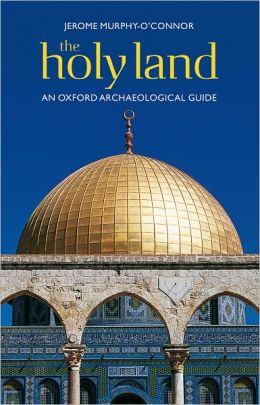
Jerome Murphy-O’Connor passed away today in Jerusalem. A Dominican priest and author of many books, Murphy-O’Connor is best known to many visitors of Israel for The Holy Land: An Oxford Archaeological Guide from Earliest Times to 1700. This excellent guide has been published in five editions beginning in 1980 with the most recent update in 2008.

HT: Paleojudaica

Second edition, 1986
Third edition, 1992
Fourth edition, 1998
Fifth edition, 2008

Mohamed Ibrahim, Egypt’s minister of state for antiquities, requests help in the Washington Post in fighting antiquities theft in his country.

Egypt’s future lies in its history, particularly its archaeological history. For hundreds of years the mystery and wonders of the pyramids, the sphinx and the Valley of the Kings have attracted visitors from around the world. Tourism is the lifeblood of Egypt’s economy and touches the lives of most Egyptians, whether they work as tour guides, restaurant owners, craftsmen or bus operators. Egypt’s history holds the prosperity of the country’s future generations, including that of youths — more than 40 million Egyptians are age 30 or younger — who are seeking opportunities.
But thieves are raiding our archaeological sites and selling their findings to the highest bidders. They are taking advantage of Egypt’s security situation to loot our nation’s economic future and steal from our children.
Egyptians need the people and the government of the United States to support our efforts to combat the systematic and organized looting of our museums and archaeological sites. Imagine a world in which the stories of King Tut, Cleopatra, Ramesses and others were absent from the collective consciousness. And with much of our history still waiting to be discovered under the sand, the potential losses are staggering. Antiquities theft is one of the world’s top crimes — after the trafficking of weapons, narcotics and people — but it is seldom addressed.
Egyptian antiquities are flooding international markets. Recent auctions at Christie’s in London and New York included several items from Egypt. Fortunately, when contacted, Christie’s in London withdrew a number of items that had been stolen from the tomb of King Amenhotep III, discovered in 2000 in Luxor. Among the items was a steatite bust of an official dating from 1793 to 1976 B.C.

The full op-ed is here.

HT: Jack Sasson

Three great pyramids with smaller pyramids of queens, tbs89289701
The Pyramids of Giza
(photo source)