“Archaeologists have discovered an ancient Egyptian shipwreck which proves the Greek Historian Herodotus was correct about the observations he made about Egyptian vessels nearly 25 centuries ago.”

“Evidence of ancient hybrid camels has been uncovered by archaeologists who were working to restore a temple in northern Iraq damaged by ISIS.”

Plans have been approved for a Museum of Underwater Antiquities in Piraeus, the ancient harbor of Athens.

“The attitude towards ancient theatres has changed” in Greece and work has been carried out on about 40 theaters in recent years.

The AP has some photos of the recent snowfall in Athens and Istanbul.

Magnesia’s “stadium of 30,000 seats is one of the most imposing and well-preserved ancient stadiums in Anatolia.”

“Ancient Egyptian wisdom and literary texts legitimize the domination of men over women, give advice regarding constraints on women, but also recommend avoiding women who are strangers or women who are adulterous.”

The Lapis Niger is an ancient sanctuary and a remnant of the Comitium in Rome, that some Romans believed was the venerated sacred tomb of the city’s legendary founder, Romulus.”

David Moster has posted a new video in which he explains how a real “secret code” in the Bible identifies a biblical place.

Carl Rasmussen has a few open spots on his May tour of Turkey, Greece, and Patmos. The itinerary looks outstanding.

HT: Agade, Joseph Lauer, Arne Halbakken, Explorator

A site I’ve long thought held the most potential for future discoveries for New Testament studies is Colossae. Many groups to Turkey don’t even bother to visit, since the ancient mound is virtually untouched and only scattered remains can be seen on the ground. So whenever I see something about archaeology at Colossae, my ears immediately perk up.

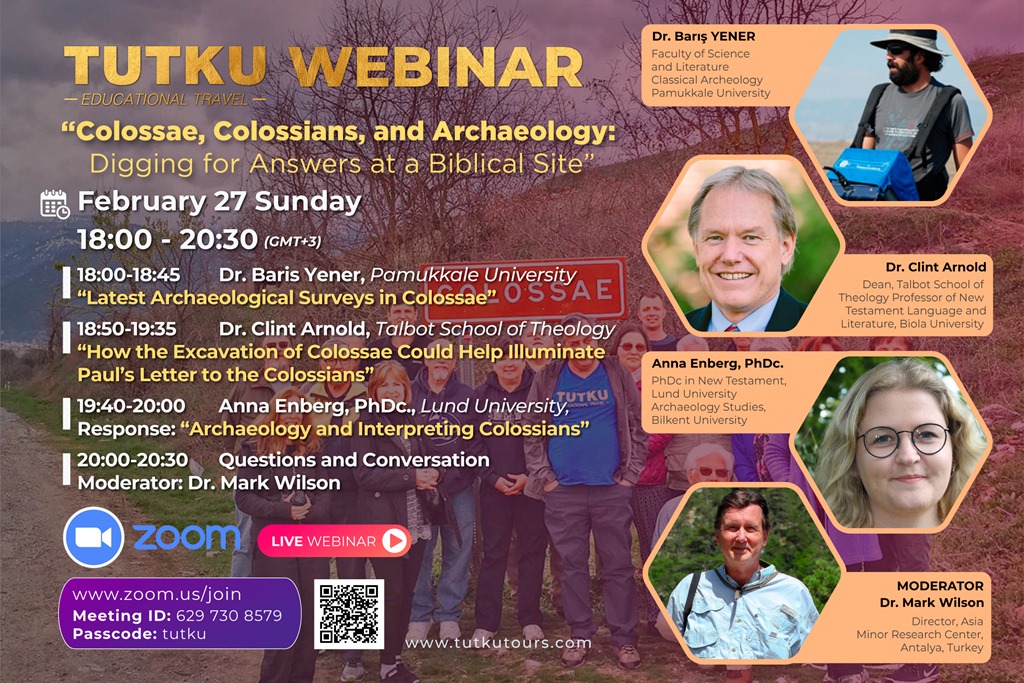
Tutku Tours is sponsoring a webinar on February 27 entitled “Colossae, Colossians, and Archaeology: Digging for Answers at a Biblical Site,” with Mark Wilson moderating. The graphic (below) provides full details, but I’ve written out the schedule here, with times in US Eastern:

10:00-10:45: “Latest Archaeological Surveys in Colossae,” by Baris Yener

10:50-11:35: “How the Excavation of Colossae Could Help Illuminate Paul’s Letter to the Colossians,” by Clint Arnold

11:40-12:00: Response: ”Archaeology and Interpreting Colossians,” by Anna Enberg

12:00-12:30: Questions and Conversation

To join, go to the Zoom website and enter Meeting ID: 629 730 8579; passcode: tutku

TUTKU-WEBINAR-COLOSSAE-2022

A Phoenician plaque, a stone pillar and the remains of boatsheds were unearthed as a result of 2021’s archaeological excavations in Kition-Pampoula, Cyprus.”

A bronze military diploma has been discovered in southeastern Turkey.

A new study has determined that a mummified fetus was preserved through acidification as the mother’s body decomposed.

“Five Roman artefacts from the ancient city of Palmyra, a site damaged during Syria’s decade-long conflict, were returned to Damascus on Thursday by a private Lebanese museum where they had been on display since 2018.”

“Turkey’s mercenaries continue to systematically destroy archaeological sites and everything related to the historical heritage of Syria.”

Archaeologists are surprised that Mesopotamians were cultivating millet centuries before the invention of large-scale irrigation.

Ramses the Great and the Gold of the Pharaohs, “an internationally touring exhibition that made its world premiere at the Houston Museum of Natural Science (HMNS) in November” is “a feat of technology, its layered display creating an immersive experience without the use of 3-D glasses.”

Apparently one of the “secrets” of Istanbul is the “Mosaic Museum of the Grand Palace of Constantinople.” It’s now on my list for my next visit.

The Historical Geography of the Biblical World unit is accepting paper proposals for the 2022 Annual Meeting in Denver.

HT: Agade, Joseph Lauer, Arne Halbakken, Keith Keyser, Charles Savelle

Archaeologists working in the temple of Amenhotep III in Luxor have discovered remains of a pair of gigantic limestone colossi.

“A joint Egyptian-Italian Mission excavating near Aswan in Egypt has discovered a tomb from the Greco-Roman period containing twenty mummies.”

“Scientists found the first recorded example of a bandaged wound on a mummified body, which could offer more insight into ancient medical practices.”

“Scholars have concluded that King Tutankhamun was not murdered, after a lengthy investigation that seemed to refute popular theory.”

Joshua Berman says that marks of Egyptian culture in the Torah give evidence of the Israelites’ sojourn in Egypt.

Deb Hurn argues that the meteoric airburst theory for the destruction of Tall al-Hammam does not match various details in the biblical text for the destruction of Sodom.

The world’s largest mosaic is now open to the public underneath the newly built Antakya Museum Hotel (in biblical Antioch on the Orontes).

“A new study has revealed that some 4,500 years ago the ancient Mesopotamians were the first to create a hybrid animal, producing an entirely new beast by mating two different species.”

New technology is allowing scientists to better determine the sex of ancient skeletons.

Candida Moss writes about the relationship that ancient Romans had with their dogs.

A Hellenistic necropolis near Naples is opening to the public for the first time.

Nimes is my favorite Roman city in France, and National Geographic reviews some of the highlights.

Michael Shutterly has written a brief guide to the coins of the Persian kings.

Carl Rasmussen shares photos of what’s new at Laodicea—“a two hundred foot long, 25 foot high Frescoed Wall.”

HT: Agade, Joseph Lauer, Explorator, Arne Halbakken

“Archaeologists working in the Wadi Al-Nasab region of the Sinai have uncovered the headquarters of a [copper and turquois] mining operation that dates back to the Middle Kingdom.

“After war and insurgency kept them away from Iraq for decades, European archaeologists are making an enthusiastic return in search of millennia-old cultural treasures.”

The only fresco preserved from the Greek classical world is in Paestum in southern Italy.

A newly restored gladiator helmet is on display at the Pompeii exhibition at the Carnegie Science Center in Pittsburgh.

A new archaeological institute will be opening in Gaziantep in southeastern Turkey.

In the first of a two-part article, Deb Hurn looks at the evidence for the location of Sodom.

The BAS Scholars Series begins on March 10 with Mark Goodacre speaking about the resurrection. This is the first of a quarterly virtual lecture series that will include Aren Maeir, Jodi Magness, and Joan Taylor.

Zoom lecture on Jan 22: “Modernity Meets Mesopotamia: An Ancient Assyrian Palace in Los Angeles.” I’ve driven by this outlet mall many times and wondered what the story was…

Christopher Rollston discusses the alleged Isaiah bulla on the Biblical World podcast.

In his final post on Paul’s shipwreck on Malta, Carl Rasmussen suggests where the ship ran aground.

HT: Agade, Joseph Lauer, Arne Halbakken, Wayne Stiles, Alexander Schick

Excavations revealed an ancient synagogue in Side near Antalya (biblical Attalia), a city where Paul preached, albeit six centuries after his visit.

“A team of researchers has successfully digitally unwrapped the mummified body of the pharaoh Amenhotep I, who lived around 3,500 years ago.”

Mark Boslough claims that the Sodom cosmic airburst theory has significant shortcomings.

108-year-old Sumerologist credits Istanbul museum for long career.”

“A digital model of Babylon is under development.”

Virtual workshop on January 11 at the Albright Institute: The Religious Soundscape of the Holy Land: From the Crusades to the Late Ottoman Empire

Webinar on January 20: “The Not-So-Innocents Abroad: The Beginnings of American Biblical Archaeology,” by Rachel Hallote

Carl Rasmussen writes about an anchor stock at Malta with the name of an Egyptian deity on it.

John DeLancey and Kyle Keimer give a virtual tour of highlights in the archaeological wing of the Israel Museum (part 1 of 4).

HT: Agade, Joseph Lauer, Alexander Schick, Arne Halbakken, Charles Savelle